


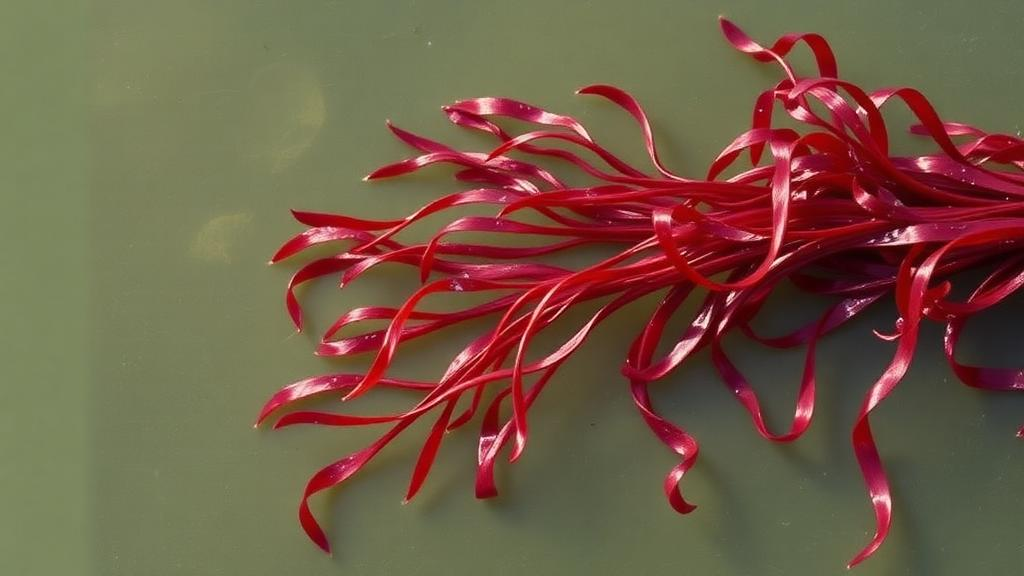
In a quiet lagoon south of Chennai, a humble red seaweed has delivered a result that could reshape coastal aquaculture in India and beyond. Researchers at ICAR–Central Institute of Brackishwater Aquaculture have shown that Gracilaria salicornia, a red alga prized for its agar content, can be cultivated with remarkable productivity in brackishwater using a simple raft-based system. Over a 45-day culture period, the seaweed multiplied its biomass roughly eightfold, a performance the team reports as substantially better than yields typically achieved in marine environments. The findings, published in the journal Blue Biotechnology, position fluctuating-salinity lagoons and estuaries, long overlooked by the seaweed industry, as promising new frontiers for sustainable farming.
The global context makes the result timely. Seaweed cultivation has expanded roughly a thousand-fold in volume since 1950, reaching 35.2 million tons of live weight in 2021. The industry’s market value more than tripled from 5 billion dollars in 2000 to 17 billion dollars in 2021, with projections suggesting growth to as much as 85 billion dollars by 2026. Yet almost all of this production takes place in fully marine waters. Brackishwater ecosystems, where rivers meet the sea and salinity swings with tides and monsoons, remain largely untapped. The new study argues that these dynamic environments may actually favor certain species, offering nutrient concentrations and bioavailability that dispersed open-ocean waters cannot match.
The experimental setup was deliberately practical. The team deployed twelve bamboo rafts, each measuring three square meters, for a total cultivated area of 36 square meters in Muttukadu lagoon on the Bay of Bengal coast. Every raft carried twelve monoline tube nets with a 25-millimeter mesh, and each net was stocked with 1.2 kilograms of G. salicornia seed material collected from natural habitats, cleaned of epiphytes and debris, and held in fiber-reinforced plastic tanks before planting. The monoline design encourages horizontal growth, while the mesh size permits adequate water exchange and sunlight penetration, the two physical requirements that dominate seaweed productivity.
Growth was assessed at 15-day intervals alongside a full suite of water quality measurements. The results traced a classic cultivation curve. By the 15th day of culture, average biomass per tube net had climbed to 5.07 kilograms, corresponding to a specific growth rate of 9.59 percent per day. By day 30, biomass reached 7.67 kilograms, with the growth rate easing to 6.16 percent per day, and by day 45 the nets held 9.09 kilograms, with the rate declining further to 4.50 percent per day. This pattern of rapid early growth followed by gradual deceleration is typical of seaweed crops as density increases and light and nutrient availability per frond diminish, and it provides farmers with a biological signal for optimal harvest timing.
The researchers attribute the exceptional productivity to the lagoon’s physicochemical character. Salinity during the trial ranged from 20 to 31 practical salinity units, a spectrum across which G. salicornia displayed what the authors describe as euryhaline adaptation, the ability to thrive across a broad salinity range. Brackishwater systems, enriched by land runoff and tidal exchange, appear to supply essential nutrients in more concentrated and bioavailable forms than marine sites. The species’ tolerance of fluctuating conditions also echoes findings from Kenya, where a 42-day cultivation trial at Kibuyuni on the south coast demonstrated consistent growth and agar yields across distinct monsoonal seasons, and concluded that G. salicornia is more resilient than the widely farmed carrageenophyte Kappaphycus alvarezii.
The trial was not without drama. After the 45th day of culture, Cyclone Michang swept through the study area, generating strong winds and currents that tore away part of the biomass from the tube nets. The incident underscores the vulnerability of nearshore aquaculture to extreme weather, an increasingly pressing concern as storm intensity rises. Notably, however, the raft structures themselves withstood the cyclonic event, suggesting that the engineering of the system is robust even when the crop is not entirely secure. The authors argue that the overall production trend remained strong despite the loss, a testament to the species’ vigor and the method’s resilience.
Beyond biology, the study offers a sober economic analysis. Scaling the trial results to 50 raft units, each fitted with 18 monoline tube nets, the team estimated an annual harvest of 710.65 kilograms of dried seaweed. At a market price of 25 rupees per kilogram, gross revenue in the first year reached 124,362 rupees against a capital outlay of 90,000 rupees, yielding a first-year net profit of 24,362 rupees. From the second year onward, once capital costs are absorbed, net revenue rises to approximately 114,362 rupees annually. The short 45-day crop cycle permits seven harvests per year, and the authors note that dried Gracilaria sold to nearby industries within a 50-to-100-kilometer radius can fetch 40 to 60 rupees per kilogram, considerably more than the lower prices farmers receive when transport costs erode returns.
The livelihood implications are significant. The team’s assessment suggests that a hectare of seaweed cultivation, optimally stocked with 400 to 600 rafts, could support roughly 8 to 12 families. Because seaweed farming requires low capital, modest technical skill and no freshwater or feed inputs, it is particularly accessible to marginalized groups, especially women, who form a large share of the seaweed workforce in many countries. The crop’s applications span food, pharmaceuticals, cosmetics and biotechnology, anchored by agar, a gelatinous gelling agent for which Gracilaria species supply more than half of the world’s output. With natural seaweed stocks declining under overexploitation, the authors, citing earlier work on the depletion of Gracilaria edulis in Indian waters, argue that cultivation is no longer optional but essential for the agar industry’s future.
The environmental case is equally compelling. Seaweed farms absorb excess nutrients from the water, mitigating the eutrophication that plagues many coastal zones, and they buffer local chemistry against acidification. Farms also dampen coastal erosion, provide habitat for marine and brackishwater organisms, and sequester carbon, aligning the practice with multiple United Nations Sustainable Development Goals, from zero hunger and gender equality to climate action and life below water. In India, the policy environment is increasingly supportive, with the National Bank for Agriculture and Rural Development, the Tamil Nadu Department of Fisheries and the National Fisheries Development Board offering financial assistance, training and infrastructure, while private buyback agreements with processors such as Aquagri Processing Private Limited guarantee market access for farmers.
Challenges remain before brackishwater seaweed farming can scale. The authors flag limited awareness of the sector’s benefits among coastal communities, unreliable access to high-quality seed stock, and price volatility in the seaweed market as critical bottlenecks requiring targeted outreach, seed banks and market development. Returns also hinge on drying efficiency, operational discipline and environmental variability, demanding careful planning from prospective farmers. Still, the Muttukadu trial demonstrates that a lagoon once valued mainly for shrimp and finfish culture can grow a commercial agarophyte at rates that outpace marine farms. If replicated across India’s vast brackishwater margins, the humble red seaweed could become a cornerstone of the blue economy, turning tidal flats and estuaries into productive, climate-friendly farmland for the coastal communities that need it most.
Subject of Research: Raft-based cultivation of the red seaweed Gracilaria salicornia in brackishwater ecosystems
Article Title: Culture potential of Gracilaria salicornia in the brackishwater ecosystem: A multifaceted approach towards sustainable development goals
Article References: R., N. R., P., N. R., R., A., S., A. K., R., J., K., A., & C. P., B. (2025). Culture potential of Gracilaria salicornia in the brackishwater ecosystem: A multifaceted approach towards sustainable development goals. Blue Biotechnology, 2(1), Article 9. https://doi.org/10.1186/s44315-025-00032-y
Image Credits: AI Generated
DOI: 10.1186/s44315-025-00032-y
Keywords: Gracilaria salicornia, brackishwater aquaculture, seaweed farming, agar, raft cultivation, specific growth rate, coastal livelihoods, sustainable development goals, Muttukadu lagoon, blue economy, water quality, economic feasibility
Cite Scienmag News
Drew Townsend. (October 1, 2026). Red Seaweed Grows Eightfold in Brackishwater Raft Trial, Boosting Coastal Livelihoods. Scienmag. https://scienmag.com/red-seaweed-grows-eightfold-in-brackishwater-raft-trial-boosting-coastal-livelihoods/
Drew Townsend. "Red Seaweed Grows Eightfold in Brackishwater Raft Trial, Boosting Coastal Livelihoods." Scienmag, 1 October 2026, https://scienmag.com/red-seaweed-grows-eightfold-in-brackishwater-raft-trial-boosting-coastal-livelihoods/. Accessed 4 October 2026.
Drew Townsend. "Red Seaweed Grows Eightfold in Brackishwater Raft Trial, Boosting Coastal Livelihoods." Scienmag. October 1, 2026. https://scienmag.com/red-seaweed-grows-eightfold-in-brackishwater-raft-trial-boosting-coastal-livelihoods/


