


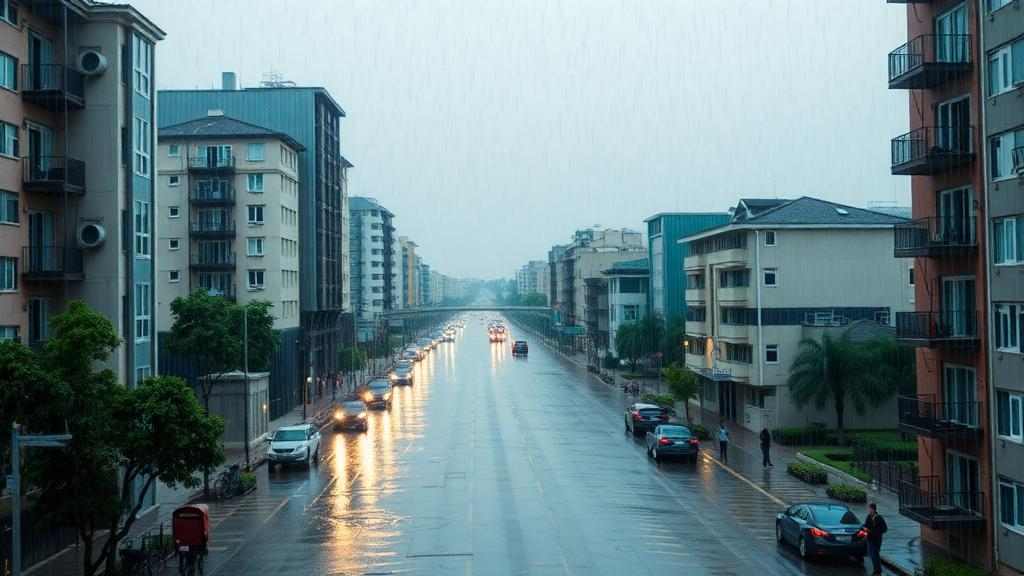
Cities have long been treated as victims of extreme weather: dense concentrations of people and pavement that happen to sit where the rain falls. A sweeping review published in Nature Cities argues that this framing gets the physics backwards. Led by Long Yang of Nanjing University, with co-authors including James Smith of Princeton University, Remko Uijlenhoet of Delft University of Technology, Valéry Masson of Météo-France, Hayley Fowler of Newcastle University and Dev Niyogi of the University of Texas at Austin, the synthesis draws together decades of observations, theory and model experiments to make a striking claim: cities are not passive recipients of storms but active participants in shaping them, and the two systems—urban development and extreme rainfall—have been co-evolving all along.
The evidence base for urban modification of rainfall is no longer anecdotal. It stretches back to the METROMEX field campaigns of the 1970s around St. Louis, and it has been dramatically sharpened by modern radar networks and dense gauge arrays. Recent studies have documented strong intensification of hourly rainfall extremes attributable to urbanization, including analyses over the Yangtze River Delta showing urbanization-enhanced summertime extreme hourly precipitation, and work identifying robust urban signatures in short-duration rainfall extremes. A global-scale assessment of urban precipitation anomalies published in 2024, along with a meta-analysis of urbanization impacts on rainfall modification, suggests the phenomenon is widespread rather than confined to a handful of well-instrumented American and Chinese cities.
The physical mechanisms fall into several interacting categories. The first is thermodynamic: the urban heat island, generated by waste heat from vehicles, industry and air conditioning combined with the reduced evapotranspiration of impervious surfaces, makes cities warmer than their rural surroundings. This warming enhances atmospheric instability and can intensify updrafts within convective storms. Numerical experiments have shown sensitivity of urban rainfall to anthropogenic heat flux, and modeling over the Seoul metropolitan area has implicated both anthropogenic heat and building height in modifying precipitation. A warmer, more buoyant boundary layer over a city is, in effect, a loaded gun for any storm that drifts overhead.
The second mechanism is aerodynamic. Tall, rough buildings increase surface friction and create mechanical turbulence that can slow approaching storms, split them, or force low-level convergence that triggers new convection. Classic case studies from Atlanta linked the urban heat island and roughness to summertime convective thunderstorms, and more recent work has examined how vertical wind shear determines whether squall lines are disrupted or amplified by city encounters. The geometry of the city matters too: studies of city shape in inland and coastal environments, and of urban development patterns and their influence on extreme rainfall occurrences, indicate that the spatial form of a metropolis—not just its size—leaves a fingerprint on where and when heavy rain falls.
The third mechanism is aerosol-driven, and it is the most contested. Cities emit vast quantities of particulate pollution that serve as cloud condensation nuclei, and the sign of the resulting effect depends on the storm environment. In moisture-rich settings, added nuclei can invigorate convection by delaying coalescence and releasing more latent heat aloft; in drier regimes, competition for water vapor can suppress rain. Idealized supercell simulations, studies of urban plume aerosols on mesoscale convective systems, and sensitivity studies such as one focused on Dallas–Fort Worth all illustrate this ambivalence. Work in the Pearl River Delta has even connected aerosols to modified lightning activity, underscoring how deeply urban emissions can penetrate storm electrification processes.
Critically, the review emphasizes that none of these mechanisms operates in isolation from the background weather. A recurring finding across the literature is that urban effects are scale-dependent and regime-dependent: they tend to be most visible in weakly forced, summertime convective environments and harder to detect when strong synoptic systems—fronts, mesoscale convective complexes, landfalling tropical cyclones—dominate. Yet even hurricanes are not immune: research on Hurricane Harvey showed that urbanization exacerbated the rainfall and flooding in Houston, and studies over South China and Charlotte, North Carolina, have quantified urban contributions to tropical cyclone rainfall. A 2026 study documented divergent urban storm responses across convective, frontal and tropical systems, reinforcing the point that there is no single ‘urban rainfall effect’ but a family of context-dependent interactions.
This complexity cascades directly into flood risk. Short-duration rainfall extremes are precisely the events that overwhelm urban drainage, because impervious surfaces convert intense rain into runoff within minutes rather than hours. Analyses of the Charlotte metropolitan region’s flood frequency, studies of storm scale, position and movement in controlling urban flood response, and investigations of flash-flood-producing storms in small urban watersheds all show that the hydrological consequences depend on the fine-grained alignment between rainfall location, storm motion and drainage network structure. When a city also intensifies the storm itself, the feedback loop tightens: more extreme rain produces more runoff, and the design storms engineers rely on—typically estimated from historical records that may already embed urban modification—can silently underestimate present-day hazard, let alone future risk.
The implications extend beyond flooding into water resources and ecosystems. In arid and semi-arid regions, urban-induced precipitation variability has been documented as a real feature of the climate, with consequences for aquifer recharge—groundwater storage change in the Phoenix area being one documented example. Altered runoff quality, including the ‘first flush’ of pollutants from roads documented in Chongqing, degrades receiving waters. The concept of a ‘hydrological urban heat island’ describes how warm urban runoff stresses stream ecosystems. Even vegetation is affected: recent research attributes accelerating loss of resilience in suburban woodlands largely to changed urban precipitation patterns. Meanwhile, drinking-water systems face their own vulnerabilities, as the 2007 Lake Taihu crisis in China illustrated when climatic variability and lake management failures converged.
What makes the review’s framing genuinely new is its insistence on co-evolution. Cities grow in response to economic and demographic forces, and their growth alters the rainfall environment; that altered environment then feeds back into flood exposure, water security and land-use decisions, which in turn shape further development. The authors argue that this coupling must be built into attribution studies, climate projections and risk management, rather than treated as a nuisance term. Attribution of individual flood events, for instance, cannot cleanly separate ‘climate change’ from ‘urbanization’ when the two interact—though one 2025 analysis of tropical cyclone rainfall patterns concluded that climate change dominates over urbanization in that context, a useful reminder that the balance varies by hazard and region.
Meeting this challenge will require both better observations and better models. On the observing side, the review highlights the promise of phased-array radar networks now being deployed for hazard monitoring in urban environments, polarimetric radar estimates of extreme urban rainfall, opportunistic sensing through crowdsourced personal weather stations such as those quality-controlled in the Amsterdam metropolitan area, and machine-learning approaches to downscaling urban precipitation climatology. On the modeling side, convection-permitting and hectometric-scale simulations, improved urban canopy parameterizations evaluated in projects such as URBAN-PLUMBER, and city-descriptive input datasets are closing the gap between the scales at which urban processes act and the scales at which models represent them. The authors argue that integrating this urban–storm coupling into the next generation of attribution, projection and risk frameworks is not an academic refinement but a necessity: as cities expand into a warmer atmosphere, the storms they help intensify will increasingly be the storms their infrastructure must survive.
Subject of Research: Urban modification of extreme rainfall and its co-evolution with city development
Article Title: Co-evolution of cities and extreme rainfall
Article References: Yang, L., Smith, J., Uijlenhoet, R., Masson, V., Fowler, H. J., & Niyogi, D. (2026). Co-evolution of cities and extreme rainfall. Nature Cities. https://doi.org/10.1038/s44284-026-00530-z
Image Credits: AI Generated
DOI: 10.1038/s44284-026-00530-z
Keywords: urban rainfall effect, extreme precipitation, urban heat island, flood risk, aerosol-cloud interactions, urbanization, convection, storm dynamics, urban hydrology, climate attribution, Nature Cities, co-evolution
Cite Scienmag News
Violet Maxwell. (October 1, 2026). Cities Don’t Just Get Soaked by Extreme Rain—They Help Brew It. Scienmag. https://scienmag.com/cities-dont-just-get-soaked-by-extreme-rain-they-help-brew-it/
Violet Maxwell. "Cities Don’t Just Get Soaked by Extreme Rain—They Help Brew It." Scienmag, 1 October 2026, https://scienmag.com/cities-dont-just-get-soaked-by-extreme-rain-they-help-brew-it/. Accessed 1 October 2026.
Violet Maxwell. "Cities Don’t Just Get Soaked by Extreme Rain—They Help Brew It." Scienmag. October 1, 2026. https://scienmag.com/cities-dont-just-get-soaked-by-extreme-rain-they-help-brew-it/


