


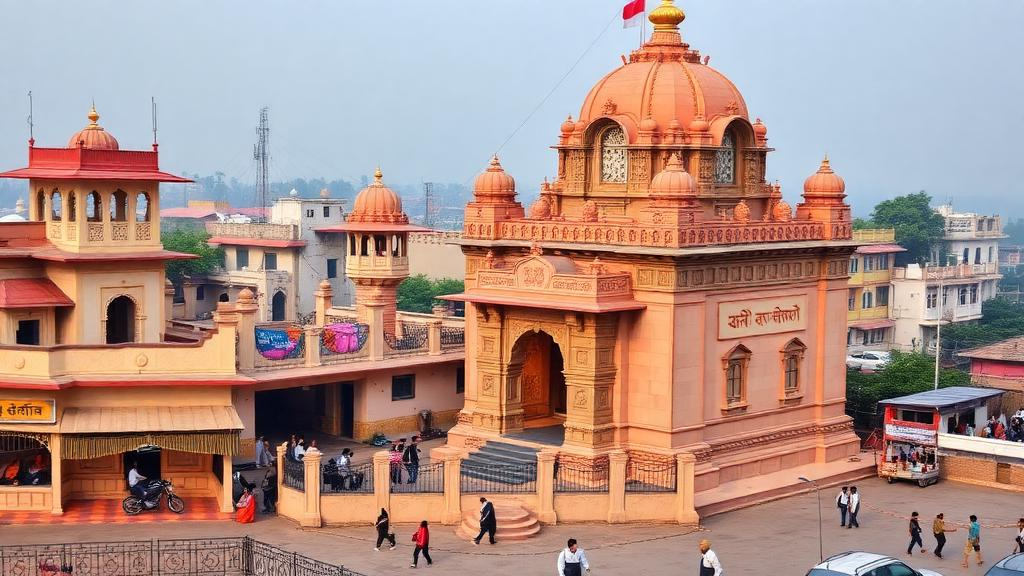
Ayodhya, the ancient city on the banks of the Sarayu River in Uttar Pradesh, has long been defined by its place in Hindu mythology as the birthplace of Lord Rama. For centuries its economy rested almost entirely on pilgrimage, a dependence that brought steady revenue but also chronic vulnerability: employment was seasonal, infrastructure was thin, and young residents routinely left for opportunities elsewhere. The completion and inauguration of the Ram Mandir has changed that equation in a matter of years, and a new open-access study in Discover Global Society sets out to measure exactly how. Combining an exploratory machine-learning forecast of tourist arrivals with a synthesis of government tourism data, planning documents and prior scholarship, the research offers one of the first integrated assessments of how a single monumental religious project can restructure the socioeconomic, cultural and physical fabric of a historic city.
The study’s only original quantitative analysis is a forecasting exercise built on annual domestic and foreign visitor counts from the Uttar Pradesh State Tourism Department and the Open Government Data Platform India, covering 2016 to 2023. The authors deployed a Long Short-Term Memory (LSTM) recurrent neural network, a deep-learning architecture whose gated memory cells are designed to capture temporal dependencies and non-linear dynamics in sequential data. That choice mattered because the series is anything but a smooth trend: it contains an abrupt structural break in 2020, when the COVID-19 pandemic collapsed arrivals, followed by a sharp, non-linear rebound that culminated in a surge in 2023. Classical linear forecasting methods assume stable trends or seasonal patterns, precisely what this series lacks, which is why the researchers argued that a recurrent architecture was worth trying even on so short a record.
The technical implementation was deliberately transparent about its limits. The eight-year series was Min-Max normalised to the interval between zero and one, with the scaler fitted only on the training partition to prevent information leakage. A sliding-window procedure with a two-year look-back converted the univariate series into six supervised input-output sequences, five for training and a single held-out year, 2023, for testing. The network itself was a stacked LSTM with 64 units, a dropout layer, a second LSTM of 32 units, further dropout, a 16-unit ReLU dense layer and a linear output neuron, compiled with the Adam optimiser and mean squared error loss. Training ran with early stopping and learning-rate reduction callbacks, terminating at epoch 400 with the best weights restored from epoch 201. Because the test set contains only one observation, the reported error metrics are explicitly framed as indicative rather than statistically robust estimates of generalisation.
To keep the deep-learning ambition honest, the team benchmarked the LSTM against three classical baselines on the identical data split: a naïve persistence model that simply repeats the previous year’s value, an ordinary least-squares linear trend model, and a simple exponential smoothing model with a heavily damped smoothing parameter. The comparison proved sobering. The LSTM returned a negative R-squared of minus 0.5370 for domestic visitors, meaning it fell marginally below a naïve mean baseline, while performing better for foreign arrivals. Rather than treating this as a failure, the authors read it as an informative finding: the pandemic collapse, the depressed 2021 figure and the violent post-pandemic rebound broke the temporal regularity on which sequence models depend, so the network could not recover a single stable mapping from past to future years. The 2024 to 2028 projections should therefore be treated as illustrative model-based estimates, not reliable predictions of demand.
What the secondary data do show unambiguously is an economic transformation reported across government and media sources. Hotels, guesthouses and homestays have seen bookings climb sharply during pilgrimage seasons, prompting new lodging construction, while restaurants and eateries catering to diverse visitor preferences have flourished. Small enterprises have been swept along: souvenir shops selling religious artefacts, artisans producing temple-themed merchandise, and transport operators running auto-rickshaws, cycle-rickshaws and taxis have all expanded. The construction phase itself generated employment and stimulated supply chains for building materials, and external investors have poured capital into roads, smart parking and public spaces. The ripple extends into real estate, with rising demand for both residential and commercial space. To contextualise this trajectory, the authors compared Ayodhya’s visitor statistics with three purposively selected North Indian pilgrimage cities, Varanasi, Mathura and Prayagraj, chosen because comparable year-wise visitor data exist for all four. The authors stress this is an illustrative, non-random comparison, and no causal inference about the relative effect of temple construction across cities should be drawn from it.
The urban-planning dimension is equally striking. Ayodhya’s historic layout, in which landmarks such as Hanuman Garhi, Kanak Bhavan and Treta Ke Thakur were interwoven with residential neighbourhoods along narrow, informally arranged lanes, has been reorganised around the Ram Janmabhoomi complex. Major infrastructure projects documented in the study include the 67.17-kilometre Ayodhya Ring Road, an investment of roughly 3,935 crore rupees split between a northern and southern bypass, the widening of the central Ram Path corridor from Sahadatganj to Naya Ghat completed in early 2024 at approximately 700 crore rupees, and a proposed 20-kilometre Bharat Path corridor costing around 900 crore rupees. The major religious sites now form a connected corridor of worship within roughly one to two kilometres of the temple, converging on wider pedestrian and vehicular routes rather than the old lanes, a pattern the authors link to the concept of the ‘sacredscape’ in Indian pilgrimage urbanism.
Water, power and waste systems have been overhauled alongside the roads. New reservoirs, treatment plants and pipelines aim to secure supply for residents and the swelling visitor population, with regular quality testing and sustainability-minded groundwater management, since urbanisation is placing pressure on local aquifers. The electrical grid has been expanded into newly developed areas, with solar power incorporated as a renewable component of generation. Waste management has been scaled up through strategically placed bins, more frequent collection in high-density zones, recycling plants, source-segregation campaigns and sanitary landfill provision for non-recyclable material. The authors also flag an honest data gap: Ayodhya’s last official census population figure is 55,890 from 2011, no newer national census exists, and verified current counts of new water or electrical connections were not available in public sources, a limitation they note explicitly rather than fill with estimates.
The study does not shy away from the project’s contested history and continuing frictions. It traces the dispute from the 1528 construction of the Babri Masjid, through the 1949 idol placement that locked the premises, the 1992 demolition that triggered nationwide communal riots, the Liberhan Commission report, the 2010 Allahabad High Court three-way division of the land, and finally the Supreme Court’s November 2019 verdict that awarded the site for the temple while declaring the demolition a violation of law. On present-day impacts, the authors distinguish between groups: business owners in hospitality, retail and transport generally report rising demand and income, while residents affected by road-widening and land acquisition have raised concerns about displacement, compensation and loss of livelihoods. A cited sentiment analysis of Twitter reactions to the 2019 verdict found responses spanning relief, resignation and continued concern about implications for communal relations, neither uniformly celebratory nor uniformly critical. The authors acknowledge they hold no primary survey data from Ayodhya’s religious-minority residents, and they decline to fill that gap with unsupported claims.
Looking forward, the authors frame Ayodhya’s sustainability challenge through the lens of the UNESCO Recommendation on the Historic Urban Landscape, which treats development in historic cities as managed change requiring sustained stakeholder engagement rather than a one-time construction milestone. Economic gains, they argue, must be distributed equitably across the local population, with social welfare programmes, skill development and measures to prevent displacement of vulnerable and minority communities. Cultural preservation, community participation in decision-making, eco-friendly transport options such as electric and hybrid vehicles, curated nature trails and tourist education programmes all feature in their roadmap. The forecasting exercise, for all its humility about a seven-observation dataset, captures the central tension the city now faces: a visitor economy surging on the back of faith, infrastructure racing to keep up, and a historic landscape whose future depends on whether growth and heritage can be made to evolve together rather than in conflict.
Subject of Research: Socioeconomic, cultural and urban impacts of the Ram Mandir construction on Ayodhya, India
Article Title: Socioeconomic and cultural impacts of ram mandir construction on urban transformation in Ayodhya India
Article References: Choudhury, R., Choudhury, T., Singh, M., Bachute, M., Kandpal, V., & Gite, S. (2026). Socioeconomic and cultural impacts of ram mandir construction on urban transformation in Ayodhya India. Discover Global Society, 4(1), Article 260. https://doi.org/10.1007/s44282-026-00615-z
Image Credits: AI Generated
DOI: 10.1007/s44282-026-00615-z
Keywords: Ayodhya, Ram Mandir, pilgrimage tourism, urban transformation, LSTM forecasting, heritage management, socioeconomic impact, infrastructure development, sustainable tourism, India, historic urban landscape, religious tourism
Cite Scienmag News
Courtney Benton. (October 1, 2026). How the Ram Mandir Is Rewriting Ayodhya’s Urban and Economic Future. Scienmag. https://scienmag.com/how-the-ram-mandir-is-rewriting-ayodhyas-urban-and-economic-future/
Courtney Benton. "How the Ram Mandir Is Rewriting Ayodhya’s Urban and Economic Future." Scienmag, 1 October 2026, https://scienmag.com/how-the-ram-mandir-is-rewriting-ayodhyas-urban-and-economic-future/. Accessed 4 October 2026.
Courtney Benton. "How the Ram Mandir Is Rewriting Ayodhya’s Urban and Economic Future." Scienmag. October 1, 2026. https://scienmag.com/how-the-ram-mandir-is-rewriting-ayodhyas-urban-and-economic-future/


