


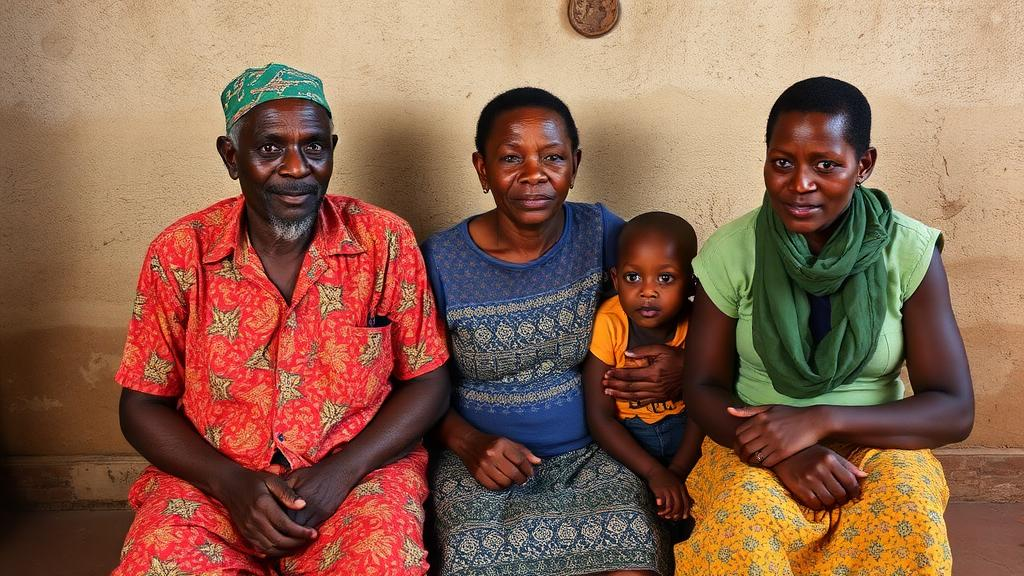
In the rural villages of Nkayi District in western Zimbabwe, a quiet demographic transformation has reshaped the architecture of family life. Across the district, growing numbers of children are being raised not by their parents but by their grandparents, a pattern driven by labor migration to towns and neighboring countries, the long shadow of HIV/AIDS-related mortality, and the grinding pressures of economic hardship. A new phenomenological study published in Discover Social Science and Health by Phumuzani Mpofu of the University of the Witwatersrand and Mthokozisi Moyo of Zimbabwe Open University offers one of the most intimate portraits yet of what these skipped-generation households actually feel like from the inside, because for the first time in this setting the researchers placed children’s own voices at the center of the analysis rather than treating them as passive subjects of adult concern.
The study’s methodological approach is as important as its findings. Mpofu and Moyo conducted in-depth interviews with 20 children aged between 10 and 18 years, alongside 10 grandparent caregivers, using a phenomenological design that seeks to understand how people interpret and make meaning of their own everyday experiences. Rather than measuring outcomes through standardized instruments, the researchers asked children to describe their daily lives, their relationships, their worries, and their sources of joy in their own words. The analytical framework was Ecological Systems Theory, the influential model developed by developmental psychologist Urie Bronfenbrenner, which holds that a child’s development unfolds across nested layers of context, from the immediate microsystem of family and household, through the mesosystem of connections between those settings, to the exosystem, macrosystem, and chronosystem of institutions, cultural values, and historical change.
What emerged from the interviews is a strikingly paradoxical picture of childhood. On one side of the paradox lies profound emotional security. Children consistently described their relationships with their grandparents as sources of care, warmth, and belonging, describing bonds of attachment and trust that anchored their sense of identity and worth. Grandparents, for their part, spoke of deep commitment to the children in their charge, framing their caregiving as both a moral duty and an expression of love. In a research literature that has often emphasized the burdens carried by elderly caregivers, this finding is a corrective: the grandchild-grandparent relationship, in these households, functions as a genuine emotional resource for both generations, a relational microsystem that buffers children against the losses and disruptions that brought them into their grandparents’ care in the first place.
The other side of the paradox is structural vulnerability, and it is severe. Children reported chronic poverty and food insecurity as defining features of their daily lives, with hunger shaping everything from their concentration at school to their energy for household tasks. Schooling was frequently disrupted, whether through inability to pay fees, the need to work, or the simple exhaustion of children stretched beyond their years. Many described assuming adult responsibilities early, taking on caregiving, agricultural labor, and income-generating work that would ordinarily fall to parents. The study also documents heightened gendered risks, particularly in mining communities, where girls face elevated exposure to exploitation and danger. These are not incidental hardships; the researchers show how they are co-produced by the wider systems surrounding the household, from national economic collapse to local labor markets, exactly as Ecological Systems Theory would predict.
The gendered dimension of vulnerability deserves particular attention. In communities where artisanal and small-scale mining activity draws migrants and money, the study found that children, and especially girls, navigate risks that their grandparents are often too old, too distant, or too constrained to monitor or mitigate. This finding connects the intimate microsystem of the grandparent-headed home directly to the exosystem of economic activity that children do not control but must nevertheless survive. It also illustrates why the researchers argue that resilience and vulnerability are co-constructed across relational, institutional, and structural contexts: the same child can be deeply loved and protected at home while remaining acutely exposed beyond it, and no single level of intervention can address both realities at once.
Yet the story the children and grandparents tell is not one of passive suffering. The study documents a repertoire of resilience strategies operating at multiple ecological levels. Within households, grandparents and children developed livelihood strategies to stretch scarce resources, combining subsistence farming, petty trading, and piecework. Kinship ties beyond the household provided crucial support, with extended family members stepping in with food, school fees, or labor when the core household could not cope. At the community level, neighbors and local institutions offered forms of mutual aid, while non-governmental organizations supplied material assistance and programs that reached skipped-generation families directly. These findings map neatly onto the mesosystem and exosystem layers of Bronfenbrenner’s model, demonstrating empirically how support flows, or fails to flow, across the boundaries between family, community, and institution.
The theoretical contribution of the study lies in this multi-level demonstration. Much of the existing scholarship on grandparent caregiving in sub-Saharan Africa, the authors note, has centered on the burdens faced by elderly caregivers: their health problems, their poverty, their grief. By foregrounding children’s voices, Mpofu and Moyo shift the analytical lens and reveal that children are not merely recipients of care or victims of circumstance but active interpreters and navigators of their worlds. Children in the study described how they made sense of their parents’ absence, how they weighed pride in their grandparents against embarrassment about their poverty, and how they strategized to keep themselves in school. This agency-centered perspective aligns with contemporary developmental science, which increasingly treats children as competent social actors whose subjective experience is essential data rather than background noise.
The policy implications are concrete. The authors argue for child-centred social protection that goes beyond generic household transfers to address the specific needs of skipped-generation families: support that recognizes that caregivers are elderly and often infirm, that children shoulder adult burdens, and that educational costs are the mechanism through which poverty most directly converts into lifelong disadvantage. They call for interventions that strengthen both material support and psychosocial well-being, pairing school-fee assistance and food security programs with counseling and mentorship that address the emotional complexities of parental absence. The gendered risks identified in mining communities suggest the need for targeted protective measures rather than one-size-fits-all programming. Because the study is grounded in Ecological Systems Theory, its recommendations are deliberately multi-level, targeting the relational, institutional, and structural contexts simultaneously rather than expecting grandparents alone to solve problems that originate far beyond the household.
For a global audience, the Nkayi findings resonate far beyond Zimbabwe. Grandparent-headed households are rising across much of sub-Saharan Africa in the wake of the HIV/AIDS epidemic and continuing labor migration, and similar skipped-generation arrangements are increasingly common in Eastern Europe, Southeast Asia, and among migrant communities in high-income countries, where parents leave children with grandparents while seeking work abroad. The Zimbabwean study offers a template for how to study these families: listen to the children, situate the household within its nested contexts, and resist the temptation to reduce complex lives to either tragedy or triumph. The paradox the researchers document, of emotional richness coexisting with material deprivation, is likely the defining feature of skipped-generation childhood wherever it occurs, and policies that address only one side of that paradox will fail the children they are meant to serve.
The study, which received ethical approval from the Zimbabwe Open University Research Ethics Committee and obtained informed consent from guardians and assent from all child participants, was published open access, making the full account of these children’s experiences freely available to researchers, policymakers, and communities. Its publication comes at a moment when social protection systems across the region are being rethought in the wake of successive economic shocks. If the voices of Nkayi’s children are heeded, the lesson is clear: grandparental love is a powerful foundation for a child’s development, but love alone cannot pay school fees, fill an empty plate, or make a mining town safe for a twelve-year-old girl. Building childhoods that are both emotionally secure and materially protected requires strengthening every ring of the ecological system that surrounds them.
Subject of Research: The lived experiences of children raised in grandparent-headed households in rural Zimbabwe
Article Title: Exploring the lived experiences of children raised by grandparents in Nkayi District, Zimbabwe
Article References: Mpofu, P., & Moyo, M. (2026). Exploring the lived experiences of children raised by grandparents in Nkayi District, Zimbabwe. Discover Social Science and Health. https://doi.org/10.1007/s44155-026-00446-y
Image Credits: AI Generated
DOI: 10.1007/s44155-026-00446-y
Keywords: grandparent-headed households, child welfare, kinship caregiving, Ecological Systems Theory, rural Zimbabwe, orphaned and vulnerable children, intergenerational support, food insecurity, qualitative phenomenology, socio-emotional development, social protection, Nkayi District
Cite Scienmag News
Courtney Benton. (October 1, 2026). Grandparents Raise Zimbabwe’s Children: Love and Hardship in Skipped-Generation Homes. Scienmag. https://scienmag.com/grandparents-raise-zimbabwes-children-love-and-hardship-in-skipped-generation-homes/
Courtney Benton. "Grandparents Raise Zimbabwe’s Children: Love and Hardship in Skipped-Generation Homes." Scienmag, 1 October 2026, https://scienmag.com/grandparents-raise-zimbabwes-children-love-and-hardship-in-skipped-generation-homes/. Accessed 4 October 2026.
Courtney Benton. "Grandparents Raise Zimbabwe’s Children: Love and Hardship in Skipped-Generation Homes." Scienmag. October 1, 2026. https://scienmag.com/grandparents-raise-zimbabwes-children-love-and-hardship-in-skipped-generation-homes/


