


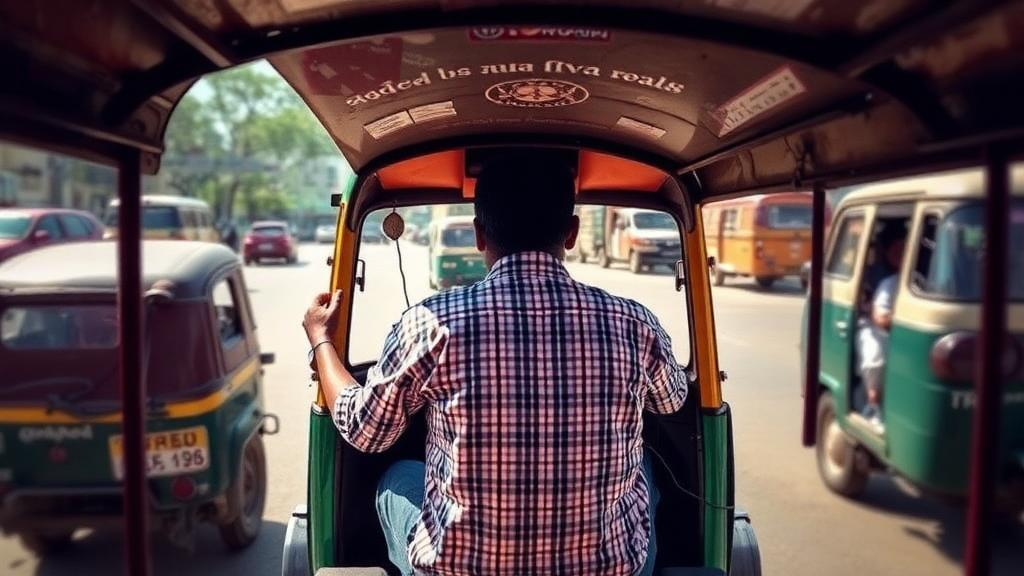
In the western Indian city of Satara, the summer of 2024 pushed temperatures to 42 degrees Celsius, and for the men who make their living ferrying passengers in open-sided auto-rickshaws, there was no escape. A new study published in Discover Geoscience offers one of the first detailed portraits of how extreme heat is simultaneously eroding the health and the livelihoods of these informal transit workers, a group that occupational health research has largely overlooked. Interviewing 107 male drivers aged 22 to 60 across four crowded locations in the city during the peak summer month of May 2024, researchers led by Yogeshwar Bajare of the Yashwantrao Chavan School of Social Work documented a cascade of heat-related symptoms, lost income, and coping strategies stretched to their limits.
The numbers are stark. Heat rash and fatigue were each reported by 74 of the 107 drivers, dry mouth by 61, small blisters or pimples by 51, and headaches by 47. Heavy sweating affected 34 drivers, while leg swelling, eye irritation, and muscle cramps each afflicted 10. Eleven drivers reported vomiting during May 2024 due to extreme outdoor heat exposure. In total, 59 percent of respondents reported at least one self-reported heat-related symptom, 15 percent reported five symptoms simultaneously, and two individuals reported seven. Ninety-five percent said their clothes became soaked with sweat during the peak heat hours between 11 a.m. and 4 p.m., a physiological signal that the body’s cooling system was already overwhelmed.
The economic dimension of this exposure is equally revealing. Auto-rickshaw drivers in Satara earn an average of 11,500 rupees per month for 12-hour workdays, and heat directly attacks that income. Seventy-one percent of drivers reported losing up to 1,000 rupees during the study period, 27 percent lost between 1,001 and 3,000 rupees, and 2 percent lost between 3,001 and 5,000 rupees. Ninety-seven percent said extreme heat reduced their daily income, because fewer passengers venture out during scorching afternoons. Some drivers with a decade or more of experience reported spending entire days without a single customer, riding from place to place in a futile search for fares.
What makes the study methodologically interesting is its combination of primary survey data with satellite-derived remote sensing indices. The researchers analysed Land Surface Temperature (LST), the Normalised Difference Vegetation Index (NDVI), the Normalised Difference Built-up Index (NDBI), and the Normalised Difference Water Index (NDWI) for Satara city each May from 2020 to 2024. The LST analysis reveals a clear warming trajectory: in 2020, the city showed a relatively balanced mix of cooler and moderately warm zones with only isolated hotspots, but by 2023, areas in the 48 to 54 degree Celsius range had expanded markedly, and by 2024, large portions of the landscape exceeded 54 degrees Celsius on the surface. The NDBI maps show a corresponding intensification of built-up areas spreading outward from the urban core, while NDVI data indicate that only about a quarter of the study area supports high-quality vegetation, with nearly half representing sparse or low-quality cover.
The authors frame their analysis using the vulnerability framework of the Intergovernmental Panel on Climate Change, which decomposes risk into exposure, sensitivity, and adaptive capacity. Exposure factors included hours spent outdoors, perceived workplace temperature, and the presence of shade or vegetation at waiting stands. Sensitivity encompassed age, self-reported symptoms, and socioeconomic indicators. Adaptive capacity covered access to drinking water, cooling devices, and awareness of heat risks. Notably, the order of importance of these vulnerability indicators emerged as exposure first, then sensitivity, then adaptive capacity, suggesting that reducing the sheer duration and intensity of heat contact should be the primary policy lever.
The most conceptually significant contribution of the paper is its reframing of why drivers continue working past apparent physiological limits. The authors argue that adaptive capacity is the mechanism that converts exposure into forced choice. Where adaptive capacity is high, a worker can reduce heat exposure without an income penalty, for example through paid rest breaks or employer-provided shade. Where it is low, as in Satara’s informal transit economy, the same symptoms of heat rash, dizziness, and fatigue are insufficient to trigger a stop-work decision, because stopping directly threatens daily earnings. The health cost of continuing is cumulative and deferred, while the economic cost of stopping is immediate and certain. Income precarity itself, the authors conclude, is a heat-vulnerability amplifier independent of ambient temperature.
Satara’s situation is not an anomaly but a preview. According to the study, Maharashtra is expected to experience a two- to five-fold increase in the frequency of daytime and night-time heat extremes by 2050. India ranks tenth on the Global Climate Risk Index for 2022, with an average of 114 heat wave days recorded each year, and National Crime Records Bureau data compiled in the study indicate 30,352 heat-related deaths in India between 1991 and 2024. District Health Office records for Satara show 81 suspected heatstroke cases between 2023 and 2025, seven of them confirmed, all in 2024. A 30-year trend analysis of May temperatures using the ERA5-Land dataset and the Mann-Kendall test found a marginally significant warming of roughly 0.023 degrees Celsius per year.
Night-time conditions compound the problem. Seventy-three percent of drivers described the daytime air as hot, and 51 percent reported still, warm air in the evening between 6 p.m. and 9 p.m., reflecting the urban heat island effect in which built-up surfaces slowly release stored heat after sunset. Seventy-four percent of respondents said night temperatures left them unable to sleep, and sleep deprivation itself feeds back into next-day vulnerability and driving safety. At home, drivers rely on table fans (49 percent), wall fans (25 percent), ceiling fans (22 percent), and traditional cooling methods such as drinking water from earthen pots (70 percent) or wrapping vessels with wet cotton cloth (23 percent). Forty-four percent bathe twice daily to cope.
The physical environment at the waiting stands offers little relief. The researchers found adequate shaded resting places at three of the four study sites, but the Rajwada bus stop, near a market and schools, lacks meaningful green cover, with only three young Pimpal trees too small to provide shade. Traditional Panpoi water-distribution points, historically maintained by social groups to offer free cool drinking water, have largely been discontinued, forcing drivers and passengers alike to buy bottled water. Drivers carry water bottles, but these are insufficient for a full day in the heat.
The authors propose a tiered set of interventions grounded in their remote sensing findings. First, shaded waiting structures with reflective or lightweight roofs should be prioritised at stands identified as high-LST, low-NDVI hotspots. Second, organised rest periods and cold drinking water stations should operate during the peak hours of noon to 4 p.m., potentially using nearby public buildings as cooling shelters. Third, the municipal corporation should issue heat and health guidelines specific to auto-rickshaw drivers, supported by SMS or WhatsApp early-warning messages about peak heat hours and symptom recognition. The study also notes that shifting work from the conventional 8 a.m. to 6 p.m. schedule to a split pattern of 6 to 11 a.m. and 3 to 7 p.m. could recover five to fifteen percent of heat-lost productivity. The authors caution that their findings are associative rather than causal, since self-reported symptoms can stem from dehydration, traffic pollution, or pre-existing conditions, and that satellite-derived land surface temperature overestimates the air temperature pedestrians actually experience. Still, as heatwaves intensify across South Asia, the study makes clear that protecting informal outdoor workers will require treating economic precarity as a climate health problem in its own right.
Subject of Research: Occupational heat stress, health impacts, and livelihood effects on auto-rickshaw drivers in Satara city, India
Article Title: Examining perceived heat stress: health and livelihood effects on auto-rickshaw drivers in Satara city (India) of the South Asia Region
Article References: Bajare, Y., Tasgaonkar, P., & Sankpal, S. (2026). Examining perceived heat stress: health and livelihood effects on auto-rickshaw drivers in Satara city (India) of the South Asia Region. Discover Geoscience, 4(1), Article 383. https://doi.org/10.1007/s44288-026-00754-5
Image Credits: AI Generated
DOI: 10.1007/s44288-026-00754-5
Keywords: heat stress, auto-rickshaw drivers, India, urban heat island, land surface temperature, occupational health, climate change adaptation, informal workers, Maharashtra, heat action plan, remote sensing, vulnerability
Cite Scienmag News
Violet Maxwell. (October 1, 2026). Riding Through the Furnace: How Extreme Heat Is Breaking India’s Auto-Rickshaw Drivers. Scienmag. https://scienmag.com/riding-through-the-furnace-how-extreme-heat-is-breaking-indias-auto-rickshaw-drivers/
Violet Maxwell. "Riding Through the Furnace: How Extreme Heat Is Breaking India’s Auto-Rickshaw Drivers." Scienmag, 1 October 2026, https://scienmag.com/riding-through-the-furnace-how-extreme-heat-is-breaking-indias-auto-rickshaw-drivers/. Accessed 1 October 2026.
Violet Maxwell. "Riding Through the Furnace: How Extreme Heat Is Breaking India’s Auto-Rickshaw Drivers." Scienmag. October 1, 2026. https://scienmag.com/riding-through-the-furnace-how-extreme-heat-is-breaking-indias-auto-rickshaw-drivers/


