


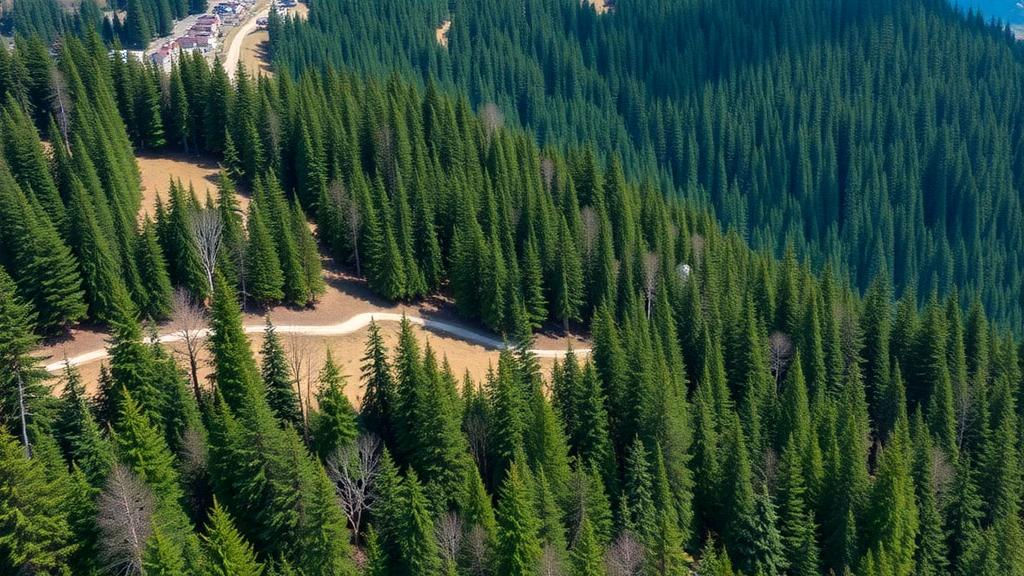
Switzerland’s mountain forests have long stood as an invisible shield for the people living below them. Anchoring steep slopes with their roots, these so-called protective forests blunt the force of avalanches in winter, hold back rockfalls and landslides during thaws, and slow the runoff that feeds floods in the valleys. For decades, scientists and foresters assumed that the stands at the highest altitudes enjoyed a measure of natural immunity from one of the greatest threats to forest health: summer drought. Cold temperatures and a deep, long-lasting snowpack kept subalpine soils moist well into the growing season, and the trees’ water demand remained modest. A new study now shows that this assumption no longer holds, and the implications reach far beyond the treeline.
Writing in the journal Frontiers in Forests and Global Change, Dr Estelle Noyer of Bern University of Applied Sciences and her colleagues present evidence that declining forest stands have become an increasingly common phenomenon across every altitude belt in Switzerland. The team analyzed nearly four decades of records from the Swiss national forest inventory, focusing exclusively on protective forest stands that had not been damaged by fire or altered by interventions such as selective logging. Their conclusion is stark: even at altitudes of up to 2,200 meters, the number of trees per stand is falling as large, dominant trees in particular decline or die, a process that is steadily eroding the very forests that protect mountain communities from natural hazards.
The technical foundation of the study is the Swiss national forest inventory, or NFI, a nationwide monitoring program that has been running since 1983. Foresters regularly measure the diameter at breast height of every tree across hundreds of representative plots, each covering 200 square meters and arranged on a systematic grid across the country. From this archive, Noyer and her colleagues drew on five successive survey periods, examining between 891 and 1,543 tree stands in each period, spanning elevations from 282 to 2,219 meters above sea level. By tracking how the condition of each stand changed between surveys, the researchers could quantify where and when drought stress began to leave its mark on the canopy.
To interpret the patterns, the team relied on the established classification of Swiss vegetation belts. The colline belt, the lowest zone, ranges from 282 to 1,184 meters; the montane belt spans roughly 600 to 1,648 meters; and the subalpine belt, where the protective forests of the high Alps grow, extends from 1,235 to 2,219 meters. Historically, drought vulnerability followed a clear altitudinal gradient. Low-elevation forests in the colline and lower montane belts suffered most during hot summers, while the subalpine belt was buffered by cold air, persistent snow cover, and the slow release of meltwater from glaciers and snowfields into the soil.
That buffering is now failing. Over recent decades, warming at intermediate and high altitudes has outpaced warming at low elevations, and the result is physiological stress for subalpine trees. Higher temperatures raise the vapor pressure deficit between leaves and air, effectively making trees thirstier and forcing them to draw more water from soils that are receiving less of it. At the same time, declining precipitation and the retreat of Alpine glaciers have reduced the water supply that once sustained high-elevation soils through the growing season. Previously, some researchers had suggested that longer and warmer growing seasons would give subalpine trees a net growth boost, allowing them to recover quickly from dry spells. The new data indicate that any such benefit is being overwhelmed by the intensifying water deficit.
The numbers tell the story with unusual clarity. In the colline belt, the share of protective stands classified as declining rose from 11.1 percent in 1983 to 30.4 percent by 2022, the strongest increase recorded anywhere in the country. In the lower montane belt, the declining share climbed from 17.4 percent to 21.4 percent, while in the higher montane belt it remained roughly constant at around 10.8 percent. Most striking, however, was the pattern in the highest zones. In the subalpine inferior belt, between 1,208 and 1,897 meters, and the subalpine superior belt, between 1,752 and 2,219 meters, the percentage of declining stands reached its lowest values, between 10.3 and 15.3 percent, in the mid-1990s to early 2000s, and then rose sharply to 18.8 percent in the years since.
Tree density, meanwhile, decreased in every altitude belt over the study period. Declining stands typically showed the highest drought indices and the steepest drop in tree basal area, a standard measure of cumulative tree cover that reflects both tree size and numbers. This combination indicates that the stands under decline were experiencing the most severe drought stress while simultaneously losing canopy. Perhaps the most consequential finding, though, is what disappeared from the data: the historic strong link between higher altitude and less severe drought stress was no longer visible in the records after 2017. The altitudinal gradient that once structured drought vulnerability across the Swiss Alps has, in effect, collapsed.
The study also reveals how drought reshapes the composition of forest stands, and why this matters for the future. Drought does not kill trees at random. It selectively removes the largest, dominant individuals and the species and size classes most vulnerable to water stress, even at the greatest heights. What remains after these losses are stands that appear, on paper, to be composed of more drought-resilient species and smaller size classes. Yet the authors caution that this apparent hardiness may be deceptive. When drought episodes arrive in quick succession, as is increasingly common under continued warming, the tolerance and resilience of even these tougher stands can be worn down, leaving forests progressively less able to withstand the next dry summer.
For Switzerland, and for mountain communities across Europe, the stakes are concrete rather than abstract. Protective forests are the first line of defense against avalanches, rockfalls, landslides, and floods, and a thinning canopy means a weakening barrier. Noyer and her colleagues argue that there is a pressing need for adaptive forestry strategies, not only in Switzerland but throughout European mountain ranges. The critical open questions, as Noyer frames them, center on how rapidly forest species composition will change, and how foresters can make forests more resilient by promoting multi-layered and diverse stands. Her team’s ongoing follow-up study is expected to yield actionable spatial data to help foresters identify where interventions would do the most good.
The research, published as an observational study based on four decades of inventory data, arrives at a moment when the Alps are warming faster than the global average, and when the consequences of forest decline are no longer hypothetical. What the study documents is a tipping point of sorts: the tolerance and resilience of Swiss trees against summer drought are being overwhelmed by the frequency and intensity of recent dry episodes, from the valley floors to the uppermost forests below the treeline. If the trend continues, the quiet work performed by these forests, season after season, in holding mountainsides together, may become visibly harder to take for granted. The message for policymakers and foresters alike is that the time to adapt the management of protective forests is now, before the next sequence of droughts tests stands that are already thinner, drier, and less diverse than the forests of four decades ago.
Subject of Research: Drought impacts on Swiss protective forests across altitude belts
Article Title: Even high-altitude forests in Switzerland are now weakened by frequent droughts, making natural hazards more dangerous
Article References: Even high-altitude forests in Switzerland are now weakened by frequent droughts, making natural hazards more dangerous. (n.d.). Original publication
Image Credits: AI Generated
DOI: Not provided
Keywords: Switzerland, protective forests, drought, subalpine forests, climate change, forest decline, Swiss national forest inventory, natural hazards, avalanches, adaptive forestry, Frontiers in Forests and Global Change, altitudinal gradient
Cite Scienmag News
Russell Cooper. (October 1, 2026). Drought Now Weakens Even Switzerland’s High-Altitude Protective Forests, Study Finds. Scienmag. https://scienmag.com/drought-now-weakens-even-switzerlands-high-altitude-protective-forests-study-finds/
Russell Cooper. "Drought Now Weakens Even Switzerland’s High-Altitude Protective Forests, Study Finds." Scienmag, 1 October 2026, https://scienmag.com/drought-now-weakens-even-switzerlands-high-altitude-protective-forests-study-finds/. Accessed 1 October 2026.
Russell Cooper. "Drought Now Weakens Even Switzerland’s High-Altitude Protective Forests, Study Finds." Scienmag. October 1, 2026. https://scienmag.com/drought-now-weakens-even-switzerlands-high-altitude-protective-forests-study-finds/


