


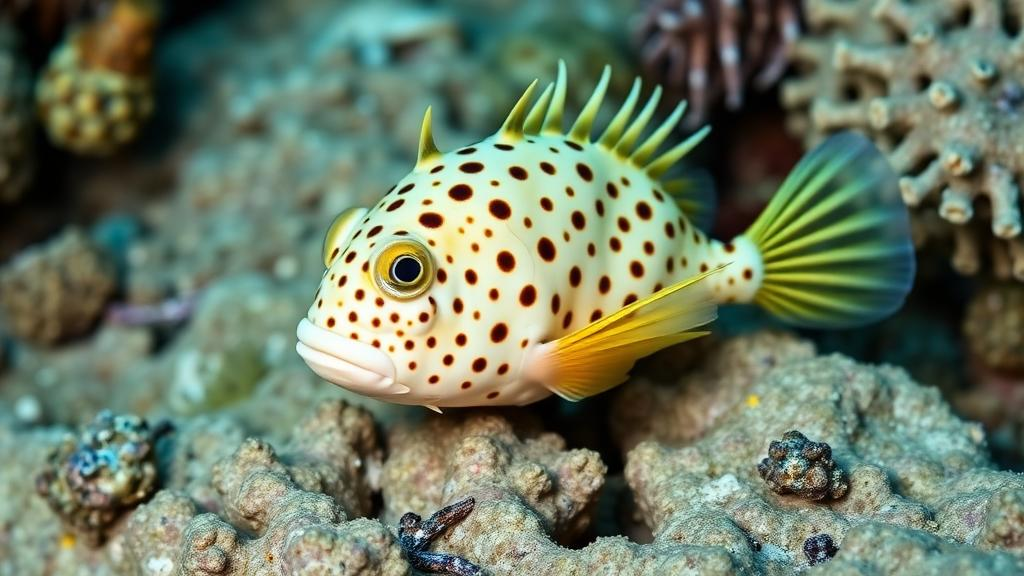
On a shallow fringing reef off Sesoko Island in Okinawa, Japan, researchers spent three years following one of the reef’s most conspicuous predators: the blackspotted pufferfish, Arothron nigropunctatus. What they documented is a rare, real-time account of how a coral-eating fish rewires its diet when a mass bleaching event devastates its food supply. The study, published in the journal Coral Reefs, combines more than 100 hours of direct underwater observation with fecal analysis and statistical modeling, and its findings challenge long-held assumptions about how dangerous these fish really are to corals recovering from heat stress.
Corallivores, animals that eat live coral tissue, occupy an ambivalent position on reefs. At least 128 fish species from 11 families feed on coral polyps, mucus, and skeleton, forming an important pathway that channels the energy produced by the corals’ photosynthetic symbionts up the food web. Yet skeletal-feeding species such as pufferfish, parrotfish, and some triggerfish bite off chunks of skeleton along with the tissue, leaving lesions that cost corals energy to repair, potentially reducing growth and reproduction, and sometimes acting as vectors for coral disease. On healthy reefs, these effects are generally considered modest, because corals can defend themselves and regrow. After a disturbance, however, the equation changes: with fewer colonies remaining, the feeding pressure concentrated on each survivor can rise sharply, raising concerns that corallivores might slow reef recovery precisely when it matters most.
Pufferfish are particularly well equipped for this kind of predation. Their beak-like tooth plates, fused into four powerful cutting surfaces and driven by strong jaw muscles, allow them to shear through hard-bodied prey of nearly any kind. At least five Arothron species are known to eat corals. Despite this, most evidence for their diets has come from snapshot gut-content analyses of dead specimens, and detailed field observations have focused almost entirely on Arothron meleagris in the tropical eastern Pacific, where coral diversity is low. How Arothron pufferfishes behave on the species-rich reefs of the western Pacific, and how they respond to bleaching, remained largely unknown until now.
Mei Kubota, Hajime Sato, and Yoichi Sakai of Hiroshima University conducted their observations between 2023 and 2025 on a protected shallow reef in front of Sesoko Station, covering roughly 2.56 hectares at depths of one to five meters. Because A. nigropunctatus bears distinctive black spot patterns, the team could identify individuals photographically and track the same fish across years, a methodological advantage that allowed them to account for individual differences in feeding preferences. Snorkeling observers kept a distance of at least five meters and discarded the first minutes of each session to avoid disturbing the wary fish. Across 190 observation sessions totaling 6,064 minutes, they recorded bites on hard corals, the epilithic algal matrix, sponges, and sand-buried prey, along with movement patterns tracked by handheld GPS.
The baseline picture, gathered in 2023 when the reef was relatively healthy, showed a flexible omnivore rather than a coral specialist. The pufferfish fed mainly on Acropora and Porites corals but also bit the epilithic algal matrix, a complex of filamentous algae and cyanobacteria, dug sand-buried invertebrates by jetting water from their mouths, and occasionally took sponges. Activity was remarkably even across the day, with swimming occupying nearly 78 percent of observation time and no significant diel pattern in feeding. The fish showed no territoriality, moved hundreds of meters during half-hour watches, and never displayed aggression toward one another. Fecal analysis confirmed the observational data: Acropora dominated the diet by both weight and frequency of occurrence before bleaching.
Then came 2024. From July to September, seawater temperatures around Sesoko Island reached record highs, triggering a mass bleaching event. At a nearby reef, coral cover collapsed from 70 percent to under 5 percent within months, and at the study site nearly all Acropora colonies eventually died. The researchers had, by accident of timing, a natural experiment. Dividing their data into four phases, one year before bleaching, immediately before, during, and one year after, they fitted generalized linear mixed models to the bite counts, using observation time as an offset and individual identity as a random effect.
The results were striking. Bites on Acropora, which had averaged about 6.5 per 30 minutes in 2023, fell to nearly zero during bleaching and remained almost absent a year later, with the only two feeding events recorded in 2025 directed at small juvenile colonies sheltering under rocks. Notably, the pufferfish never bit bleached Acropora colonies at all. Feeding on Porites, a more bleaching-resistant genus, stayed stable throughout. Meanwhile, bites on other scleractinian corals such as Lobophyllia and Favites increased significantly, and feeding on the epilithic algal matrix surged to roughly seven times the pre-bleaching rate. Water-blowing on sandy patches, used to expose buried prey, declined to zero, suggesting that heat stress may have disturbed the sand-dwelling fauna as well. The pufferfish even began biting Chalinula nematifera, a sponge that can overgrow and kill corals, a predation event the authors believe has never been reported before.
Perhaps the most intriguing observation concerns how the pufferfish handle sediment-laden algal turfs. These mats, which accumulate heavy sediment loads after disturbances, are known to inhibit coral larval settlement and to suppress feeding by many herbivorous fishes, which tend to swallow calcium carbonate sediment along with the algae. The researchers watched A. nigropunctatus bite the algal matrix, hold it in its mouth, and expel the sediment, effectively separating food from grit. Because pufferfish lack the pharyngeal crushing apparatus of parrotfish and routinely ingest calcified prey, they may be unusually tolerant of sediment. The authors hypothesize that this could give the species a previously overlooked functional role: removing sediment-laden turf and creating gaps in the substrate that coral larvae could colonize, a service that typical herbivorous fishes may not readily replicate.
The study also quantifies how little coral these fish actually remove. Using the mean dry mass of fecal fragments and average bite rates, the team estimated that each pufferfish consumes about 7.9 grams of coral skeleton per day, or roughly 2.9 kilograms per year. At the observed density of 8.7 individuals per hectare, that amounts to about 25 kilograms of coral per hectare annually, equivalent to just 2.5 grams of calcium carbonate per square meter, far below rates reported for A. meleagris in the eastern Pacific and small relative to coral calcification rates in Okinawa. The authors caution that their estimates are minimums, since fragments may be abraded during digestion, and that coral skeletons can persist in the gut for weeks, which may explain why earlier gut-content studies overestimated the species’ dependence on coral.
Taken together, the findings recast the blackspotted pufferfish as a facultative corallivore whose flexible foraging may buffer it through disturbances rather than amplify them. Instead of concentrating on the few surviving colonies after bleaching, as feared, the fish shifted toward algae and other resources, and its total coral consumption appears too low to hinder reef recovery. Whether the dietary shift carries hidden costs, such as reduced growth or reproduction in the medium term, remains an open question, as does the precise mechanism behind the avoidance of bleached Acropora. But on a reef still reeling from record heat, the pufferfish’s plasticity offers a rare note of ecological nuance: a coral predator that, in the short term at least, appears to step aside, and may even lend a jaw, when the reef needs room to rebuild.
Subject of Research: Foraging behavior and dietary flexibility of the facultative corallivorous pufferfish Arothron nigropunctatus in response to mass coral bleaching on Okinawan reefs
Article Title: Foraging behavior and short-term response to mass coral bleaching by the facultative corallivorous pufferfish Arothron nigropunctatus in Okinawa, western Pacific
Article References: Kubota, M., Sato, H., & Sakai, Y. (2026). Foraging behavior and short-term response to mass coral bleaching by the facultative corallivorous pufferfish Arothron nigropunctatus in Okinawa, western Pacific. Coral Reefs. https://doi.org/10.1007/s00338-026-02961-5
Image Credits: AI Generated
DOI: 10.1007/s00338-026-02961-5
Keywords: coral bleaching, pufferfish, Arothron nigropunctatus, corallivory, Okinawa, epilithic algal matrix, dietary shift, reef recovery, behavioral ecology, Acropora, Porites, Tetraodontidae
Cite Scienmag News
Gavin Prescott. (October 1, 2026). Pufferfish Pivot to Algae After Coral Bleaching, Okinawa Study Reveals. Scienmag. https://scienmag.com/pufferfish-pivot-to-algae-after-coral-bleaching-okinawa-study-reveals/
Gavin Prescott. "Pufferfish Pivot to Algae After Coral Bleaching, Okinawa Study Reveals." Scienmag, 1 October 2026, https://scienmag.com/pufferfish-pivot-to-algae-after-coral-bleaching-okinawa-study-reveals/. Accessed 1 October 2026.
Gavin Prescott. "Pufferfish Pivot to Algae After Coral Bleaching, Okinawa Study Reveals." Scienmag. October 1, 2026. https://scienmag.com/pufferfish-pivot-to-algae-after-coral-bleaching-okinawa-study-reveals/


