


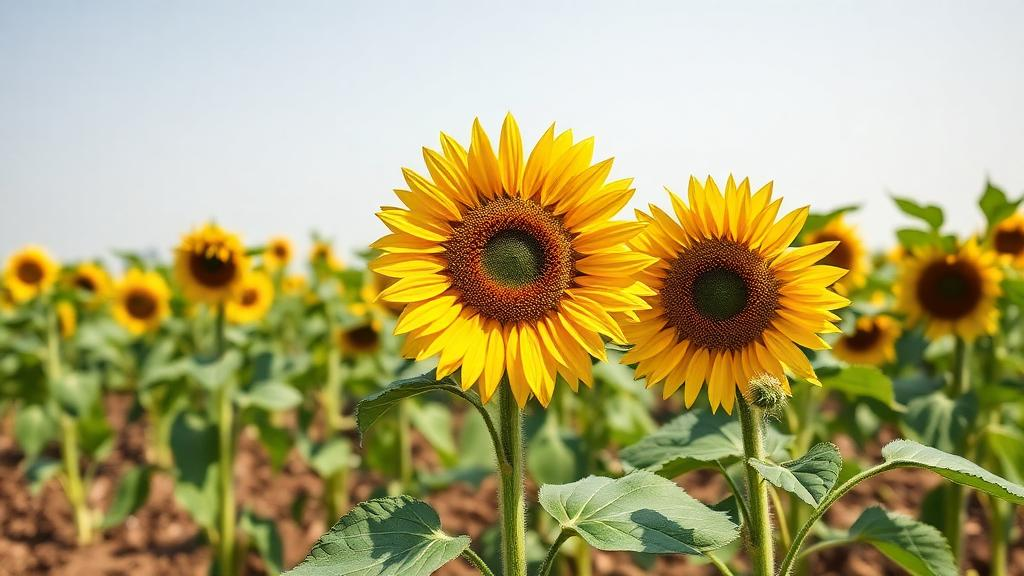
Every year, Ukraine’s vast sunflower processing industry burns mountains of husks to generate energy, and every year it is left with a problem: what to do with the ash. A new study published in Discover Sustainability suggests the answer may lie in putting that ash straight back into the ground. Researchers report that a fertilizer made from sunflower husk ash increased yields across seven different crops by roughly 10 to 18 percent compared with unfertilized control plots, while also improving key soil nutrients and even the nutritional quality of the harvested food. In a country that generates more than 100 thousand tonnes of this ash annually, the finding could transform an industrial waste burden into a homegrown mineral resource.
The research, led by Andrii Dankevych of the National University of Food Technology in Kyiv together with colleagues from Ukraine, Lithuania and Uganda, set out to test whether sunflower husk ash, or SHA, could serve as a genuine secondary mineral resource within a circular economy. The logic is elegantly simple. Sunflower plants draw potassium, phosphorus, calcium, magnesium and sulfur out of the soil as they grow. When the husks are burned for energy, those minerals are not destroyed; they are concentrated in the ash. Returning that ash to farmland effectively closes a nutrient loop that industrial agriculture has traditionally left wide open, sending minerals off-site and replacing them with mined, energy-intensive synthetic fertilizers.
The chemistry of the ash-based fertilizer is central to the story. According to the study, the SHA fertilizer contained 30 percent potassium oxide, 5 percent phosphorus pentoxide, 9 percent calcium oxide, 10 percent magnesium oxide and 4 percent sulfur. Notably, it contained no chlorine at all. That composition matters for two reasons. First, the high potassium fraction makes it a credible alternative or supplement to conventional potash fertilizers, which are among the most geopolitically sensitive and price-volatile inputs in modern farming. Second, the absence of chloride is an advantage for crops such as potato, tomato and cucumber, which are known to be sensitive to chloride accumulation in soil.
To test the fertilizer under real field conditions rather than in pots or greenhouses, the team conducted experiments during one growing season at the Slobozhanske Experimental Field of the National Scientific Center O.N. Sokolovsky Institute for Soil Science and Agrochemistry Research in Ukraine. The soil was a typical heavy loam chernozem, the famously fertile black earth that underpins much of Eastern Europe’s agricultural output. Seven crops were evaluated side by side: barley, maize, sunflower, potato, tomato, table beet and cucumber. Each crop occupied a plot of 0.1 hectares, allowing the researchers to observe how the ash-based fertilizer performed across a genuinely diverse rotation of cereals, oilseeds, tubers and vegetables.
The experimental design compared four treatments for each crop: an unfertilized control, a conventional NPK 16:16:16 mineral fertilizer, and the SHA-based fertilizer applied at two rates, 200 and 300 kilograms per hectare. The ash fertilizer was delivered in two ways, as a basal application and during pre-sowing cultivation, so the researchers could see whether timing and placement influenced performance. Yield, soil agrochemical properties and selected quality parameters of the harvested products were then measured, and the data were processed using descriptive and comparative statistical methods, including arithmetic means and absolute and relative differences between treatments.
The headline result is that plots treated with the SHA-based fertilizer yielded approximately 10 to 18 percent more than the unfertilized controls. Just as important for long-term soil health, the content of mobile phosphorus and exchangeable potassium in the soil rose by roughly 10 to 22 percent following treatment. Soil pH shifted by approximately 0.3 to 0.5 units, a change consistent with the liming-like effect of the calcium and magnesium oxides in the ash, which can help buffer acidity in intensively farmed soils. Beyond quantity, the researchers also recorded improvements in quality parameters of the produce itself, including higher dry matter, protein and fat content in the harvested crops, suggesting that the ash-derived nutrients were genuinely feeding the plants rather than merely sitting in the soil.
The authors are careful, and rightly so, about the limits of what a single-season, single-site trial can prove. Because all the data came from one growing season at one experimental station, the results reflect the specific soil, climatic and experimental conditions of the study and should be interpreted descriptively rather than as statistically significant effects. That caveat is standard scientific caution, but it is also a roadmap: the team explicitly calls for further studies in different natural and climatic zones and on soils with different properties to establish whether the yield gains and soil improvements hold up more broadly. Multi-year trials would also be needed to confirm that repeated ash application does not lead to unwanted accumulations of trace elements, a question that remains open for many waste-derived fertilizers.
Even with those caveats, the scale of the opportunity is hard to ignore. Ukraine is one of the world’s largest sunflower producers, and the husk that remains after oil extraction is widely burned in boilers as biomass fuel. That combustion, while renewable in energy terms, produces ash streams exceeding 100 thousand tonnes per year that currently must be landfilled or otherwise disposed of, at cost to processors and with no agronomic return. If even a fraction of that ash were diverted into fertilizer production, it would simultaneously reduce waste disposal volumes, displace demand for imported or mined potassium and phosphorus, and return nutrients to the very fields that grew the crop. This is the circular economy in its most literal form: minerals harvested from the soil, used in processing, burned for energy, and then sent home again.
The study also carries broader implications for the bioeconomy beyond Ukraine. Sunflower is grown commercially across Europe, the Black Sea region, Argentina and elsewhere, and husk ash is a ubiquitous by-product of the oilseed industry wherever husks are used as fuel. The Ukrainian findings provide initial field evidence that this ash stream, rather than being a niche curiosity, can function as a standardized fertilizer input with a defined nutrient profile. Because the ash is essentially a concentrated, chlorine-free potassium source with secondary phosphorus, calcium, magnesium and sulfur, it could be blended or granulated with other materials to create tailored formulations for chloride-sensitive crops, organic-adjacent production systems, or regions where conventional potash supplies are expensive or unreliable.
What makes the work resonate beyond agronomy is its framing of waste as a design flaw rather than an inevitability. The researchers argue that valorizing sunflower processing residues can contribute to added value, increased agricultural production and the implementation of environmental initiatives all at once, turning a disposal liability into a revenue stream and a soil amendment in a single move. As fertilizer prices remain volatile and the environmental footprint of synthetic nutrient production draws increasing scrutiny, studies like this one point toward a pragmatic middle path: not a rejection of mineral fertilizers, but a smarter, more circular sourcing of them. The next seasons of field trials will determine whether sunflower husk ash can graduate from promising one-site evidence to a dependable ingredient of sustainable agriculture. For now, the message from the chernozem of eastern Ukraine is clear: the minerals that leave the farm in a sunflower seed do not have to be gone for good.
Subject of Research: Use of sunflower husk ash as a secondary mineral resource for fertilizer production in circular-economy agriculture
Article Title: Agricultural waste valorization in the circular economy using sunflower husk ash as a secondary resource
Article References: Dankevych, A., Nitsenko, V., Dankevych, V., Ogbu, E. F., Lastauskaitė, A., & Kapelista, I. (2026). Agricultural waste valorization in the circular economy using sunflower husk ash as a secondary resource. Discover Sustainability. https://doi.org/10.1007/s43621-026-04879-y
Image Credits: AI Generated
DOI: 10.1007/s43621-026-04879-y
Keywords: sunflower husk ash, circular economy, agricultural waste valorization, fertilizer, crop yield, soil nutrients, chernozem, potassium, biomass energy, sustainable agriculture, Ukraine, bioeconomy
Cite Scienmag News
Alan Morgan. (September 30, 2026). Sunflower Husk Ash Turns Farm Waste Into Fertilizer That Boosts Crop Yields. Scienmag. https://scienmag.com/sunflower-husk-ash-turns-farm-waste-into-fertilizer-that-boosts-crop-yields/
Alan Morgan. "Sunflower Husk Ash Turns Farm Waste Into Fertilizer That Boosts Crop Yields." Scienmag, 30 September 2026, https://scienmag.com/sunflower-husk-ash-turns-farm-waste-into-fertilizer-that-boosts-crop-yields/. Accessed 4 October 2026.
Alan Morgan. "Sunflower Husk Ash Turns Farm Waste Into Fertilizer That Boosts Crop Yields." Scienmag. September 30, 2026. https://scienmag.com/sunflower-husk-ash-turns-farm-waste-into-fertilizer-that-boosts-crop-yields/


