


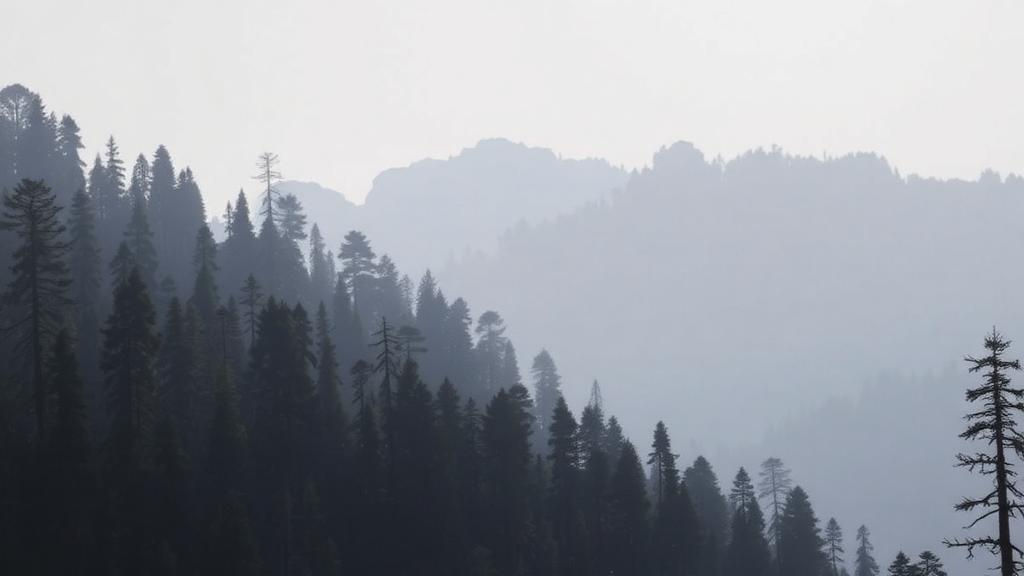
High in the Bhagirathi river catchment of the Garhwal Himalaya, where steep gorges give way to forests of fir, oak and deodar, the future of an entire temperate ecosystem is being decided in the understorey. A new field study of twenty-four forest stands between 1500 and 3000 metres above sea level has documented, in unprecedented detail, how human disturbance reshapes the structure and regeneration of these ecologically vital forests. The findings, published in Discover Forests, paint a picture of woodlands that still appear intact from the canopy down, but are quietly failing to replace themselves from the forest floor up.
The research team, led by Om Prakash Tiwari of the Department of Botany at HNB Garhwal University, together with Chandra Mohan Sharma and Yashwant Singh Rana, set out to test a deceptively simple hypothesis: that the regeneration ability, composition and structure of Himalayan temperate forests change as disturbance intensity increases. After a reconnaissance survey, the researchers selected twenty-four forest stands spanning the full temperate elevational band of the catchment, each characterised by a different degree of human pressure. The Bhagirathi Catchment Area, located in the Uttarkashi and Tehri districts of Uttarakhand, is a rugged landscape of high peaks and narrow valleys where commercial timber extraction, livestock grazing, fuelwood collection, agriculture, road building, tourism and hydropower development have intensified since the colonial period.
To quantify disturbance, the team went well beyond visual impressions. They measured canopy cover directly with a spherical densiometer, recorded the presence and frequency of lopping, grazing, litter removal, fires, stem cutting, hutments, scraping and resin tapping, and counted cut stumps in every sampling unit. From these data they derived disturbance indices based on stump density and total basal cover, and classified each stand as highly disturbed, moderately disturbed or least disturbed. Highly disturbed forests showed open canopies below 40 percent cover and heavy human activity; least disturbed stands retained almost closed canopies above 75 percent. Light attenuation within each forest was measured with a digital lux meter, allowing the researchers to link the physical light environment directly to the fate of young trees.
The sampling design was exhaustive. Ten 10 by 10 metre plots were laid out in each of the twenty-four stands, giving 240 plots in total, in which all trees greater than or equal to 10 centimetres in diameter at breast height were measured. Nested 5 by 5 metre quadrats captured saplings, and 2 by 2 metre quadrats placed along regeneration survey lines counted seedlings. This three-tiered approach, tracking the full life cycle from seedling to adult tree, is what makes the study a genuine diagnostic of forest health rather than a simple inventory of what currently stands.
The results were stark. Tree species richness ranged from just 2 species in a highly disturbed pure chir pine forest to 20 species in a least disturbed mixed broad-leaved forest, with richness values generally declining as disturbance intensified. Tree density spanned 411 to 840 trees per hectare, sapling density ranged from 587 to 3655 saplings per hectare, and seedling density from 944 to 6572 seedlings per hectare. Crucially, the highest sapling and seedling densities were recorded in moderately disturbed stands rather than intact ones, a pattern the authors attribute to moderate canopy gaps that increase solar influx and ground temperature while reducing humidity, creating favourable conditions for seedling establishment. Under heavy disturbance, however, seed sources collapse, and the entire regeneration pipeline fails.
Of the 41 species recorded across all life stages, only about 34 percent showed good regeneration, defined as seedlings outnumbering saplings outnumbering adults. More alarmingly, 22.6 percent of species showed no regeneration at all, surviving only as adult trees with seedlings and saplings completely absent. Species failing to regenerate included Acer caesium, Aesculus indica, Cedrus deodara in certain stands, Juglans regia, Taxus wallichiana and Ulmus wallichiana, among others. Such discontinuous population structures, the study warns, signal regeneration failure and raise serious concerns about long-term persistence, since populations without young individuals inevitably age out of the landscape.
The species-level stories are particularly revealing. The Himalayan fir, Abies pindrow, regenerated fairly well at higher altitudes but produced no seedlings at all in a highly disturbed Quercus semecarpifolia stand, where human interference was intense. The high-altitude birch Betula utilis showed poor regeneration overall and appeared only as saplings in some stands, marking it as a species requiring continuous monitoring. Perhaps most striking was the case of the Himalayan yew, Taxus wallichiana, whose regeneration was poor across most stands, apparently because its tiny population produces too little seed and because illegal lopping for pharmaceutical purposes continues unabated. Earlier research cited in the study notes that ruthless harvesting of twigs, bark peeling and whole-tree felling place this species at high risk of extinction, even though yew seedlings need only 2 to 3 percent of incident light to grow and can persist for very long periods under unfavourable conditions.
Statistical analysis confirmed that these patterns were not random. Sapling density correlated positively with adult tree density, seedling density correlated positively with sapling density, and total regeneration potential tracked seedling and sapling densities closely. Regression models showed that canopy cover significantly explained variation in seedling density, sapling density and total regeneration across all stands, while the density of cut stumps significantly depressed seedling and sapling numbers, and tree lopping significantly reduced total regeneration. The average diameter of trees in these forests was 31.38 centimetres, with most stands in a demographic transition phase dominated by smaller diameter classes, and old-growth trees either dead or displaced from the upper canopy by past disturbance and habitat fragmentation.
Population structure analysis added a further layer of insight. Many dominant species, including Abies pindrow, Quercus semecarpifolia and Rhododendron arboreum in several stands, displayed the inverse-J shaped diameter distributions that signal stable, self-replacing populations. Others showed sporadic or unimodal structures, with gaps in intermediate size classes or peaks that indicate hampered seedling establishment and intense competition. Logarithmic density-diameter curves ranged from near-linear to reverse-J and sigmoid shapes, with depressions in the mid-diameter range of many stands pointing to disturbance-driven mortality at those sizes. Notably, several species, including Abies spectabilis, Betula utilis and Lyonia ovalifolia, were recorded as new recruits outside their conventional altitudinal ranges, suggesting that some dominant species may be shifting uphill toward alpine meadows under changing climatic conditions.
The authors argue that the findings carry an urgent management message. Forests near human settlements at lower altitudes experienced the heaviest pressure, partly because peak seed production in many trees coincides with the period of intensive forest resource collection, and seasonal migration of communities to upper reaches compounds the problem, with fir planks and oak logs harvested for temporary wooden hutments. The study concludes that species showing poor or no regeneration require immediate conservation intervention and assisted regeneration, including enrichment planting with native, site-appropriate species, to arrest population decline. Cut-stump density and canopy cover emerged as the most decisive factors governing tree regeneration in the catchment, offering managers concrete, measurable levers. As the Himalaya warms and human pressure mounts, this survey provides both a warning and a baseline: the temperate forests of the Bhagirathi catchment can still sustain themselves, but only where the disturbance clock is slowed and the next generation of trees is given a fighting chance to grow.
Subject of Research: Regeneration and structure of temperate Himalayan forests along altitudinal and human disturbance gradients
Article Title: Forest structure and regeneration responses to altitudinal and disturbance gradients in the temperate Garhwal Himalaya
Article References: Tiwari, O. P., Sharma, C. M., & Rana, Y. S. (2026). Forest structure and regeneration responses to altitudinal and disturbance gradients in the temperate Garhwal Himalaya. Discover Forests, 2(1), Article 71. https://doi.org/10.1007/s44415-026-00135-3
Image Credits: AI Generated
DOI: 10.1007/s44415-026-00135-3
Keywords: Himalaya, forest regeneration, anthropogenic disturbance, temperate forests, canopy cover, seedlings, saplings, Abies pindrow, Quercus, Taxus wallichiana, biodiversity conservation, Garhwal
Cite Scienmag News
Margaret Porter. (September 30, 2026). Human Pressure Is Silently Rewiring Himalayan Forests, Landmark Survey Reveals. Scienmag. https://scienmag.com/human-pressure-is-silently-rewiring-himalayan-forests-landmark-survey-reveals/
Margaret Porter. "Human Pressure Is Silently Rewiring Himalayan Forests, Landmark Survey Reveals." Scienmag, 30 September 2026, https://scienmag.com/human-pressure-is-silently-rewiring-himalayan-forests-landmark-survey-reveals/. Accessed 30 September 2026.
Margaret Porter. "Human Pressure Is Silently Rewiring Himalayan Forests, Landmark Survey Reveals." Scienmag. September 30, 2026. https://scienmag.com/human-pressure-is-silently-rewiring-himalayan-forests-landmark-survey-reveals/


