


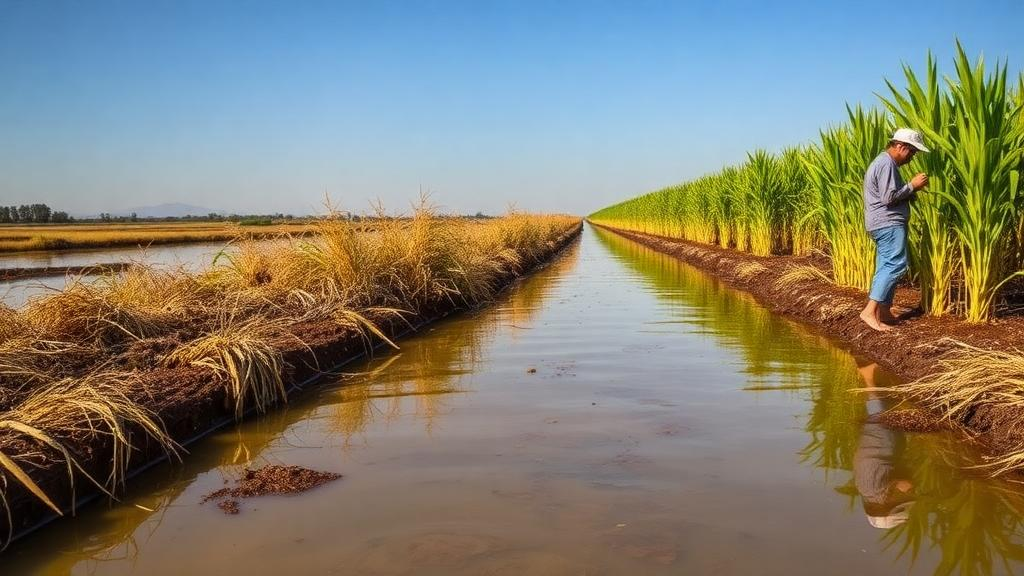
Along the Tarnab canal in Peshawar, Pakistan, the water that nourishes thousands of hectares of maize carries an invisible passenger. A new study of three irrigated farming sites has found that cadmium concentrations in the irrigation water consistently exceed the World Health Organization’s guideline of 0.01 micrograms per milliliter, with measured values ranging from 0.02 to 0.05 micrograms per milliliter across every location and sampling date. The finding, published in Discover Agriculture, offers one of the first integrated pictures of how cadmium, chromium, and lead move through the water-soil-plant system in this intensively farmed corner of Khyber Pakhtunkhwa, and it reveals a subtle but consequential asymmetry: the grain that people eat remains largely clean, while the leaves, shoots, and roots that livestock consume do not.
The research team, led by Muhammad Faraz Khan of The University of Agriculture Peshawar together with colleagues from Pakistan, China, and Syria, selected three villages that all draw their irrigation water from the Tarnab canal, which in turn is fed by the Bara River. Mera Kachori, Tarnab Farm, and Haider Khan Garhi sit in a semi-arid landscape where maize dominates the cropping calendar. The canal’s catchment receives industrial effluent from upstream marble processing units, agricultural runoff from heavily cultivated land, and urban wastewater discharged from Peshawar city. Years of phosphate fertilizer application may add further metal loading, since phosphate rocks naturally carry cadmium impurities. Over a single growing season, the researchers collected 27 soil samples, 54 water samples taken twice daily, and 108 maize plant samples segmented into leaves, shoots, roots, and grains.
The analytical work, performed at the Directorate of Soil and Plant Nutrition at the Agriculture Research Institute Tarnab, relied on atomic absorption spectrophotometry with a rigorous quality control protocol. Calibration curves for all three metals achieved correlation coefficients of at least 0.999, and certified reference materials spanning plant tissue, calcareous loam soil, and trace elements in water produced recoveries between 91 and 99 percent, well within the accepted range. Method detection limits were as low as 0.001 micrograms per milliliter for cadmium. Every sample was analyzed in triplicate, and procedural blanks stayed below detection limits, giving the dataset a level of analytical confidence that many field surveys lack.
Before the metals told their story, the baseline chemistry of the sites set the stage. The soils were slightly to moderately alkaline, with pH values between 7.75 and 8.15, and electrical conductivity far below the salinity hazard threshold of 4 decisiemens per meter. Mera Kachori and Tarnab Farm were classified as silty clay loam, while Haider Khan Garhi was silt loam. Irrigation water was neutral to slightly alkaline with low conductivity. These conditions matter because soil chemistry governs metal behavior: alkaline soils tend to immobilize metals such as lead, zinc, and nickel through precipitation and adsorption, whereas acidic conditions increase their mobility. The alkaline buffering of these Peshawar soils is, for now, a quiet ally against contamination.
Indeed, the soil results were reassuring. Cadmium ranged only from 0.04 to 0.08 micrograms per gram, chromium from 0.01 to 0.04, and lead peaked at 1.46 micrograms per gram at Tarnab Farm, all far below the FAO/WHO thresholds of 3, 50, and 100 micrograms per gram respectively. Yet the water told a different story. Cadmium exceeded the WHO limit at every site and on every sampling occasion, peaking at 0.05 micrograms per milliliter in a morning sample at Mera Kachori. Chromium and lead in the water stayed within safe limits, though lead showed pronounced temporal and spatial variability, reaching 0.09 micrograms per milliliter at Tarnab Farm and Haider Khan Garhi, hinting at localized sources feeding the canal.
The most striking pattern emerged inside the maize plants themselves. Cadmium accumulated in vegetative tissues to levels that occasionally breached safety guidelines: leaves at Mera Kachori reached 0.23 micrograms per gram in the second week, more than double the FAO/WHO limit of 0.10, and roots at Tarnab Farm climbed to 0.17 micrograms per gram. Lead was even more conspicuous, with roots at Mera Kachori accumulating 0.45 to 0.68 micrograms per gram, well above the 0.2 microgram per gram limit, and leaves and shoots at several sites also exceeding the threshold. Chromium, by contrast, never approached its 1.3 microgram per gram limit in any tissue. Crucially, grain samples remained consistently safe for all three metals, with cadmium between 0.02 and 0.07 micrograms per gram and lead mostly below 0.14, indicating that the plant’s internal transport controls largely keep these metals out of the edible seed.
That partitioning between vegetative tissue and grain is where the study’s implications sharpen. In the Peshawar valley, maize stover and fodder are the primary feed resources for buffalo, cows, and goats. Leaves carrying 0.23 micrograms per gram of cadmium and lead concentrations above 0.2 micrograms per gram mean that the metal bypasses the dinner plate and enters the food chain through a side door: the animal. Chronic exposure to cadmium and lead in livestock can produce subclinical toxicity, including reduced weight gain, reproductive dysfunction, and kidney damage, and these metals bioaccumulate in liver and kidney tissue before reaching human consumers through meat and milk. Because feed safety regulations in developing countries are typically less stringent and less monitored than those for human food, this pathway represents what the authors describe as a hidden but present danger.
The study also sounds a cautionary note about time. Even though today’s soil concentrations sit comfortably below guideline values, repeated irrigation with cadmium-laden water constitutes a chronic loading pathway. Lead, though currently within limits in the water, binds strongly to clay particles and organic matter, so each irrigation season deposits a small additional reservoir that roots can later tap, which may explain why lead levels in roots and shoots exceeded limits even when the source water did not. Cadmium, two to twenty times more toxic than many other metals and possessing no known biological function, is highly soluble and readily absorbed by plant roots, and its bioavailability is governed by soil pH and redox conditions. Long-term accumulation could degrade soil microbial activity, disrupt nutrient cycling, and slowly erode the productivity of the entire soil-plant system.
The authors recommend continuous monitoring of irrigation water quality and improved irrigation management, alongside further research into bioconcentration factors and the transfer of metals into animal products from farms across the Peshawar valley. Practical mitigation options exist at several points in the chain. Soil amendments such as biochar and compost have been shown to reduce the bioavailability of cadmium and lead and improve maize growth, while phytoremediation with deep-rooted plants and plant growth promoting rhizobacteria offer environmentally friendly routes to detoxify contaminated ground. Fodder management, including blending contaminated stover with cleaner feed or treating biomass through ensiling, can lower metal bioavailability for livestock. Conventional water treatment methods such as activated carbon adsorption or chemical precipitation, however, remain impractical at the volumes agriculture demands, which places the emphasis squarely on preventing contamination at its source. For now, the message from Peshawar is nuanced: the maize grain on the table is safe, but the system that produced it is quietly accumulating a burden that will demand attention long before it becomes visible.
Subject of Research: Heavy metal contamination of irrigation water, soil, and maize crops in Peshawar, Pakistan
Article Title: Assessment of heavy metal contamination in irrigation water and its impact on maize crops: a case study of Peshawar, Pakistan
Article References: Assessment of heavy metal contamination in irrigation water and its impact on maize crops: a case study of Peshawar, Pakistan. (n.d.). https://doi.org/10.1007/s44279-026-00782-2
Image Credits: AI Generated
DOI: 10.1007/s44279-026-00782-2
Keywords: heavy metals, cadmium, lead, chromium, irrigation water, maize, soil contamination, food safety, livestock fodder, Peshawar, Pakistan, water quality
Cite Scienmag News
Alan Morgan. (September 30, 2026). Cadmium in Canal Water Raises Concerns for Peshawar’s Maize Fields. Scienmag. https://scienmag.com/cadmium-in-canal-water-raises-concerns-for-peshawars-maize-fields/
Alan Morgan. "Cadmium in Canal Water Raises Concerns for Peshawar’s Maize Fields." Scienmag, 30 September 2026, https://scienmag.com/cadmium-in-canal-water-raises-concerns-for-peshawars-maize-fields/. Accessed 30 September 2026.
Alan Morgan. "Cadmium in Canal Water Raises Concerns for Peshawar’s Maize Fields." Scienmag. September 30, 2026. https://scienmag.com/cadmium-in-canal-water-raises-concerns-for-peshawars-maize-fields/


