


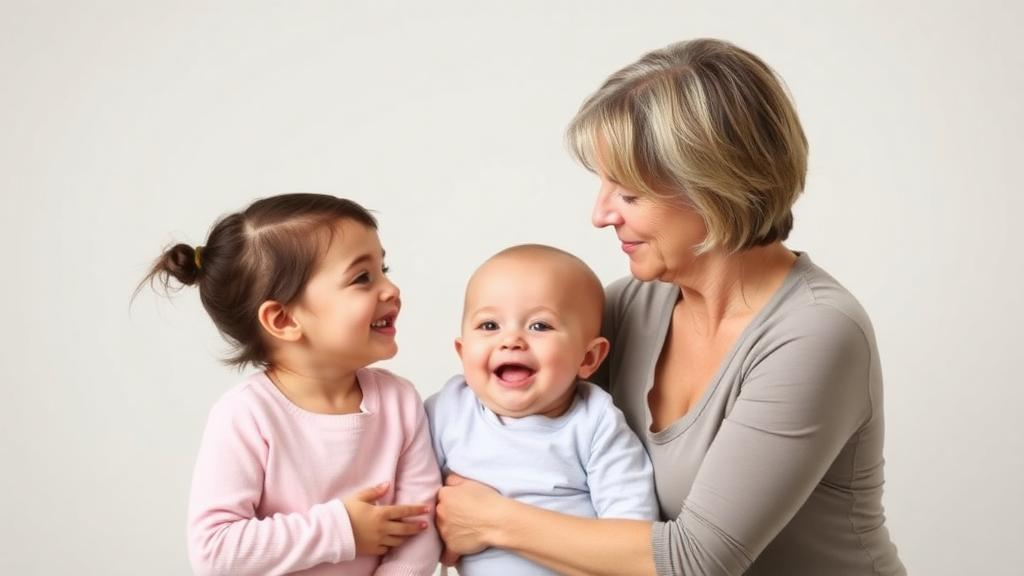
Interacting with young children is often described as a natural mood booster, and a growing industry of intergenerational programs now pairs older adults with children in schools, daycare centers, and community gardens on the promise that both generations benefit. But what actually happens inside the body during these encounters, and does a warm exchange have to happen face to face to register physiologically? A new prospective observational study from Japan set out to answer these questions with an unusually careful design, tracking salivary oxytocin and self-reported well-being in community-dwelling older women before, during, and after direct and remote intergenerational exchanges with children. The results, published in BMC Geriatrics, are a sobering lesson in how easily the apparent benefits of social contact can be confounded by the simple experience of taking part in a study.
The research team, led by Shujiro Sakata and Hisashi Masuyama of Okayama University Graduate School of Medicine together with colleagues from hospitals and research centers across western Japan, recruited forty-six community-dwelling older women and analyzed data from forty of them. Eighteen women participated in a direct, face-to-face exchange with children, while twenty-two took part in a remote exchange conducted over a video call. The study was conducted in collaboration with community organizations in Maniwa City and Kibichuo Town, and the exchanges involved the staff and children of two local daycare facilities, Hoshi no Kodomoen and Niko-Niko Futaba Kodomoen. The protocol was approved by the Ethics Committee of Okayama University Hospital and registered retrospectively with the University Hospital Medical Information Network Clinical Trials Registry under identifier UMIN000058936.
The design hinged on a deceptively simple comparison. On a reference day with no exchange, each participant provided saliva samples at 10:00 and again at 11:00, establishing a baseline for how her oxytocin levels naturally drift across the late morning. On the exchange day, saliva was collected at 11:00, immediately in the window of the interaction. The primary outcome was the salivary oxytocin concentration at that exchange-day 11:00 sample relative to the same-clock-time 11:00 sample on the reference day. This same-clock-time contrast matters because oxytocin, like many hormones, fluctuates across the day, and comparing an exchange-day measurement against a morning baseline taken hours earlier could manufacture an effect out of ordinary circadian variation.
Oxytocin itself is a small peptide hormone produced in the hypothalamus, best known for its roles in childbirth, lactation, and social bonding. In recent decades it has become a favorite biomarker in studies of human connection, with salivary measurements offering a non-invasive window into its peripheral levels. Yet the hormone’s dynamics are notoriously noisy, influenced by circadian rhythms, stress, food intake, and the sheer novelty of a laboratory visit. Peripheral salivary oxytocin also may not map cleanly onto central neural oxytocin signaling, which is one reason the field has been peppered with findings that fail to replicate. The Japanese team was clearly aware of these pitfalls and built their analysis accordingly.
So what did they find? In the direct group, salivary oxytocin at the exchange-day 11:00 sample was estimated to be higher than at the same-clock-time reference-day sample, with a geometric mean ratio of 1.220, corresponding to roughly a twenty-two percent relative elevation. But the 95 percent confidence interval stretched from 0.987 to 1.507, crossing the null value of 1, meaning the primary analysis was not statistically significant. In the remote group, the corresponding geometric mean ratio was 1.046, with a confidence interval of 0.851 to 1.284, essentially indistinguishable from no change. When the researchers formally compared the two conditions, the ratio of geometric mean ratios for direct versus remote exchange was 1.166, with a confidence interval of 0.877 to 1.551, providing no evidence of a between-group difference.
The subjective well-being results followed a similar pattern of tantalizing but ambiguous signals. Participants rated their well-being using the Personal Wellbeing Index, a validated multi-item measure of life satisfaction, and a simpler numerical rating scale, with assessments spanning multiple time points from before to after the exchange. Linear mixed-effects models, which handle repeated measurements within individuals while accommodating missing data under a missing-at-random assumption, showed positive changes from immediately before to immediately after the exchange. But here was the catch: changes in the same direction were also observed on the reference day, when no children were involved at all. Neither the Personal Wellbeing Index nor the numerical rating scale showed a significant group-by-time interaction.
This last finding is arguably the most scientifically valuable part of the paper. The researchers explicitly attribute the reference-day improvements to non-specific study-context effects, the general lift that comes from being observed, visited, and engaged by a research team, regardless of the experimental manipulation. In behavioral research this is a cousin of the placebo effect and the Hawthorne effect, and it is chronically undercontrolled in studies of psychosocial interventions. A program evaluation that measures well-being only before and after an intergenerational session, without a same-clock-time reference day, could easily mistake this contextual glow for a genuine effect of the exchange itself. The Japanese team’s design, by contrast, allows that possibility to be seen and quantified.
The study does have limitations that temper interpretation. It was observational rather than randomized, so participants self-selected into the direct or remote conditions, and the sample of forty analyzed women is small, which is reflected in the wide confidence intervals. The confidence interval for the direct-group oxytocin change, while including the null, does not rule out a moderate effect, and a larger trial might detect a difference that this study could only gesture toward. The authors also performed sensitivity analyses to probe the robustness of their findings, and the core conclusions held. Still, with a single exchange session per participant and a single primary biomarker, the study is best read as a rigorous proof of concept and a methodological caution rather than a definitive verdict on intergenerational contact.
That caution lands at a moment when remote communication has become woven into the lives of older adults, particularly after the pandemic years normalized video calls as a substitute for in-person visits. If remote exchange produced physiological and psychological changes equivalent to face-to-face contact, the implications for scalable loneliness interventions would be enormous, since video calls cost a fraction of in-person programs. The present data cannot confirm equivalence, but they also found no evidence that the remote condition was inferior, with both groups showing similarly modest, non-significant oxytocin changes and similar non-specific well-being lifts. For program designers, the practical message is that the biological case for choosing one delivery mode over the other remains unproven.
What the study ultimately delivers is a template for how this field should move forward. Future trials of intergenerational programs, whether delivered in person or through a screen, would do well to adopt same-clock-time reference-day measurements, adequate sample sizes, and pre-registered primary outcomes, and to treat study-context effects as a real signal to be modeled rather than noise to be ignored. The romance of the idea, that time spent with children can measurably nourish the bodies and minds of older adults, remains alive; the Japanese data neither confirm nor kill it. But they make clear that demonstrating it will require more careful designs than the field has typically mustered, and that the simple act of being studied can look a lot like the benefit we are trying to measure.
Subject of Research: Salivary oxytocin and subjective well-being changes in older women during direct and remote intergenerational exchange with children
Article Title: Changes in salivary oxytocin and subjective well-being in older women participating in direct or remote intergenerational exchange with children: a prospective observational study
Article References: Sakata, S., Mitoma, T., Maki, J., Oishi, K., Ooba, H., Sakurai, J., Maeda, Y., & Masuyama, H. (2026). Changes in salivary oxytocin and subjective well-being in older women participating in direct or remote intergenerational exchange with children: a prospective observational study. BMC Geriatrics. https://doi.org/10.1186/s12877-026-08353-2
Image Credits: AI Generated
DOI: 10.1186/s12877-026-08353-2
Keywords: oxytocin, intergenerational exchange, older women, subjective well-being, saliva biomarkers, remote communication, loneliness, aging, prospective observational study, social bonding, BMC Geriatrics, Japan
Cite Scienmag News
Glenn Wilkins. (September 30, 2026). The Oxytocin Test: Does Time With Children Really Lift Older Women’s Biology? Scienmag. https://scienmag.com/the-oxytocin-test-does-time-with-children-really-lift-older-womens-biology/
Glenn Wilkins. "The Oxytocin Test: Does Time With Children Really Lift Older Women’s Biology?" Scienmag, 30 September 2026, https://scienmag.com/the-oxytocin-test-does-time-with-children-really-lift-older-womens-biology/. Accessed 30 September 2026.
Glenn Wilkins. "The Oxytocin Test: Does Time With Children Really Lift Older Women’s Biology?" Scienmag. September 30, 2026. https://scienmag.com/the-oxytocin-test-does-time-with-children-really-lift-older-womens-biology/


