


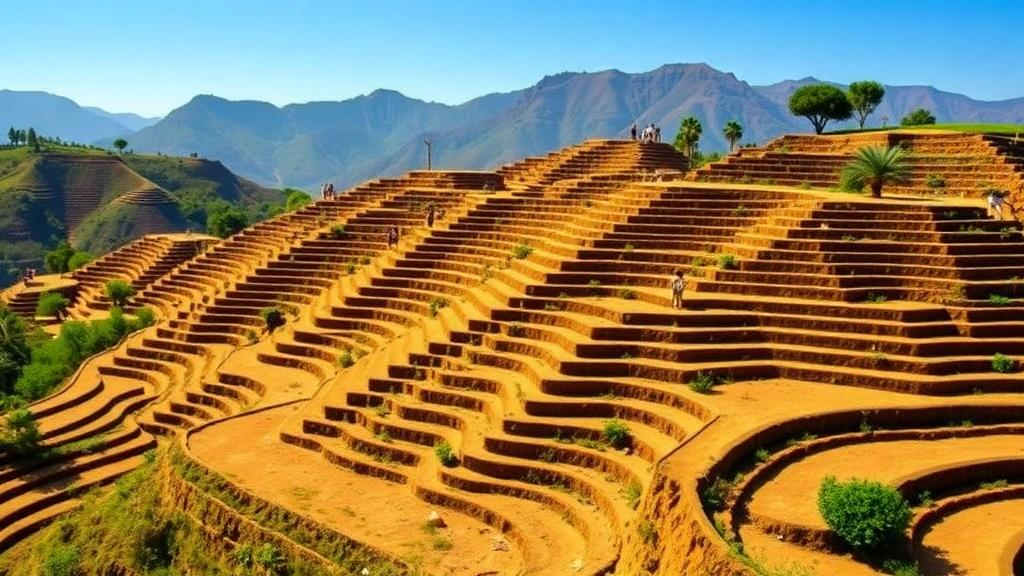
On the eroded hillsides of Tigray in northern Ethiopia, decades of terracing, trenching, and tree planting are quietly rewriting the story of one of the world’s most degraded landscapes. A new study published in BMC Environmental Science provides some of the most detailed quantitative evidence yet that integrated soil and water conservation measures can measurably restore the physical and chemical health of hillside soils, with direct implications for climate resilience across semi-arid highlands. The findings come at a moment when dryland restoration is moving from ideology to engineering, and when governments and donors urgently need numbers rather than promises.
The research, led by Zufan Desta of Adigrat University and Mekelle University together with Emiru Birhane, Mitiku Haile, and Dawit Gebregziabher, focused on the Mechahile subwatershed in the Atsbi-Wenberta district, a highland zone sitting between 2,300 and 3,200 meters above sea level. The region receives roughly 635 millimeters of rain annually, almost all of it concentrated between June and September, under a mean annual temperature of about 14.7 degrees Celsius. Dominant soils include Leptosols, Regosols, Cambisols, and Fluvisols, thin and fragile profiles that erode rapidly under intense seasonal rainfall and long histories of cultivation and grazing. Between 2011 and 2020, teams implemented a suite of physical structures, including deep trenches, trench bunds, half-moons, micro basins, and stone-faced soil bunds, alongside biological interventions such as exclosures and plantations of native and adapted species including Juniperus procera, Olea europaea subsp. cuspidata, and Eucalyptus globulus.
The experimental design is what sets this study apart from much of the existing conservation literature. Rather than simply comparing a treated site with a distant control, the researchers built a factorial randomized complete block design across the hillside. They stratified the landscape into upper, middle, and lower slope positions, sampled two soil depths of 0 to 30 and 30 to 60 centimeters, and placed sampling plots at two distance intervals from conservation structures, 0 to 4 meters and 4 to 8 meters. In total, 96 composite soil samples were collected from 40 by 40 meter plots, supplemented by undisturbed core samples for bulk density determination. Treated plots and adjacent untreated, open-access grazing land were matched for aspect, soil type, topography, land use history, and agroecological conditions, so that observed differences could be attributed primarily to the conservation measures themselves.
The physical results are striking. Bulk density, a measure of soil compaction, dropped by up to 6 percent in conserved plots, with the lowest value of 1.56 grams per cubic centimeter recorded on treated lower slopes, compared with the highest value of 1.66 grams per cubic centimeter in untreated upper-slope soils exposed to erosion and trampling by livestock. Lower bulk density means more pore space, better root penetration, and faster water infiltration, all of which are prerequisites for vegetation recovery on degraded land. Water-stable aggregates, the soil crumbs that resist breakdown by raindrops and running water, increased by 28 percent in treated plots, reaching 64.03 percent in the topsoil of conserved lower slopes against 50.16 percent in untreated areas. Stable aggregates are the architecture of a functioning soil; without them, seasonal rains strip away fine particles and the organic matter bound to them.
Perhaps the most consequential finding concerns water. Soil moisture content was 67 percent higher in treated lower-slope plots at the 30 to 60 centimeter depth, reaching 7.99 percent, than in untreated upper-slope surface soils, which averaged just 4.77 percent. In a semi-arid system with a single annual rainy season, that difference is the difference between seedlings surviving the dry season and dying. The researchers attribute the moisture gains to a combination of reduced runoff behind physical barriers, improved infiltration through less compacted soil, and the water-holding capacity conferred by accumulating organic matter. Notably, moisture peaked in the deeper layer while aggregate stability peaked in the surface layer, a depth-dependent pattern that reflects reduced evaporation and finer subsoil textures below ground and concentrated litter inputs above.
The chemical story mirrors the physical one. Soil organic matter, total nitrogen, available phosphorus, and pH were all significantly higher in treated plots, particularly at lower slope positions and in the topsoil. The pattern follows the logic of erosion and deposition: upper slopes lose fine particles and nutrients, while lower slopes act as depositional zones where sediment, organic residues, and base cations accumulate. Treated plots also showed higher pH, likely because organic matter improves the retention of calcium and magnesium ions and reduces leaching, which buffers acidity and supports nutrient uptake and microbial activity. The interaction effects among management, slope position, and soil depth were statistically significant for moisture, aggregates, and all chemical indicators, confirming that conservation effectiveness is not uniform across a landscape but depends critically on where interventions are placed.
Distance from the structures themselves emerged as a decisive variable. Every measured property, from moisture and aggregate stability to organic matter and phosphorus, was highest within 0 to 4 meters of a bund or trench and declined measurably by 4 to 8 meters. Bulk density was slightly lower near the barriers. This spatial gradient demonstrates that conservation structures work locally, slowing runoff, trapping sediment, and creating fertility hotspots. The practical implication is that bund spacing matters: structures placed too far apart leave wide bands of hillside effectively untreated, a finding consistent with earlier work showing that tighter bund spacing improved soil water content in the Lake Tana basin.
Correlation analysis placed soil organic matter at the center of the entire restoration process. Organic matter correlated positively with available phosphorus, with a Pearson coefficient of 0.648, as well as with total nitrogen, water-stable aggregates, moisture content, and pH, and negatively with bulk density, with a coefficient of minus 0.729. In other words, as organic matter accumulates under exclosures and plantations, it simultaneously feeds nutrient cycling, binds soil particles into stable aggregates, holds water, and loosens compacted profiles. Texture also shifted along the degradation gradient, with untreated plots trending toward coarser, sandier compositions that lose nutrients and moisture more readily, while conserved plots retained more silt and clay, the particle fractions with the greatest surface area and cation exchange capacity.
The study is honest about its limits. Phosphorus remained very low across all plots, even in treated areas, indicating that conservation structures alone cannot correct every fertility deficit and that phosphorus-specific amendments may be needed. The observation window is short, the sampling confined to selected subwatersheds, and biological and hydrological indicators and socio-economic drivers of adoption were not assessed. Long-term monitoring across multiple agroecological zones, the authors argue, is essential to confirm that these gains persist and scale.
Even with those caveats, the message for policymakers is unusually actionable. Ethiopia has invested in soil and water conservation at national scale since the aftermath of the 1973-74 famine, through the integrated watershed programs of the 1980s and 1990s, the national exclosure program, the Productive Safety Net Programme from 2005, and the Sustainable Land Management Programme from 2008. This study provides the quantitative justification for that investment and, more importantly, a design principle for the next phase: targeted placement beats blanket coverage. Conservation structures deliver the greatest returns on lower slopes, in topsoil layers, and close to the structures themselves, which is precisely where erosion and deposition dynamics can be harnessed rather than fought. In a warming climate where rainfall in the Horn of Africa is becoming more erratic, rebuilding the sponge of degraded hillsides is not sentimental conservation. It is infrastructure, and the hills of Tigray are showing exactly how to build it.
Subject of Research: Effects of integrated soil and water conservation measures on physicochemical soil properties in degraded highlands of northern Ethiopia
Article Title: Effect of biophysical soil and water conservation measures on physicochemical soil properties and their implications for climate resilience in degraded hillside landscapes of Tigray, Ethiopia
Article References: Desta, Z., Birhane, E., Haile, M., & Gebregziabher, D. (2025). Effect of biophysical soil and water conservation measures on physicochemical soil properties and their implications for climate resilience in degraded hillside landscapes of Tigray, Ethiopia. BMC Environmental Science, 2(1), Article 24. https://doi.org/10.1186/s44329-025-00037-3
Image Credits: AI Generated
DOI: 10.1186/s44329-025-00037-3
Keywords: soil and water conservation, soil erosion, Tigray, Ethiopia, climate resilience, bulk density, soil moisture, water-stable aggregates, soil organic matter, exclosures, hillside restoration, drylands
Cite Scienmag News
Margaret Porter. (September 30, 2026). Terraces That Heal: Conservation Structures Rebuild Soil and Water in Ethiopia’s Highlands. Scienmag. https://scienmag.com/terraces-that-heal-conservation-structures-rebuild-soil-and-water-in-ethiopias-highlands/
Margaret Porter. "Terraces That Heal: Conservation Structures Rebuild Soil and Water in Ethiopia’s Highlands." Scienmag, 30 September 2026, https://scienmag.com/terraces-that-heal-conservation-structures-rebuild-soil-and-water-in-ethiopias-highlands/. Accessed 30 September 2026.
Margaret Porter. "Terraces That Heal: Conservation Structures Rebuild Soil and Water in Ethiopia’s Highlands." Scienmag. September 30, 2026. https://scienmag.com/terraces-that-heal-conservation-structures-rebuild-soil-and-water-in-ethiopias-highlands/


