


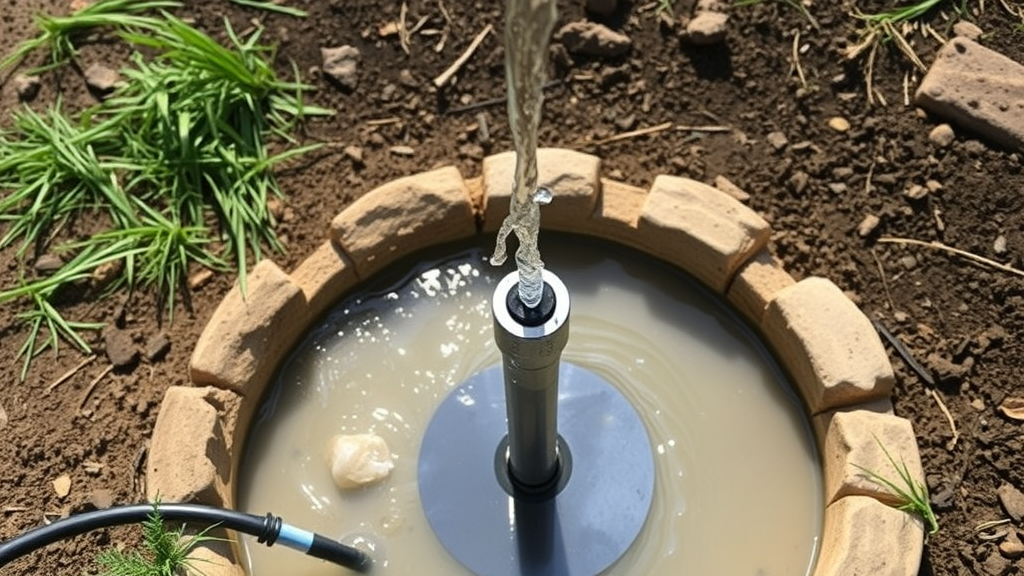
Beneath a plum garden on the campus of Hunan University of Science and Technology in Xiangtan, China, lies a water well that has quietly shaped decades of geophysical debate. Drilled in 1988 by geology students and faculty, the well plunges 180.9 meters into Cretaceous siltstone and conglomerate, yielding more than 60 tonnes of groundwater per hour from sand-filled karst cavities. Now, that same well has become the proving ground for a method that has divided geophysicists for nearly fifty years: the telluric field frequency selection method, or TFFSM. A new open-access study published in Discover Geoscience puts the technique head-to-head with the audio-magnetotelluric method, or AMT, in one of the most electromagnetically hostile environments imaginable—a busy university campus threaded with power lines, traffic, and electrical infrastructure.
The TFFSM is an unusual instrument in the geophysical toolbox. Developed in China, it borrows the observational philosophy of magnetotellurics, the grand old method that reads natural electromagnetic fields to peer into the Earth, but with a crucial twist. Rather than recording raw time-domain signals and extracting frequencies later through spectral analysis, TFFSM devices use hardware-based frequency selection: they lock onto predefined frequencies in advance, targeting specific subsurface depths while suppressing noise at the circuit level. The approach requires minimal post-processing, and its instruments are light enough for a single operator to carry. One commercially produced frequency selector has been deployed in more than 180 countries, yet many academic geophysicists have remained skeptical, largely because rigorous theoretical work on the method has been scarce.
The heart of the controversy lies in what actually causes the anomalies that TFFSM detects. The new study, led by Tianchun Yang of Hunan University of Science and Technology together with colleagues in China and Italy, set out to answer that question with an unusually well-constrained experiment. Because the water well’s geology is known in exquisite detail from drilling logs—25 meters of Quaternary clay overlying siltstone, glutenite, and conglomerate, with a static water level at 27 meters and two major water-bearing karst cavities at depths of roughly 40 and 56 to 77 meters—any anomaly the instruments recorded could be checked against ground truth. The survey line itself was constrained to less than 30 meters by hardened pavement, forcing the team to work in tight quarters beside the well, which intersects a small southwest-trending secondary fault.
The physics behind the method’s signal is subtle and elegant. In a layered Earth, natural electromagnetic fields induce currents that flow preferentially in horizontal planes. When a near-surface body with different electrical conductivity is present—say, a water-saturated cavity—it accumulates electric charge at its boundaries, distorting the horizontal electric field measured at the surface. Using Gauss’s law and the quasi-static approximation, the researchers show that this secondary electric field is proportional to, and in phase with, the primary field. The result is a frequency-independent multiplicative shift in the measured electric field, a phenomenon known in magnetotellurics as the static effect. Conventionally, static shift is treated as a nuisance that corrupts deep-crustal soundings and must be corrected away. TFFSM, in a stroke of methodological audacity, deliberately embraces it: the static offset becomes the signal, and its spatial pattern maps shallow electrical heterogeneities such as groundwater.
The experimental design was methodical. First, a rapid triple-frequency survey at 25, 67, and 170 hertz—frequencies chosen because they coincide with Schumann resonances and lightning-driven magnetotelluric fluctuations while avoiding odd multiples of the 50-hertz power-line frequency—scanned the line in about three seconds per station. The team then deployed three commercial frequency selectors, the PQWT-TC150, TC300, and TC1200, with maximum detection depths of roughly 150, 300, and 1200 meters. These were run in two configurations: each instrument using its own electrode pair, and all three sharing a single pair. Finally, electrode spacing was varied from 10 meters down to 6 and then 2 meters, and AMT measurements were taken at two stations using a Chinese Academy of Sciences SEP system.
The results were strikingly consistent. All three instruments, in both electrode configurations, recorded a pronounced low-potential-difference anomaly at the 8-to-9-meter mark of the survey line—directly above the known water-bearing structure. The pseudo-sections built from the multi-frequency data displayed the characteristic noodle-like vertical streak that is the fingerprint of static shift, confirming that groundwater produces exactly this signature in TFFSM data. Notably, whether the instruments shared electrodes or used separate ones made essentially no difference to the results, underscoring the method’s famously relaxed grounding requirements. The static effect was strongest in the TC150, whose higher minimum frequency of about 100 hertz keeps its signal clean, while the deeper-sounding TC1200, sampling down to 8 hertz, showed a weaker expression because low-frequency signals are inherently feeble and more vulnerable to cultural noise.
The electrode-spacing experiments revealed a practical rule that commercial manufacturers may need to heed. As spacing shrank from 10 to 6 to 2 meters, peak potential differences collapsed from about 30 millivolts to under 10 millivolts, the anomaly narrowed, and at 2 meters the static effect vanished almost entirely. The water-bearing cavities lie deeper than 40 meters, and with electrodes only 2 meters apart, the induced potential difference simply fell below the detectable threshold. Smaller spacing also destabilized the low-frequency data, with curves below roughly 20 hertz becoming erratic. The authors conclude that fixed cable lengths of 10 or 20 meters are a design limitation, and that users should adaptively choose electrode spacing according to the depth of their target—larger spacing for deeper objectives, potentially approaching 1000 meters.
The comparison with AMT was where the study delivered its most dramatic verdict. In the campus environment, the AMT power spectral density curves for both electric and magnetic field components fluctuated wildly and broke down across the frequency band, contaminated by traffic, high-voltage transmission lines, and electrical appliances. The derived apparent resistivity curves were severely corrupted, especially below 10 hertz, and failed to represent the true subsurface. In practice, the authors note, such conditions render AMT unusable for routine exploration. The TFFSM curves at the same stations, by contrast, varied smoothly and gradually—a resilience the team attributes to hardware-level frequency selection and noise suppression, which sidesteps the time-domain acquisition and spectral processing that make conventional AMT so noise-sensitive.
The implications reach beyond groundwater. The authors propose that future AMT instruments could borrow the frequency-selective acquisition strategy, sampling discrete frequencies sequentially so that filters can be pre-configured to suppress ambient noise. More immediately, the study positions TFFSM as a viable tool for urban geological prospecting, where electromagnetic interference, confined spaces, and hardened surfaces defeat most conventional methods. Prior work has already shown the technique can deliver high-quality imaging near high-voltage lines when the survey line runs parallel to them, and its lightweight, portable hardware suits the cramped logistics of city surveys.
For a method once dismissed as theoretically undercooked, the water well experiment offers something rare: a clean, physically grounded explanation of what its anomalies mean. Groundwater does not reflect electromagnetic waves back like radar in any dominant way; instead, it stamps a static, frequency-independent distortion onto the telluric electric field, and that distortion can be read as a map of hidden water. By turning magnetotellurics’ most notorious artifact into a diagnostic tool, and by demonstrating robustness where AMT fails outright, the Xiangtan team has given a five-decade-old technique the theoretical legitimacy it long lacked—and perhaps pointed the way toward a new generation of noise-hardened electromagnetic instruments for the crowded, electrified cities of the future.
Subject of Research: Comparative field testing of the telluric field frequency selection method and audio-magnetotelluric method for groundwater detection near a known water well
Article Title: A comparative experiment of telluric field frequency selection method and audio-magnetotelluric method next a water well
Article References: Yang, T., Yang, Z., Qin, Q., Hussain, Y., Yu, Q., & Zhu, M. (2026). A comparative experiment of telluric field frequency selection method and audio-magnetotelluric method next a water well. Discover Geoscience, 4(1), Article 367. https://doi.org/10.1007/s44288-026-00704-1
Image Credits: AI Generated
DOI: 10.1007/s44288-026-00704-1
Keywords: telluric field frequency selection method, audio-magnetotelluric method, groundwater exploration, static effect, geophysics, electromagnetic methods, water well, electrode spacing, hydrogeology, karst aquifer, urban geophysical prospecting, natural electromagnetic fields
Cite Scienmag News
Violet Maxwell. (September 26, 2026). Water Well Experiment Reveals Why a Controversial Groundwater Method Actually Works. Scienmag. https://scienmag.com/water-well-experiment-reveals-why-a-controversial-groundwater-method-actually-works/
Violet Maxwell. "Water Well Experiment Reveals Why a Controversial Groundwater Method Actually Works." Scienmag, 26 September 2026, https://scienmag.com/water-well-experiment-reveals-why-a-controversial-groundwater-method-actually-works/. Accessed 26 September 2026.
Violet Maxwell. "Water Well Experiment Reveals Why a Controversial Groundwater Method Actually Works." Scienmag. September 26, 2026. https://scienmag.com/water-well-experiment-reveals-why-a-controversial-groundwater-method-actually-works/


