


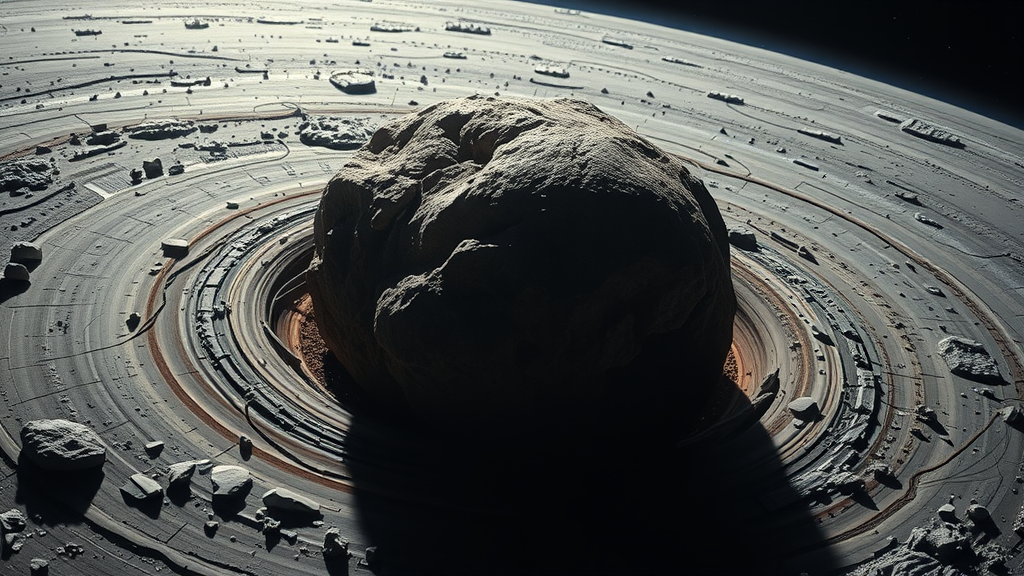
For decades, asteroid Bennu has been one of the most closely watched objects in the Solar System, and now the tiny carbon-rich world has finally revealed where it came from. New laboratory analyses of material delivered to Earth by NASA’s OSIRIS-REx spacecraft point to a surprising origin: rather than forming in the frigid outer reaches of the planetary system, Bennu’s parent body most likely emerged in a narrow transition zone close to the water-ice line, the boundary beyond which water vapour freezes into solid ice. Remarkably, this birthplace sat at a location where the young Jupiter, still in the process of growing, acted as a cosmic gatekeeper, stirring and mixing material from both the inner and outer Solar System. The findings, published in Science Advances by researchers at ETH Zurich, rewrite the story of one of the most primitive objects ever sampled by humankind.
Bennu is an unusually accessible target for science. The asteroid completes one orbit of the Sun every 1.2 years and passes within roughly 300,000 kilometres of Earth every six years, a close approach that made it an ideal destination for a sample-return mission. NASA seized this opportunity with its OSIRIS-REx probe, which in a spectacular operation touched down on the asteroid’s surface and collected material directly from it. In 2023, the sample container descended into the Utah desert carrying around 120 grams of Bennu’s rocky payload, the largest amount of asteroid material ever returned to Earth. From that haul, a small but extraordinarily precious portion made its way to Switzerland, where Maria Schönbächler, Professor of Isotope Geochemistry at ETH Zurich, received half a gram for analysis. Her laboratory began working on the samples immediately, and the completed investigations have now yielded results that reach far beyond Bennu itself, offering new insight into how the entire Solar System took shape.
The key to the discovery lies in isotopes, atoms of the same element that differ slightly in mass because their nuclei contain different numbers of neutrons. The ETH team measured isotopes of three elements: iron, titanium and chromium. Together, these isotopic ratios create a distinctive chemical fingerprint that allows researchers to determine where a body’s raw material originated and, to some extent, how old it is. Because isotopic ratios are inherited from the cloud of dust and gas that formed the Solar System and are altered only by specific nuclear and chemical processes, they act like immutable birth certificates written into the fabric of rocks. For Bennu, that fingerprint turned out to be unlike anything scientists expected.
The measurements revealed that titanium and iron are uniformly distributed throughout the Bennu material, a sign of a remarkably well-mixed source. More striking still, the analyses showed that Bennu has close relatives scattered across the Solar System. The asteroid Ryugu, sampled by Japan’s Hayabusa2 mission, and the so-called CI meteorites, a rare class of primitive, carbon-rich rocky bodies occasionally found on Earth, all share a similar isotopic fingerprint with Bennu. This shared signature indicates that all three bodies formed from the same reservoir of cosmic dust. At the same time, the group differs significantly in isotopic composition from other known asteroids, meteorite groups and the planets, marking Bennu and its siblings out as members of a chemically distinct family with a very specific place of origin.
That place of origin is precisely where the new study overturns long-held assumptions. Until now, scientists had assumed that asteroids such as Bennu formed in the outer regions of the Solar System, possibly in the same environment where comets formed, and that they accreted relatively late in the Solar System’s evolution. The new isotope data contradict both ideas. Instead, the most likely scenario is that the birthplace of Bennu, Ryugu and the CI meteorites lay close to the water-ice line, the boundary marking the point where water vapour freezes. Around 4.5 billion years ago, as the Solar System was still taking shape, this location was a dynamic mixing zone where material from the inner and outer regions met and mingled. The ice present there acted as a kind of glue, binding the finest dust particles together into larger aggregates that would eventually grow into asteroid-sized bodies.
Bennu, in other words, is a hybrid. As Schönbächler explains, the material does not clearly match either the inner or the outer Solar System; it bears characteristics of both regions, having formed in a specific zone where flows of matter from both sides converged. This hybrid character explains several long-standing puzzles about Bennu’s composition, including why its material is so rich in water. In the vicinity of the water-ice line, ice evaporated as temperatures fluctuated, and some of the resulting water vapour condensed again in exactly the region where Bennu’s parent body formed, soaking the accumulating dust with hydrated minerals. The result is an asteroid whose substance carries the chemical memory of a boundary environment that no longer exists in the modern Solar System.
The ETH researchers and their co-authors attribute a central role in this story to Jupiter. The gas giant formed remarkably early, within roughly one million years of the Sun’s birth from a collapsing cloud of dust and gas, driven by gravitational forces within the swirling disc of material that surrounded the young star. Because it grew so rapidly, Jupiter acted as a bridge pillar within that disc: its growing bulk blocked most coarse material from crossing its orbit, while fine dust from various regions of the disc flowed around the giant planet and mixed evenly in the transition zone near the water-ice boundary. The precursors of Bennu, Ryugu and the CI meteorites subsequently accreted in this sheltered region, built almost entirely from finely intermixed dust rather than from the larger pebbles and boulders that Jupiter filtered out.
This scenario elegantly accounts for another of Bennu’s defining traits: the extraordinary chemical similarity of its material to that of the Sun itself. Because Jupiter’s protective influence ensured that Bennu formed mainly from fine dust, and because fine dust orbiting in the disc around the young Sun was thoroughly mixed, the asteroid’s composition mirrors the average Solar System inventory of elements. Schönbächler compares it to fine dust at home, which simply ends up everywhere over time. That makes Bennu an extraordinarily valuable scientific resource. It is a very primordial asteroid, and its material dates back to the birth of the Solar System around 4.5 billion years ago, having hardly changed since. As Schönbächler notes, Bennu may offer our best glimpse of the original mix of chemical elements from which the terrestrial planets were ultimately built.
The implications extend to the deepest questions about our own origins. By performing precise geochemical analyses of Bennu’s samples, researchers are refining our understanding of how the Solar System arose and under what conditions planets formed. Because the asteroid is rich in water and organic material, it also provides important pieces of the puzzle regarding how the young Earth acquired the building blocks of life, the volatile compounds and carbon-based chemistry that may have been delivered to our planet by primitive bodies like Bennu during the chaotic early era of planetary formation.
Many questions remain open. The team is now wondering whether other asteroids share the same isotopic signature as Bennu and Ryugu, and it is still unclear to what extent the young Jupiter contributed to the fact that only fine dust particles clumped together in the transition zone. Further research will help clarify this picture. Meanwhile, Schönbächler is eagerly awaiting the Japanese sample-return mission to Mars’ moon Phobos, due to launch at the end of October this year, and intends to apply to the Japanese space agency JAXA for material to analyse in her laboratory. Patience will be required, however: the capsule containing the Phobos material is not expected to return to Earth until 2031. When it does, it may allow scientists to test whether the strange hybrid fingerprint of Bennu, forged beside a growing Jupiter at the edge of the ice, was shared more widely across the early Solar System than anyone had imagined.
Subject of Research: Isotopic analysis of OSIRIS-REx samples revealing the formation origin of asteroid Bennu near the Solar System's water-ice line
Article Title: Mystery surrounding the formation of asteroid Bennu solved
Article References: Mystery surrounding the formation of asteroid Bennu solved. (n.d.). Original publication
Image Credits: AI Generated
DOI: Not provided
Keywords: asteroid Bennu, OSIRIS-REx, isotope geochemistry, water-ice line, Jupiter, Solar System formation, Ryugu, CI meteorites, ETH Zurich, sample return, Science Advances, planet formation
Cite Scienmag News
Grant Pearson. (September 26, 2026). Asteroid Bennu’s true birthplace revealed near the water-ice line of the young Solar System. Scienmag. https://scienmag.com/asteroid-bennus-true-birthplace-revealed-near-the-water-ice-line-of-the-young-solar-system/
Grant Pearson. "Asteroid Bennu’s true birthplace revealed near the water-ice line of the young Solar System." Scienmag, 26 September 2026, https://scienmag.com/asteroid-bennus-true-birthplace-revealed-near-the-water-ice-line-of-the-young-solar-system/. Accessed 26 September 2026.
Grant Pearson. "Asteroid Bennu’s true birthplace revealed near the water-ice line of the young Solar System." Scienmag. September 26, 2026. https://scienmag.com/asteroid-bennus-true-birthplace-revealed-near-the-water-ice-line-of-the-young-solar-system/


