


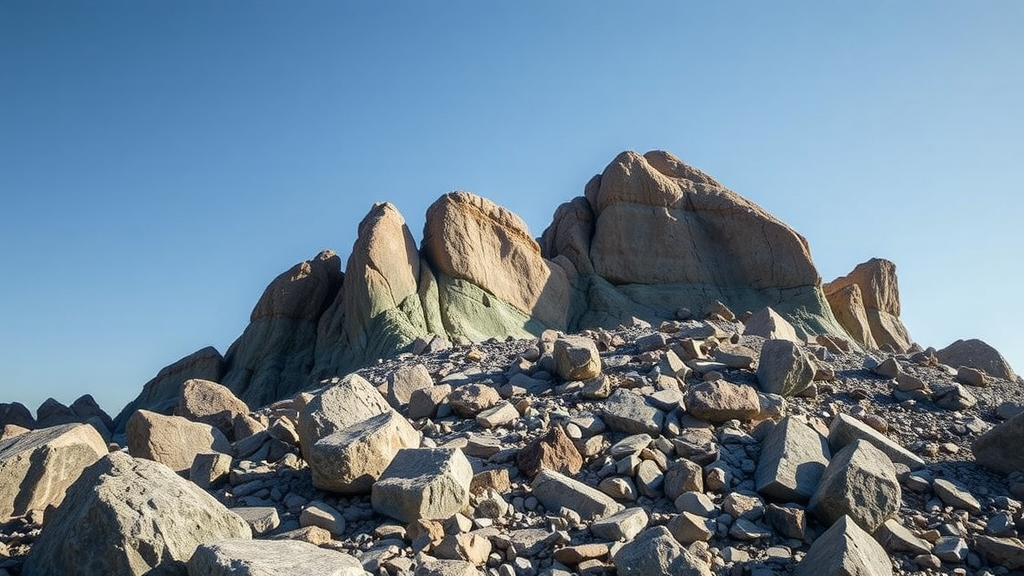
Identifying the type of rock in a photograph, a drill core sample, or a tunnel face image may look like a task for a trained geologist with a hand lens, but it is increasingly a job for artificial intelligence. In a study published in Earth Science Informatics, a research team from Guilin University of Technology in China has introduced a deep learning architecture designed to do precisely that, and to do it with an unusual combination of accuracy and computational economy. The model, named SpecMamba-Net, was developed by Yan Zhang, Fan Zhang, Ruifeng Li, and Zongguo Zhang, and tackles a long-standing bottleneck in the automated classification of lithology: the difficulty of capturing both the fine texture of a rock surface and the large-scale arrangement of its minerals within a single, efficient framework.
Lithology identification is one of those deceptively simple tasks that underpins an enormous range of practical work. Geological exploration, mining, tunneling, drilling operations, and hazard assessment all depend on knowing whether the material at hand is granite, basalt, limestone, or something else entirely. Misclassification can propagate through an entire project, from inaccurate resource estimates to unstable excavation designs. Traditionally, the job has fallen to specialists who read visual cues such as grain size, color, foliation, and crystalline structure. Automating that expertise has proven attractive but technically stubborn, because rocks present image-analysis challenges that generic computer vision systems were never designed to handle.
The dominant tool for image classification over the past decade has been the convolutional neural network, or CNN. Convolutional layers excel at detecting local patterns, such as the edges of individual mineral grains or small repetitive textures, because each filter scans only a small neighborhood of pixels at a time. That locality is a strength for fine detail but a weakness for global structure. To understand how grains are distributed across an entire rock face, or how layered patterns stretch across the whole image, a CNN must stack many layers, each expanding its effective field of view. The result is models that can be large, computationally expensive, and still imperfect at representing long-range spatial relationships, which are exactly the relationships that distinguish many lithological classes.
Transformers, borrowed from natural language processing, offered one way forward by letting every part of an image attend to every other part. But that power comes at a steep price: the attention mechanism scales quadratically with the number of image patches, so the cost of processing grows rapidly as image resolution or model size increases. The newer alternative inspiring the Chinese team’s work is the state-space model, and in particular its vision-oriented incarnation known as Mamba. State-space models compress a sequence’s history into a compact hidden state and update it as they scan the input, which means they can model dependencies across an entire image with computational complexity that grows only linearly rather than quadratically. For geologists staring at high-resolution outcrop photographs, that scaling difference is not an academic nicety; it determines whether the model can run on practical hardware in the field or the lab.
SpecMamba-Net combines this linear-complexity global modeling with a second, complementary branch devoted to the frequency domain. The idea rests on a well-known property of image analysis: while spatial representations describe where features are, their Fourier transform describes which patterns repeat and at what scales. Different rock types produce characteristic signatures in the frequency spectrum, because texture is fundamentally a statistical statement about periodicity, granularity, and roughness. The spectral enhancement branch of SpecMamba-Net transforms feature representations into the frequency domain and amplifies the discriminative spectral components that separate one lithology from another, effectively giving the network a tuning fork for rock texture that the purely spatial branch lacks.
The two branches work in parallel. The state-space scanning branch sweeps across the image, building a representation of global spatial dependencies and long-range mineral arrangement patterns at linear cost. The spectral branch, meanwhile, extracts frequency-domain cues tied to texture. A gated fusion mechanism then serves as the arbiter, adaptively deciding how much weight to give spectral features versus spatial evolution features for each input. Rather than forcing the network to choose between texture and structure, the gating lets the model lean on whichever cue is more informative for a given specimen, producing what the authors describe as a more comprehensive lithology representation. This kind of adaptive fusion has become an increasingly popular strategy in remote sensing and hyperspectral imaging, and the study positions SpecMamba-Net within that broader lineage of dual-branch spectral-spatial architectures.
To test the design, the researchers evaluated the model on a seven-class lithology dataset, using five repeated stratified holdout splits to ensure that results were not an artifact of a single lucky train-test division. SpecMamba-Net achieved a mean test accuracy of 0.8654 with a standard deviation of 0.0155, and a macro-F1 score of 0.8667 plus or minus 0.0179, the highest mean performance among all models evaluated in the comparison. The macro-F1 figure is particularly meaningful in this context because it averages performance across classes, preventing a model from posting a flattering score by excelling on common categories while neglecting rare ones. In geology, where some lithologies are inherently overrepresented in field datasets, that class-balanced metric matters.
The authors were careful about statistical rigor in a way that is not always typical of deep learning papers in the geosciences. Paired comparisons at the split level showed statistically supported improvements over most baseline models, which included mainstream CNNs such as ResNet18 and a range of lightweight architectures. Notably, however, the difference from ResNet18 did not reach the conventional significance threshold, a candid acknowledgment that the classic residual network remains a formidable competitor. Equally important, Grad-CAM interpretability analysis provided qualitative evidence that SpecMamba-Net focused its attention on lithologically relevant texture and structural regions of the images rather than on background artifacts or irrelevant correlations. For a field in which scientists must trust automated judgments, that kind of visualizable attention is a genuine selling point.
The practical implications extend across several industries. In tunneling, rapid and reliable lithology identification from tunnel face images informs support design and safety decisions in real time. In drilling, cuttings analysis has already been explored as a target for intelligent image-based logging, and a model that balances accuracy against computational cost could bring such systems closer to deployment on rigs with limited hardware. In mining and geological hazard assessment, automated classification of field photographs could accelerate mapping campaigns that currently demand scarce expert attention. The linear scaling of the Mamba backbone makes the framework attractive wherever high-resolution imagery and constrained compute collide, which describes most field geology.
The work, published as volume 19, article 177 of Earth Science Informatics on 5 September 2026, also reflects a broader shift in how geoscientists think about machine learning architecture. Rather than importing the largest available vision model and fine-tuning it, the authors designed a domain-motivated structure: one branch that asks what textures repeat in the image and another that asks how mineral patterns are organized across it. The favorable balance between classification performance and computational efficiency reported in the study suggests that such purpose-built hybrids may define the next generation of geological AI tools. The datasets analyzed in the research are available from the corresponding author on reasonable request, and the work was supported by the National Natural Science Foundation of China, the Guangxi Science and Technology Program, and the Guangxi Key Laboratory of Geomechanics and Geotechnical Engineering.
Subject of Research: Deep learning-based lithology classification using frequency-domain enhancement and visual state-space modeling
Article Title: A novel Mamba model based on frequency domain enhancement and visual state space for high-precision lithology classification
Article References: Zhang, Y., Zhang, F., Li, R., & Zhang, Z. (2026). A novel Mamba model based on frequency domain enhancement and visual state space for high-precision lithology classification. Earth Science Informatics, 19(10), Article 177. https://doi.org/10.1007/s12145-026-02233-4
Image Credits: AI Generated
DOI: 10.1007/s12145-026-02233-4
Keywords: lithology classification, Mamba, state-space model, frequency-domain enhancement, deep learning, rock images, feature fusion, CNN, Grad-CAM, geological exploration, Earth Science Informatics, machine learning
Cite Scienmag News
Violet Maxwell. (September 26, 2026). New Mamba AI Reads Rocks in Frequency and Space to Classify Lithology. Scienmag. https://scienmag.com/new-mamba-ai-reads-rocks-in-frequency-and-space-to-classify-lithology/
Violet Maxwell. "New Mamba AI Reads Rocks in Frequency and Space to Classify Lithology." Scienmag, 26 September 2026, https://scienmag.com/new-mamba-ai-reads-rocks-in-frequency-and-space-to-classify-lithology/. Accessed 4 October 2026.
Violet Maxwell. "New Mamba AI Reads Rocks in Frequency and Space to Classify Lithology." Scienmag. September 26, 2026. https://scienmag.com/new-mamba-ai-reads-rocks-in-frequency-and-space-to-classify-lithology/


