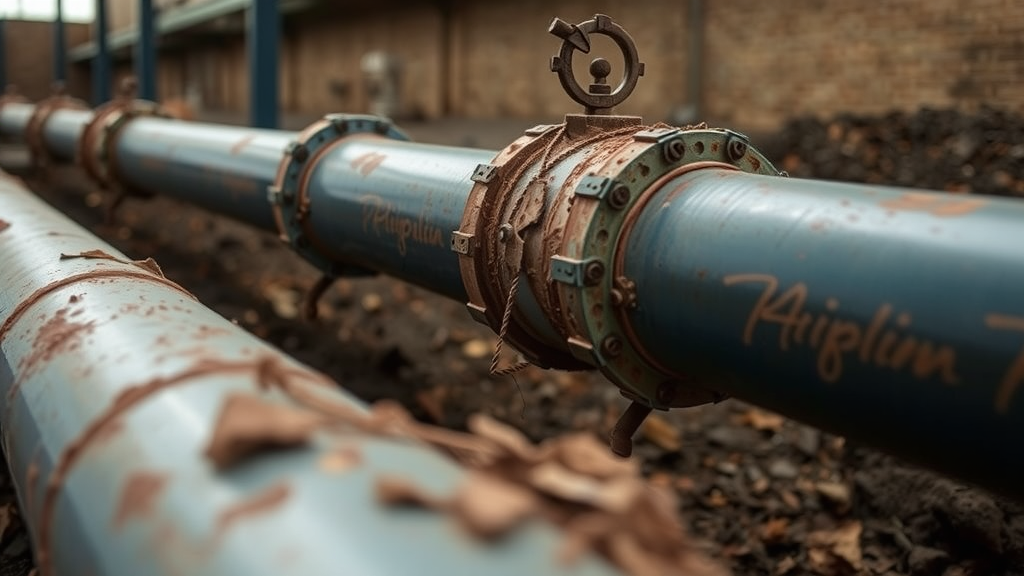
Buried oil and gas pipelines are among the most exposed pieces of critical infrastructure on the planet, threading silently for thousands of kilometers through some of the most geologically restless terrain on Earth. When an active fault slips, the ground does not merely shake—it tears, shears, and offsets, dragging everything buried within it along for the ride. A new experimental and computational study published in the Bulletin of Earthquake Engineering has now mapped, in unusual detail, what happens when that violent ground movement strikes a pipeline that is already weakened by corrosion defects, and the results reveal failure mechanisms that standard design practice has largely overlooked.
The research team, led by Chen Yanhua, Hao Erhao, Yang Mei, and Wei Rong of North China University of Science and Technology in Tangshan, China, focused on one of the trickiest fault geometries an engineer can face: the oblique-slip fault. Unlike pure strike-slip faults, where the two sides of the fracture grind horizontally past each other, or pure dip-slip faults, where one block lurches vertically relative to the other, oblique-slip faults combine both motions simultaneously. The result is a compound displacement field that subjects a crossing pipeline to a twisting cocktail of axial tension or compression, lateral bending, and vertical flexure all at once—a mechanical environment far more punishing than any single component acting alone.
To capture this complexity, the researchers took a two-pronged approach. First, they built a two-box device experiment, a laboratory setup in which soil and a model pipeline are housed in two adjacent containers that can be displaced relative to one another, physically simulating the sudden offset produced when a fault ruptures beneath a buried line. This sandbox-style testing lets researchers watch deformation evolve in a controlled, repeatable way. Second, they constructed detailed finite element simulations in ABAQUS, a commercial computational mechanics platform, replicating the pipe-soil interaction and extending the parametric reach of the experiments to conditions that would be impractical to test physically.
The central question was deceptively simple: where do corrosion defects fit into this already dangerous picture? Corrosion is a slow, relentless enemy of buried steel. Over years and decades, it eats away at pipe walls, thinning them locally and creating spots where the cross-section that carries the load is diminished. Engineers have long assessed such defects with established fitness-for-service codes, but those frameworks were largely built around internal pressure and ordinary operational loads—not around a fault shoving meters of ground displacement through the pipeline in a matter of seconds. The new study interrogates exactly this coupled scenario.
One of the most striking findings concerns what the authors call peak shifting. In an intact pipeline, the largest bending strain tends to occur at predictable locations dictated by the fault geometry and soil resistance. But when a corrosion defect is present, stress concentrates at the weakened spot, and the location of the peak strain migrates toward it. In other words, the defect does not merely weaken the pipe locally; it actively reorganizes the entire deformation field around itself, pulling the most dangerous strains to the very place where the pipe can least afford them.
The experiments also exposed a subtle measurement trap that could mislead field monitoring programs. Because instrumentation points are physically fixed to the pipe surface, they move together with the deforming pipe, and this fixity can create what the researchers describe as an illusion of reduced peak strain. A sensor bolted to a section that is bending and shifting wholesale may register a lower differential strain than the true localized peak, simply because the reference frame itself is in motion. For operators relying on strain gauges to flag danger, this is a sobering caveat: the instruments may be quietly under-reporting the worst of the damage.
Among the variables the team examined, defect location emerged as the dominant driver of failure risk. When a corrosion defect sits inside a large deformation zone—the region where the fault’s passage forces the most intense bending—the strain concentrates sharply there, and the maximum strain nearly doubles compared with defects placed in calmer stretches of the alignment. This finding has immediate practical weight: two pipelines with identical corrosion defects can carry dramatically different risk profiles depending on where along a fault crossing those defects happen to lie. Defect assessment, the study implies, cannot be done in isolation from seismic fault-hazard mapping.
The researchers also tested how pipe diameter and burial depth reshape the response. Increasing the pipe diameter spreads the fault-imposed displacement over a larger and stiffer structure, which mitigates strain localization—the dangerous funneling of deformation into a narrow band. However, bigger diameter does not eliminate the problem: stress at the defect site remains significantly concentrated, meaning the thinning caused by corrosion continues to matter even on large, robust pipes. Reducing burial depth, meanwhile, loosens the soil’s grip on the pipe, easing the constraint the surrounding ground imposes on its deformation. But that relief comes at a price: a shallower pipe experiences a wider deformation zone, distributing bending over a longer length while becoming more exposed to surface loads such as traffic and construction. The authors conclude that engineers face a genuine trade-off between soil constraint and surface loading when choosing burial depth in fault zones—a balance with no universally correct answer.
Why does this matter now? Global energy demand keeps pipelines crossing seismically active corridors, from Central Asia to the Pacific Rim, and much of that buried steel is aging. Corrosion is consistently identified in the engineering literature as a leading cause of pipeline failures, and great earthquakes recur on timescales that guarantee many pipelines will encounter fault rupture during their service lives. When the two hazards overlap, the margin of safety can erode much faster than either hazard alone would suggest. The Tangshan team’s work provides a quantitative reference for prioritizing inspection and maintenance: pipelines with corrosion defects inside mapped fault deformation zones deserve elevated scrutiny, and monitoring strategies should account for the peak-strain shifting and measurement illusions the study documents.
The study, funded by the Hebei Natural Science Foundation and the National Natural Science Foundation of China, arrives as the field of pipeline earthquake engineering steadily shifts from idealized intact-pipe models toward a more honest accounting of real-world degradation. By fusing physical two-box experiments with high-fidelity finite element simulation, the researchers have delivered a framework that connects laboratory-scale mechanics directly to the decisions operators must make in the field. As seismic hazard maps grow more precise and in-line inspection tools catalog corrosion defects with ever-finer resolution, the remaining challenge—integrating the two data streams into a single, defensible risk picture—has just become considerably clearer. For the quiet steel arteries beneath our feet, knowing exactly where a crack will want to form before the ground moves may one day be the difference between a routine inspection and a catastrophe.
Subject of Research: Mechanical behavior of corroded buried pipelines crossing oblique-slip fault zones
Article Title: Mechanical behavior analysis of defective pipelines in oblique slip fault zones based on experiments and simulation
Article References: Yanhua, C., Erhao, H., Mei, Y., & Rong, W. (2026). Mechanical behavior analysis of defective pipelines in oblique slip fault zones based on experiments and simulation. Bulletin of Earthquake Engineering. https://doi.org/10.1007/s10518-026-02684-6
Image Credits: AI Generated
DOI: 10.1007/s10518-026-02684-6
Keywords: oblique-slip fault, buried pipelines, corrosion defects, stress concentration, strain localization, pipe-soil interaction, fault rupture, ABAQUS simulation, earthquake engineering, pipeline safety, burial depth, pipe diameter
Cite Scienmag News
Violet Maxwell. (September 26, 2026). Fault Movements Turn Corroded Pipelines Into Hidden Time Bombs, Experiments Show. Scienmag. https://scienmag.com/fault-movements-turn-corroded-pipelines-into-hidden-time-bombs-experiments-show/
Violet Maxwell. "Fault Movements Turn Corroded Pipelines Into Hidden Time Bombs, Experiments Show." Scienmag, 26 September 2026, https://scienmag.com/fault-movements-turn-corroded-pipelines-into-hidden-time-bombs-experiments-show/. Accessed 26 September 2026.
Violet Maxwell. "Fault Movements Turn Corroded Pipelines Into Hidden Time Bombs, Experiments Show." Scienmag. September 26, 2026. https://scienmag.com/fault-movements-turn-corroded-pipelines-into-hidden-time-bombs-experiments-show/