


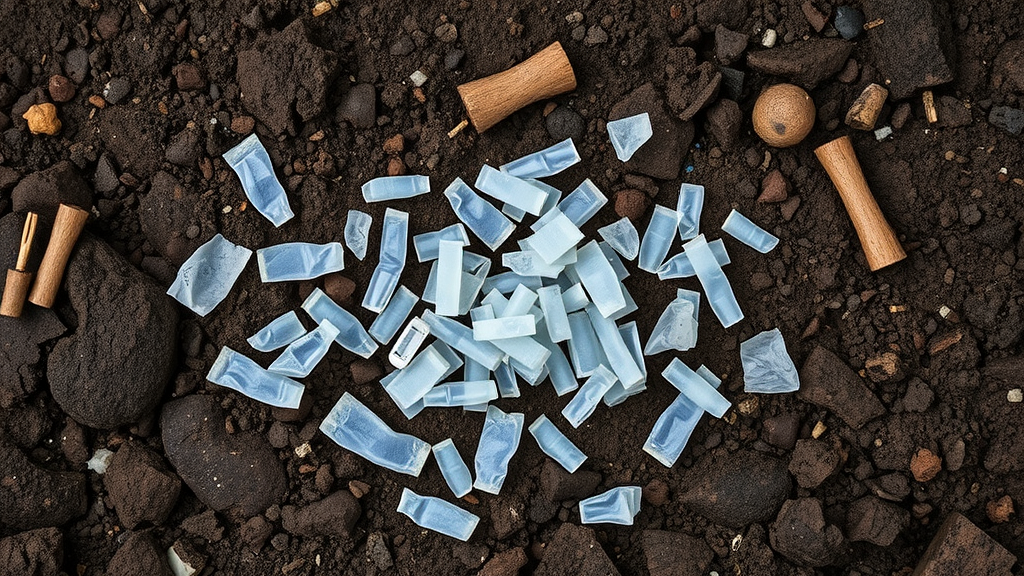
Beneath the sea of plastic greenhouses that blankets Almería in southern Spain, the soil is quietly accumulating something far smaller than the vast polyethylene sheets that cover the crops. Microplastics — fragments and fibres of polymer debris measuring mere fractions of a millimetre — have become one of the most stubborn contaminants in intensive agricultural systems, yet measuring them accurately has remained a formidable analytical challenge. Now, a team of Spanish researchers has developed and validated an optimised protocol for extracting and identifying the smallest microplastics in greenhouse soils, offering the scientific community its first comprehensive chemical and morphological picture of plastic contamination in one of the world’s most critical regions for protected agriculture.
The study, published in the journal Microplastics and Nanoplastics, was led by Enrique Rodríguez Noya and colleagues at the University of Almería’s Research Centre for Mediterranean Intensive Agrosystems and Agri-Food Biotechnology, working alongside Maria Dolores Hernando of the Spanish National Research Council’s Experimental Station of Arid Zones. Their target was a set of four polymers that dominate the plastic footprint of greenhouse farming: polyethylene (PE), polypropylene (PP), polyethylene terephthalate (PET) and polybutylene adipate terephthalate (PBAT), a biodegradable polyester increasingly used in mulching films. Each of these materials behaves differently in soil, and each demands careful handling if analysts hope to recover it intact and identify it correctly.
The core problem the researchers confronted is one that plagues microplastic science everywhere: soil is a chemically hostile matrix, packed with organic matter and mineral particles that can mask, bind to or outright mimic plastic fragments. Before any microscope or spectrometer can count microplastics, the sample must be stripped of everything that is not plastic. This means digesting organic material, dispersing soil aggregates and separating low-density polymer particles from dense mineral matter — all without dissolving, degrading or fragmenting the very particles the analyst is trying to count. Every reagent added to achieve this cleanliness is a potential threat to the target particles, so the choice of chemistry is everything.
To find the best combination, the team systematically evaluated multiple extraction agents across three chemical families. Two inorganic salt solutions, sodium chloride (NaCl) and calcium chloride (CaCl₂), were tested for their ability to float plastic particles out of suspension. Four surfactants — sodium dodecyl sulfate (SDS), cetyltrimethylammonium bromide (CTAB), Tween 20 and Triton X-114 — were assessed for their capacity to disperse soil particles and detach plastics from organic coatings. Finally, two oxidative reagents, sodium persulfate (Na₂S₂O₈) and Fenton’s reagent, were compared for their efficiency in digesting soil organic matter without destroying the polymer particles themselves. The researchers determined which combination maximised microplastic recovery across the different polymer types and particle morphologies.
The optimised method was then validated using reference microparticles as small as 50 micrometres — roughly the width of a human hair. This size threshold matters enormously. Most conventional protocols are comfortable quantifying particles above a few hundred micrometres, but the smallest fraction of the microplastic population is both the most numerous and the most likely to interact with soil organisms and crop roots. Achieving reliable recovery at 50 micrometres pushes the analytical window into territory where contamination risks and losses escalate sharply. The validation demonstrated recovery rates above 75 percent for most particle-type and polymer combinations, a performance level that gives the protocol genuine credibility for routine monitoring work.
With the method proven on reference materials, the team turned it loose on real greenhouse soils from Almería, home to Europe’s largest concentration of plastic-covered cultivation. The results were striking. Microplastic concentrations ranged from 1,133 to 8,500 particles per kilogram of soil — a wide spread that likely reflects differences in land-use history, plastic management practices and soil conditions across the sampled greenhouses. Even the lower bound of that range represents thousands of plastic particles in every kilogram of soil in which food crops are grown, a figure that underscores how thoroughly plastic has permeated the growing medium of intensive horticulture.
The morphological profile of the recovered particles told its own story. Fragments dominated the assemblage, accounting for 62 percent of all particles identified, and the majority of these sat in the 100 to 250 micrometre size range. This size class sits squarely within the range that most previous studies of agricultural soils have struggled to capture, which suggests that earlier surveys may have systematically underestimated the true particle burden. Fragment dominance is consistent with the mechanical breakdown of agricultural plastic films — mulches, greenhouse covers and irrigation components that are abraded, torn and shattered by weathering, machinery and repeated handling over growing seasons.
Chemical identification, performed using micro-Fourier transform infrared spectroscopy (µ-FTIR), added a second layer of insight. Polypropylene emerged as the most abundant polymer, making up 70 percent of the identified particles, followed by PET at 16 percent and polyethylene at 6 percent. The dominance of PP is notable because polypropylene is ubiquitous in agricultural settings — in twine, ropes, irrigation fittings, plant trays and woven fabrics — yet it has often been underreported in soil studies where analytical protocols favour other polymers. The presence of PET points to contributions from polyester fibres and rigid packaging, while the PE fraction reflects the polyethylene films that literally define the Almerían landscape. The inclusion of PBAT in the target list also matters: as biodegradable mulch films see wider adoption, tracking their fragmentation products in soil becomes essential for assessing whether these materials genuinely disappear or simply break into smaller and smaller pieces.
Beyond its regional findings, the study’s lasting contribution may be the protocol itself. By documenting recovery rates, reagent performance and validation thresholds for particles down to 50 micrometres, the researchers have provided a robust, reproducible analytical tool that other laboratories can adopt for monitoring microplastic contamination in intensive agricultural environments. Standardised, validated methods are the prerequisite for comparing contamination levels across regions, tracking trends over time and evaluating the effectiveness of mitigation measures such as improved plastic waste management or the substitution of conventional films with biodegradable alternatives. Without such comparability, the growing body of microplastic literature remains a patchwork of numbers that cannot be meaningfully compared.
The work also carries a broader significance for global food production. Protected agriculture — cultivation under plastic-covered structures — has expanded dramatically worldwide, from the Mediterranean basin to China and Latin America, and Almería serves as a bellwether for what this intensification means for soil health. The finding that greenhouse soils there carry thousands of microplastic particles per kilogram, dominated by small fragments of the very polymers used in farming infrastructure, transforms an abstract environmental concern into a quantified, chemically characterised reality. Whether these particles affect soil physics, microbial communities, nutrient cycling or crop uptake remains an open question for future research, but answering it will depend on the kind of rigorous, validated measurement that this new protocol now makes possible.
Subject of Research: Optimised extraction and identification of small microplastics in greenhouse agricultural soils
Article Title: Optimized analytical protocol for quantifying small microplastics in greenhouse agricultural soils
Article References: Rodríguez Noya, E., Flores Morales, J. J., Cortes-Corrales, L., Sahai, H., Hernando, M. D., R. Fernández-Alba, A., & Martinez Bueno, M. J. (2026). Optimized analytical protocol for quantifying small microplastics in greenhouse agricultural soils. Microplastics and Nanoplastics. https://doi.org/10.1186/s43591-026-00233-1
Image Credits: AI Generated
DOI: 10.1186/s43591-026-00233-1
Keywords: microplastics, greenhouse agriculture, soil contamination, polypropylene, polyethylene, PET, PBAT, FTIR spectroscopy, Almería, mulching films, analytical protocol, soil organic matter
Cite Scienmag News
Alan Morgan. (September 26, 2026). New Protocol Reveals Millions of Microplastic Clues Hidden in Greenhouse Soils. Scienmag. https://scienmag.com/new-protocol-reveals-millions-of-microplastic-clues-hidden-in-greenhouse-soils/
Alan Morgan. "New Protocol Reveals Millions of Microplastic Clues Hidden in Greenhouse Soils." Scienmag, 26 September 2026, https://scienmag.com/new-protocol-reveals-millions-of-microplastic-clues-hidden-in-greenhouse-soils/. Accessed 4 October 2026.
Alan Morgan. "New Protocol Reveals Millions of Microplastic Clues Hidden in Greenhouse Soils." Scienmag. September 26, 2026. https://scienmag.com/new-protocol-reveals-millions-of-microplastic-clues-hidden-in-greenhouse-soils/


