


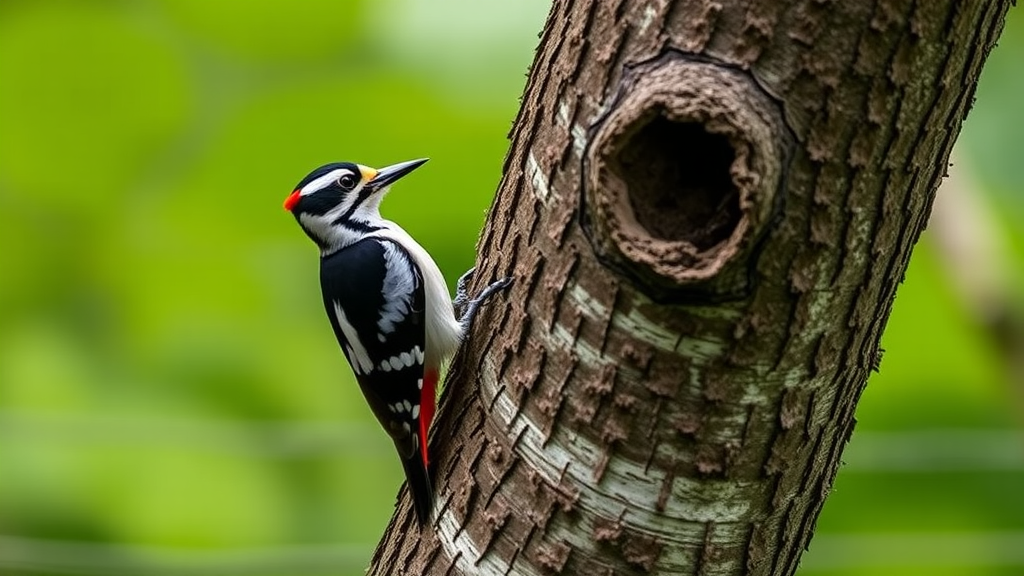
In the intensively farmed lowlands of southeastern Poland, where arable fields swallow more than two-thirds of the ground and forests cling to just 14 percent of the land, a quiet revolution in conservation diagnostics is taking shape. A new study published in Environmental Management shows that the presence of woodpeckers in tiny rural parks can reliably signal which fragments of trees hide the richest bird communities. The finding, based on surveys of 71 parks spread across 2,140 square kilometres between Tomaszów Lubelski, Zamość and Hrubieszów, offers an unexpectedly simple tool for identifying biodiversity refuges in some of Europe’s most altered agricultural landscapes.
Indicator species have long been a cornerstone of applied ecology. Lichens betray air quality, dragonflies grade the health of wetlands, and butterflies track the structural integrity of meadows. In temperate forests, woodpeckers are the gold standard: their presence reflects dead wood, old trees and the overall naturalness of a stand. What remained untested until now was whether this diagnostic power survives outside the forest, in the scattered, human-planted groves that punctuate farmland. Jerzy and Monika Michalczuk of the University of Rzeszów set out to answer that question with a rigorous field campaign conducted during the spring of 2018.
The parks themselves tell a story of rural heritage. Thirty-seven of the 71 sites were historic manor parks whose tree stands exceed one hundred years of age, averaging 3.19 hectares of woodland each. The remaining 34 were younger non-manor parks established roughly 50 to 70 years ago, with wooded areas averaging just 0.87 hectares. Lime, Norway maple, sycamore maple and European ash dominated the canopies, while oaks, alders, birches and horse chestnuts appeared less frequently. Many parks now serve public functions, hosting schools, health centres or cultural facilities, yet their ageing trees retain the decaying wood and complex structure that vanish from the surrounding farmland.
Detecting woodpeckers in these fragments demanded patience and acoustic trickery. Each park was visited four times between early March and the end of April, the peak of territorial activity. The researchers broadcast recorded territorial calls and drumming of the Lesser Spotted, Middle Spotted, Syrian, Green and Black woodpeckers from playback points spaced 200 to 350 metres apart. Notably, they deliberately excluded vocalisations of the Great Spotted Woodpecker and Grey-headed Woodpecker, because these species reliably respond to the calls of their close relatives, the Syrian and Green woodpeckers respectively. A park was considered occupied when a nesting cavity was found or territorial birds were observed on at least two of four visits.
Six woodpecker species were recorded across the network, with woodpeckers present in 58 percent of the parks. The Great Spotted Woodpecker proved the most widespread, occupying 35 percent of sites, followed by the Syrian Woodpecker at 27 percent. Most parks hosted a single woodpecker species, and only one site could boast four. Separately, the team ran standardised ten-minute point counts in the most densely wooded core of each park, repeated twice during the breeding season, and documented 52 breeding or probably breeding bird species. The Chaffinch appeared in every single park, while blackbirds, great tits, blackcaps, goldfinches and icterine warblers graced more than 70 percent of the sites.
The statistical verdict was unambiguous. Parks with woodpeckers held significantly richer bird assemblages across every ecological group tested: all species, tree-associated species, forest species, cavity nesters and forest cavity nesters. Total richness averaged 14.1 species in woodpecker parks against 11.8 in woodpecker-free ones. Even more striking, the presence of the Great Spotted Woodpecker alone pushed mean total richness to 15.7 species, compared with just 11.7 where it was absent, with cavity-nesting and forest cavity-nesting birds showing particularly sharp gains. The Syrian Woodpecker, by contrast, showed no significant association with avian richness, suggesting it marks something quite different: highly transformed, synanthropic habitats rather than ecological quality.
Generalised linear models with a Poisson distribution quantified the signal with precision. Each additional woodpecker species in a park was associated with a 12 percent increase in total bird species richness, a 14 percent increase for tree-stand birds and 13 percent for forest birds. For cavity nesters the effect jumped to 28 percent, and for forest cavity nesters to 34 percent, an incidence rate ratio of 1.34 that underscores the woodpecker’s role as an ecosystem engineer. By excavating nesting cavities, woodpeckers create housing that secondary cavity-nesters such as tits, nuthatches and flycatchers cannot make for themselves, a service that becomes critical in young stands where natural holes are scarce.
The community composition shifted alongside the richness numbers. Five species occurred significantly more often in woodpecker-occupied parks, including the Eurasian nuthatch and Song Thrush, both tied to mature, minimally altered tree stands. Only the Eurasian Collared Dove, a classic synanthropic species of open and built-up habitats, was more frequent in woodpecker-free parks, revealing that parks without these birds skew toward eurytopic and human-tolerant species. Manor parks outperformed younger non-manor parks on every richness measure, hosting means of 14.7 versus 11.4 total species, likely because their larger, older stands provide more dead wood, larger trunks and the vertical complexity that forest specialists demand, although the authors caution that park size and type could not be fully disentangled.
The researchers are careful to frame the relationship honestly. A so-called habitat filter may explain much of the pattern: woodpeckers and other forest birds select similar structural features, so they co-occur without woodpeckers necessarily causing the richness. Yet even under this interpretation, the diagnostic value holds. And the practical implications reach well beyond birds, because woodpecker presence correlates with bats, saproxylic beetles and wood-inhabiting fungi that share the same cavity- and deadwood-rich microhabitats. A morning of woodpecker playback in a country park can thus substitute for weeks of intensive multi-taxon inventories, a decisive advantage in landscapes outside protected areas where ecological monitoring is rare.
The study’s conservation message is quietly radical. Small, anthropogenic groves that most land managers treat as ornamental amenities are in fact functioning as biodiversity microrefugia, and their importance is set to grow as farmland trees continue to disappear across Central Europe. The authors recommend embedding woodpecker monitoring into local and regional conservation strategies and rural green-space planning, with the Great Spotted Woodpecker serving as the single most informative reference species for rapid assessments. Preserving old trees, deadwood and continuity in these parks, they argue, may prove among the most cost-effective ways to sustain forest biodiversity in deforested agricultural regions, turning village parks into the last strongholds of woodland life.
Subject of Research: Woodpeckers as indicator species for bird richness in non-forest tree stands of rural parks in an agricultural landscape
Article Title: Woodpeckers as Indicators of Avian Richness in Non-forest Tree Stands: A Case Study of Rural Parks in the Agricultural Landscape of SE Poland
Article References: Michalczuk, J., & Michalczuk, M. (2026). Woodpeckers as Indicators of Avian Richness in Non-forest Tree Stands: A Case Study of Rural Parks in the Agricultural Landscape of SE Poland. Environmental Management, 76(10), Article 319. https://doi.org/10.1007/s00267-026-02597-9
Image Credits: AI Generated
DOI: 10.1007/s00267-026-02597-9
Keywords: woodpeckers, indicator species, biodiversity, cavity-nesting birds, rural parks, agricultural landscape, species richness, bioindicators, conservation, Poland, ecosystem engineers, manor parks
Cite Scienmag News
Gavin Prescott. (September 26, 2026). Woodpeckers Reveal Hidden Bird Hotspots in Poland’s Rural Parks. Scienmag. https://scienmag.com/woodpeckers-reveal-hidden-bird-hotspots-in-polands-rural-parks/
Gavin Prescott. "Woodpeckers Reveal Hidden Bird Hotspots in Poland’s Rural Parks." Scienmag, 26 September 2026, https://scienmag.com/woodpeckers-reveal-hidden-bird-hotspots-in-polands-rural-parks/. Accessed 26 September 2026.
Gavin Prescott. "Woodpeckers Reveal Hidden Bird Hotspots in Poland’s Rural Parks." Scienmag. September 26, 2026. https://scienmag.com/woodpeckers-reveal-hidden-bird-hotspots-in-polands-rural-parks/


