


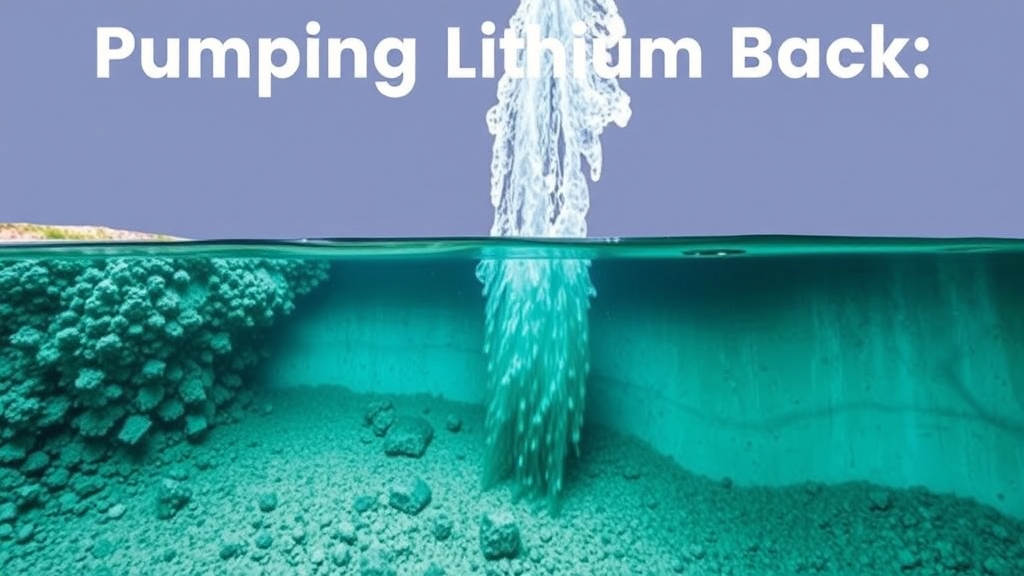
The global race toward electrification is colliding with one of Earth’s driest, most fragile landscapes. Demand projections for lithium carbonate equivalent are expected to jump from 917 kilotonnes per year in 2023 to 3829 kilotonnes per year by 2035, an increase of more than 300 percent, while projected production over the same period climbs from 875 to 2464 kilotonnes per year, leaving a potential supply gap of 55 percent. Most of that lithium will still come from two sources: hard-rock pegmatites, dominated by Australia, and the lithium-rich brines trapped beneath the vast salt flats, or salars, of the Andes. Chile, the world’s second-largest producer, draws its lithium from the Atacama Salt Flat alone, which holds roughly 40 percent of global lithium mining reserves. Now a comprehensive review published in Cleaner Engineering and Technology argues that the future of this industry may hinge on an operation that sounds deceptively simple: pumping the lithium-depleted leftover brine back into the ground.
Conventional lithium production relies on solar evaporation ponds, where brine is spread across vast surfaces and the sun removes 85 to 95 percent of its water content, equivalent to between 200 and 1400 cubic meters of water per tonne of lithium, depending on brine concentration. Overall process efficiency hovers around 50 percent, forcing operators to pump even more brine to hit production targets. This all happens in hyperarid regions where freshwater is scarce and local communities often oppose expanding extraction. Salars themselves are extraordinary ecosystems, hosting unique microbial communities and supporting wetlands and lagoons at their margins that sustain flamingos and other wildlife. As water tables drop under intense pumping, these systems come under stress. At the Salar de Atacama, reduced evaporation discharge of around 15 percent between 1986 and 2018 has partially compensated for extraction, but the ecosystems remain strained, and Chilean regulators have sanctioned companies when lagoon levels fell below legal thresholds.
Direct lithium extraction, or DLE, promises a different path. Rather than waiting years for the sun to concentrate brine, DLE technologies selectively pull lithium ions from the fluid, achieving extraction efficiencies of up to 99 percent while leaving behind a spent brine that largely preserves the original volume. Chile’s National Lithium Strategy explicitly promotes the transition from evaporation ponds to DLE and identifies sustainable brine re-injection as a key requirement. But the review, led by Santiago Montserrat and colleagues, finds a sobering gap between ambition and reality: almost no published data exist on the actual chemical composition of spent brines from any DLE process, and direct re-injection into salar aquifers remains at the testing stage in nearly every project worldwide.
The chemistry of the spent brine depends entirely on which technology extracts the lithium. Adsorption processes using aluminum-based layered double hydroxides, already deployed commercially in China and Argentina, leave the pH roughly unchanged but can introduce dissolved aluminum into the brine, an element essentially absent from natural salt-lake waters, so even trace amounts could accumulate in aquifers over years of continuous discharge. Titanium- and manganese-based ion sieves work by swapping hydrogen ions for lithium, which lowers the spent brine’s pH; acidified brine re-injected underground could dissolve evaporite salts and alter aquifer chemistry, while manganese sorbents have been reported to lose more than 15 percent of their mass through dissolution after ten operating cycles. Solvent extraction risks leaking organic compounds such as extractants and kerosene-like diluents into the aquifer, precipitation processes leave unreacted aluminum or phosphate reagents in solution, and electrochemical methods using manganese or iron phosphate electrodes face long-term material stability questions.
Concentration-based alternatives complicate the picture further. Nanofiltration, electrodialysis, and membrane distillation each split brine into streams with distinct salinities and compositions. Membrane distillation crystallization can strip water from the spent brine, raising its total dissolved solids and density and promoting salt precipitation when the concentrate is re-injected, whereas freshwater added during DLE operation dilutes the brine, potentially reducing its density by around three percent and encouraging dissolution of underground salt deposits. Neither outcome is benign: oversaturated brines clog wells and pores, while undersaturated brines can carve out dissolution cavities that undermine aquifer stability and even accelerate land subsidence. A recent study of wastewater from the Uyuni salar found evaporation pond brines reaching 360,000 milligrams per liter of dissolved solids with elevated arsenic and pH as low as 3.2, underscoring how radically processed brines can deviate from their natural state.
Re-injection itself is far from novel. Managed aquifer recharge is a mature discipline, and pressurized injection wells are standard practice in the oil, gas, and geothermal industries, where returning produced fluid stabilizes reservoir pressure and sustains production. Carbon capture and storage wells in saline aquifers have extensively documented the problem of halite scaling damaging injectivity, and a German modeling study of lithium extraction from geothermal brines in the Upper Rhine Graben simulated a 30-year operation showing a 40 percent depletion of lithium at the production well as the re-injected, lithium-depleted brine broke through. These lessons transfer only partially: salars combine extreme salinity, complex density stratification, and hypersaline-saturated mineral assemblages that react strongly with any undersaturated injectate, and the mixing behavior of two different hypersaline brines, as opposed to the well-studied freshwater-saltwater interface, has essentially never been experimentally characterized.
Density physics turns out to matter enormously. Even a small density contrast of about 0.03 grams per cubic centimeter between spent and native brine generates Rayleigh numbers between 10^3 and 10^6 under typical salar conditions, far above the critical threshold of roughly 39.5 at which convection overwhelms diffusion. Lighter spent brines will migrate upward toward ecologically sensitive wetlands and shallow compartments, potentially accelerated by fingering instabilities, while denser concentrates sink and pool in structural lows, forming stratified layers that may persist for decades. Characteristic buoyancy-driven flow velocities range from under 2 to 2000 meters per year depending on permeability, meaning re-injected plumes could reach sensitive receptors far faster than naive diffusion-based models would predict. The review’s authors argue that density-dependent reactive transport modeling must therefore become a central design tool rather than an afterthought.
Where and how to inject involves hard trade-offs. Wells placed close to extraction points stabilize pressure effectively and can push fresh brine toward production wells, cutting pumping costs, but they shorten the time before lithium-depleted brine short-circuits back into the production wells, diluting the resource. Hydraulic barriers of injection wells downstream of the saline wedge could protect marginal wetlands from encroaching salt, and direct surface recharge has already been tried in Chile to restore degraded wetlands, though an early attempt was banned after irrigation increased vegetation abundance while drastically reducing species diversity, because the system failed to replicate the natural brackish upwelling that sustains these ecosystems. The review also notes a closure problem: recharge in hyperarid basins is so limited that aquifer recovery after pumping stops can outlast the project’s lifespan, meaning re-injection systems may need to run for years or decades after lithium extraction ends, with significant cost implications.
The authors close with a research roadmap that sequences the needed work from basin-scale characterization through reactive transport model validation, pilot-scale injection tests, and long-term adaptive monitoring, all embedded in regulatory frameworks that today vary sharply among Chile, Argentina, Bolivia, and China. Only a handful of operating DLE projects, at Salar del Hombre Muerto and Centenario-Ratones in Argentina, currently rely on infiltration ponds rather than direct injection, while most planned projects, including several in Chile and the geothermal ventures of Europe and North America, promise direct re-injection that has yet to be proven at scale. The core paradox is stark: DLE’s headline environmental advantage, eliminating evaporative water loss, only materializes if the spent brine can be safely returned underground. Without that, the review concludes, alternative extraction technologies will not meaningfully shrink the water footprint of lithium production, and the non-evaporative promise of direct lithium extraction will remain exactly that, a promise.
Subject of Research: Sustainable re-injection of spent brine from direct lithium extraction in salar environments
Article Title: Lithium brine re-injection in salar environments: Perspectives for a sustainable implementation of direct lithium extraction (DLE) technologies
Article References: Montserrat, S., Niño, Y., Henriquez, Á., Zamora, J., & Estay, H. (2026). Lithium brine re-injection in salar environments: Perspectives for a sustainable implementation of direct lithium extraction (DLE) technologies. Cleaner Engineering and Technology, 34, Article 101309. https://doi.org/10.1016/j.clet.2026.101309
Image Credits: AI Generated
DOI: 10.1016/j.clet.2026.101309
Keywords: lithium, direct lithium extraction, brine re-injection, salars, hydrogeology, Salar de Atacama, evaporation ponds, reactive transport, spent brine chemistry, managed aquifer recharge, Lithium Triangle, water sustainability
Cite Scienmag News
Sloane Callahan. (September 25, 2026). Pumping Lithium Back: Why Re-injecting Spent Brine Could Make or Break Direct Lithium Extraction. Scienmag. https://scienmag.com/pumping-lithium-back-why-re-injecting-spent-brine-could-make-or-break-direct-lithium-extraction/
Sloane Callahan. "Pumping Lithium Back: Why Re-injecting Spent Brine Could Make or Break Direct Lithium Extraction." Scienmag, 25 September 2026, https://scienmag.com/pumping-lithium-back-why-re-injecting-spent-brine-could-make-or-break-direct-lithium-extraction/. Accessed 4 October 2026.
Sloane Callahan. "Pumping Lithium Back: Why Re-injecting Spent Brine Could Make or Break Direct Lithium Extraction." Scienmag. September 25, 2026. https://scienmag.com/pumping-lithium-back-why-re-injecting-spent-brine-could-make-or-break-direct-lithium-extraction/


