


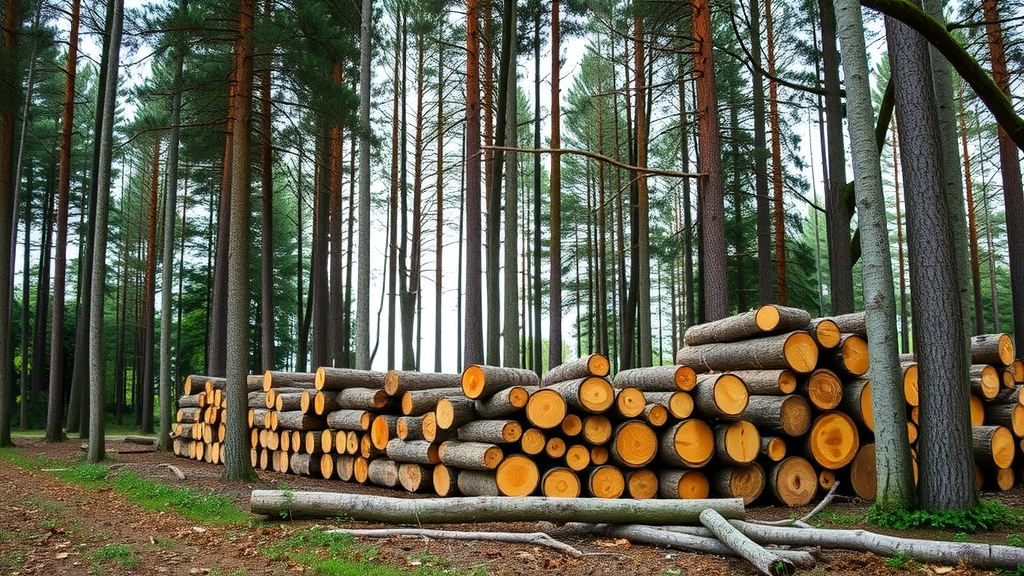
Sweden has long been held up as a proving ground for the forest-based bioeconomy. With roughly 70 percent of its land area covered by forest and some 3.5 billion cubic metres of standing timber, the country has staked much of its climate strategy on the idea that using more wood—in buildings, packaging, and energy—can help replace fossil-based materials while sustaining a rural industrial economy. Now a new open-access study in the Journal of Industrial Ecology puts that assumption under an unusually rigorous quantitative lens, and the results complicate the optimistic picture that has guided Swedish and European policy.
Researchers led by Bogomil Iliev of the University of Copenhagen, together with colleagues at the Basque Centre for Climate Change and the University of Copenhagen, built an integrated monetary-physical input–output framework for Sweden. The innovation lies in running two parallel, harmonised accounts: a monetary supply-use table capturing the entire Swedish economy across more than 430 product groups and 98 industries, and a physical supply-use table that tracks wood-containing flows—raw wood, processed products, energy, and waste—in tonnes of carbon. Because the two tables share a consistent product-industry structure, a single policy shock defined in monetary terms maps directly into physical wood flows, allowing economists and carbon accountants to read the same scenario in two languages.
On top of this accounting skeleton, the team layered dynamic carbon-stock modelling. Carbon stored in wood-based products evolves according to the IPCC’s first-order decay approach, in which each product category loses carbon at a rate determined by its half-life, from long-lived construction timber to short-lived paper. Forest carbon, meanwhile, is tracked through a bookkeeping method in which harvest deviations from a baseline trajectory translate directly into changes in the forest carbon pool. The framework thus produces, for every year between 2020 and 2040, estimates of value added, employment, production-based greenhouse gas emissions, and carbon stock changes in both forests and products.
The researchers simulated three stylised scenarios against a common baseline of two percent annual growth in final demand. The first scenario scaled up cross-laminated timber, or CLT, construction—a form of engineered wood that can substitute for concrete and steel in multi-storey buildings. The second redirected wood waste that would otherwise be incinerated into the manufacturing of new wood products. The third, called wood cascade, combined both strategies under a hard constraint: total roundwood harvest was held to its baseline path, with reduced pulp and paper demand absorbing the difference. All shocks were applied abruptly in 2020 and held constant, making the experiments counterfactual what-if probes rather than forecasts of realistic transitions.
The headline findings are striking. CLT construction delivered the strongest macroeconomic gains of the three strategies, raising national output by 17.8 billion Swedish kronor per year, value added by 5.1 billion kronor per year, and employment by about 8,500 jobs annually, while cutting production-based emissions by roughly 0.3 million tonnes of CO2-equivalent per year. Yet this apparent win came at a hidden cost: the intensified harvest needed to feed the new construction demand drew down the forest carbon pool faster than buildings could bank it. By 2040, the total system carbon balance under CLT construction was 63 million tonnes of carbon worse than the baseline—a net loss for the climate system even as the industrial economy gained.
Waste recycling produced more modest effects across the board. It increased value added by 4.3 billion kronor per year, had little effect on aggregate output, and yielded a positive but small system-carbon trajectory of about 7 million tonnes of carbon by 2040. The wood cascade scenario emerged as the quiet victor on the climate side. By combining CLT construction and recycling while constraining harvest through reduced pulp and paper production, it cut production-based emissions the most—roughly 528 thousand tonnes of CO2-equivalent per year—while keeping forest carbon on its baseline path and lifting the economy’s stored product carbon, for a cumulative system gain of about 33 million tonnes of carbon by 2040. Value added still rose, by 2.4 billion kronor per year, even though aggregate output declined slightly.
Because the forest-based economy accounts for only around six percent of national output and four percent of value added, the national percentages understate the scale of structural change. Applying the hypothetical extraction method, which measures the total direct and indirect contribution of a set of industries by removing them from the economy in a counterfactual calculation, the researchers show that a 0.09 percent national increase in value added under CLT construction corresponds to roughly a 2.1 percent increase relative to the forest sector’s own baseline contribution. The scenarios also shift the industrial geography of the sector: gains concentrate in wood products manufacturing, sawmilling, and forestry, while losses fall on non-metallic minerals, metal-related activities, and—under the cascade scenario, by design—the pulp and paper industry.
A Monte Carlo sensitivity analysis with 10,000 runs tested the robustness of these conclusions by perturbing construction cost coefficients, growth assumptions, product half-lives, and initial product carbon stocks. The economic gains of CLT construction proved consistently positive, but its negative system-carbon outcome held across the simulation under the study’s simplified forest-carbon formulation. Wood cascading retained the strongest climate effect, though its economic intervals spanned both negative and positive values, meaning the employment and value-added conclusions are far less certain. Uncertainty in carbon outcomes grew toward 2040, driven mainly by the growth path and initial stock assumptions.
The study is candid about its limits. The forest carbon module assumes constant annual growth, ignoring biological feedbacks between harvest intensity, age structure, and forest productivity—a simplification the authors show becomes problematic as harvest-to-increment ratios rise toward and beyond one, as they do in the CLT scenarios by around 2040. Emissions accounting covers only Swedish production, with fixed base-year emission coefficients and import shares, so it excludes embodied import emissions, future decarbonisation of the energy system, and market-mediated leakage. That last omission is significant: recent global modelling suggests roundwood harvest leakage rates of 40 to 60 percent and forest carbon leakage of 50 to 80 percent when Swedish production shifts to foreign suppliers, meaning global net effects could differ substantially from domestic ones.
Even with those caveats, the policy implications are pointed. Sweden’s forest industry has pledged to increase substitution effects by 20 million tonnes of CO2-equivalent annually by 2040, while national strategy also targets additional sequestration. The new results suggest these ambitions sit in tension unless wood-use incentives are explicitly linked to harvest levels consistent with maintaining the forest sink. The cascade pathway—prioritising long-lived products and recycled material within a fixed harvest envelope—offered the most coherent route to simultaneous economic and climate goals, but it implies real losses for pulp, paper, and mineral producers. The authors argue that substitution, sequestration, and circularity should be treated not as separate policy domains but as competing claims on a common forest resource, and that coordinated instruments spanning construction regulation, industrial restructuring, and demand-side measures will do more good than isolated substitution targets. As Europe’s forest sink weakens under rising harvest and mortality pressures, the Swedish case offers a warning and a template in equal measure: using more wood is not automatically climate policy, but using wood smarter might be.
Subject of Research: Integrated monetary-physical input–output modelling of wood-use scenarios and their economic and carbon impacts in Sweden
Article Title: Wood use scenarios in Sweden through integrated monetary-physical input–output framework
Article References: Iliev, B., Arto, I., Bentsen, N. S., de la Maza Larrea, A. S., & Thomsen, M. (2026). Wood use scenarios in Sweden through integrated monetary-physical input–output framework. Journal of Industrial Ecology. https://doi.org/10.1007/s44498-026-00188-9
Image Credits: AI Generated
DOI: 10.1007/s44498-026-00188-9
Keywords: bioeconomy, Sweden, forestry, carbon accounting, input–output analysis, cross-laminated timber, wood cascade, waste recycling, greenhouse gas emissions, forest carbon sink, circular economy, industrial ecology
Cite Scienmag News
Sloane Callahan. (September 25, 2026). New Model Reveals Sweden’s Wood Climate Strategy Hides a Hidden Carbon Cost. Scienmag. https://scienmag.com/new-model-reveals-swedens-wood-climate-strategy-hides-a-hidden-carbon-cost/
Sloane Callahan. "New Model Reveals Sweden’s Wood Climate Strategy Hides a Hidden Carbon Cost." Scienmag, 25 September 2026, https://scienmag.com/new-model-reveals-swedens-wood-climate-strategy-hides-a-hidden-carbon-cost/. Accessed 4 October 2026.
Sloane Callahan. "New Model Reveals Sweden’s Wood Climate Strategy Hides a Hidden Carbon Cost." Scienmag. September 25, 2026. https://scienmag.com/new-model-reveals-swedens-wood-climate-strategy-hides-a-hidden-carbon-cost/


