


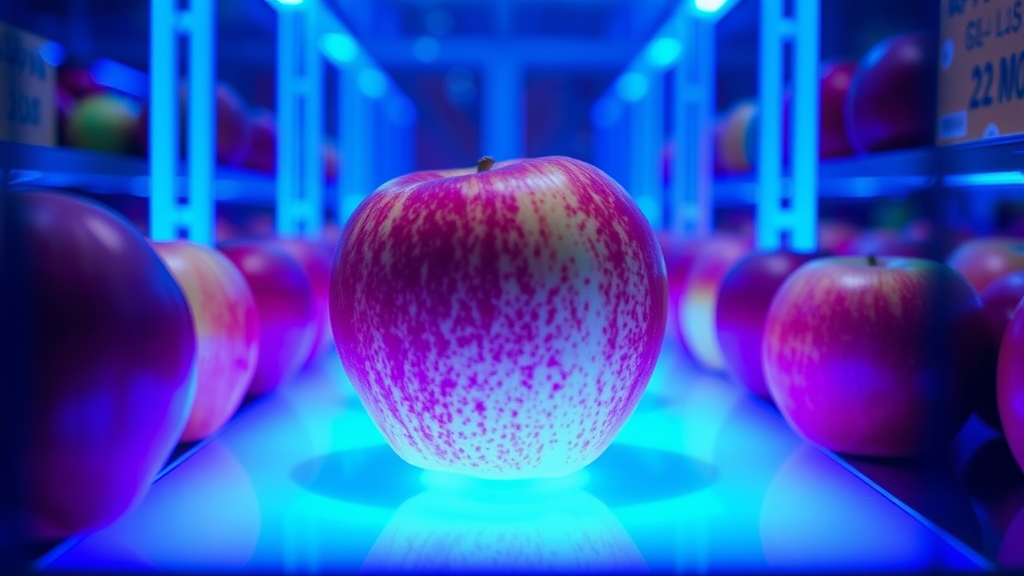
Apples are one of the planet’s most produced fruits, with global output exceeding 97 million tons in 2023, led by China, the United States, Turkey, Poland, and India. Yet from the orchard to the juice carton, they face a relentless microbial assault. Blue mold driven by Penicillium expansum, which grows happily even in refrigerated storage, destroys between 5 and 20 percent of harvests, while pathogens such as Listeria monocytogenes and Escherichia coli O157:H7 have been linked to serious outbreaks in apple products. A new systematic review published in Food Science & Nutrition has now mapped a decade of research on an elegant, chemical-free answer: ultraviolet C radiation, the shortwave band of ultraviolet light that scrambles the DNA of microbes without leaving a single chemical residue behind.
The review, conducted according to PRISMA guidelines and published in September 2026, searched ScienceDirect, Scopus, and Web of Science for studies published between January 2015 and June 2025. From 327 initial records, the researchers screened 218 full-text articles and ultimately distilled 52 studies that directly addressed UV-C treatment of fresh apples, minimally processed fresh-cut apples, and apple juice. The bibliometric analysis reveals a field that has grown steadily and shifted geographically. Spain leads the world with 11 publications, followed by the United States with 9 and China with 7, and the journal Food Control stands out as the dominant venue, contributing nine articles over the decade. Publication activity peaked in 2015, 2020, and 2021, a rhythm the authors link to real-world shocks: a deadly listeriosis outbreak tied to caramel apples in the United States in 2014 and 2015, and heightened food safety anxieties during the COVID-19 pandemic.
The science behind the technology is deceptively simple. Ultraviolet light spans wavelengths from 100 to 400 nanometers, and the UV-C band, from 100 to 280 nanometers, is the most germicidal because microbial DNA absorbs photons most efficiently in this range, peaking near 260 nanometers. Conventional low-pressure mercury lamps emit roughly 85 percent of their energy at 253.7 nanometers, almost perfectly matching that absorption maximum. When photons strike microbial DNA, they forge pyrimidine dimers, kinks in the genetic strand that block replication and render pathogens harmless. The US Food and Drug Administration has approved UV-C at 254 nanometers as an alternative to thermal pasteurization for juices, provided processors achieve a 5-log reduction, meaning a 99.999 percent kill of target pathogens.
But microbes fight back. Many organisms repair UV damage through photoreactivation, which requires light between 300 and 500 nanometers, or through light-independent nucleotide excision repair. This is where combining UV-C with other treatments, so-called hurdle technology, becomes powerful. Mild heat between 50 and 60 degrees Celsius fluidizes bacterial membranes and disables DNA repair machinery, producing synergistic lethality. In one study, adding the antimicrobial dimethyl dicarbonate before combined UV-C and heat treatment at 55 degrees achieved a 5-log reduction of E. coli in apple juice in just 1.8 minutes, cutting processing time and dose requirements by 44 percent.
On fresh apples themselves, the results are striking. Because apple skins are relatively smooth and less hydrophobic than those of berries or melons, radiation reaches microorganisms more directly. Researchers recorded reductions of 2.9 log units for E. coli O157:H7 and 1.6 log units for Listeria monocytogenes on apple surfaces after applying just 0.92 kilojoules per square meter. Low doses also trigger hormesis, a beneficial stress response in the fruit itself: irradiated apples showed increased phenolic compounds and antioxidant activity while maintaining firmness, soluble solids, and acidity through weeks of storage. Even more remarkably, UV-C fluences of 8.8 and 35.1 kilojoules per square meter degraded patulin, the dangerous mycotoxin produced by P. expansum, eliminating 99.9 percent of the contaminant at the higher dose.
Apple juice presents a tougher optical problem. The liquid is extraordinarily opaque to UV-C, with transmission below 0.01 percent, and 90 percent of radiation is absorbed within the first 0.67 millimeters. Suspended solids, fibers, pigments, and polyphenols scatter and soak up photons, shielding microbes in the liquid’s depths. Industry solutions rely on thin-film reactors that pass juice through gaps of just 2 to 3 millimeters, or on Dean vortex technology, which uses helical tube geometry to create secondary flows that continuously cycle particles toward the lamp. With these engineering fixes, studies report up to 5-log reductions of heat-resistant Alicyclobacillus acidoterrestris spores and significant kills of spoilage yeasts, alongside shelf-life extensions of at least three weeks.
A technological revolution is now underway in the light sources themselves. Ultraviolet light-emitting diodes, or UV-LEDs, are displacing mercury lamps with compelling advantages: they switch on instantly rather than requiring up to 30 minutes to stabilize, last more than 100,000 hours compared with 4,000 to 10,000 for lamps, resist breakage, and contain no mercury, a toxic metal whose disposal is increasingly restricted under the international Minamata Convention. Intriguingly, LEDs at wavelengths near 277 nanometers have inactivated P. expansum spores more effectively than traditional 253.7-nanometer lamps, and 222-nanometer far-UV sources outperformed 254 nanometers against E. coli O157:H7 in juice, possibly because their spectra overlap better with microbial action spectra or because they damage viral proteins faster.
The economics are equally persuasive. Recent analyses suggest UV-C consumes only 6 to 8 percent of the energy of conventional thermal, ohmic, microwave, or high-pressure treatments, and continuous UV-C systems use roughly 39 percent of the energy of thermal pasteurization. Because it is a dry disinfection method, it eliminates the vast wastewater streams generated by chlorine washing, and its low capital cost makes it accessible to small-scale juice producers who could never afford high-pressure processing equipment. Treated juices also retain more flavor, color, and vitamin C than heat-pasteurized counterparts, adding commercial value. Combined approaches amplify the benefits: UV-C with ultrasound achieved a 5-log kill of E. coli O157:H7 in juice in 51.5 minutes versus 77.5 minutes for ultrasound alone, while UV-C paired with peracetic acid completely inactivated E. coli O157:H7 and Listeria on apples in just 5 minutes without harming color or firmness.
Regulation, however, lags behind the science. The United States explicitly permits UV-C at 254 nanometers under 21 CFR Part 179.39, but the European Union has no framework for non-ionizing UV decontamination of food; EU Regulation 2017/2470 restricts UV-C approval to vitamin D enrichment of mushrooms, bread, yeast, and milk. This regulatory asymmetry, the review’s authors argue, hampers trade and slows adoption in a major apple-producing region. They call for internationally harmonized dose standards, validated protocols, and industrial-scale trials to close persistent gaps in the literature, where exposure conditions vary wildly between studies and real processing environments remain underexplored.
The verdict after ten years of research is that UV-C radiation stands as one of the most promising sustainable tools in the apple supply chain, capable of replacing or complementing chlorine while boosting, rather than stripping, the fruit’s natural defenses. Excessive doses do carry risks, from cell membrane rupture and browning to accelerated oxidation, so precision matters. But with LEDs making the technology cheaper, safer, and more flexible than ever, and with consumer demand for minimally processed, additive-free food only growing, the invisible light that unzips microbial DNA may soon be as standard in apple processing as refrigeration itself.
Subject of Research: Use of ultraviolet C radiation for sanitizing fresh apples, minimally processed apples, and apple juice
Article Title: Global Overview of the Use and Effectiveness of Ultraviolet C Technology in Fresh, Minimally Processed Apples and Apple Juice Over the Last 10 Years
Article References: Silva, M. D. P. E., de Azevedo, C. R., Coelho, C. C. D. S., Belas, J. P. R., Soares, A. G., Rosenthal, A., & Freitas‐Silva, O. (2026). Global Overview of the Use and Effectiveness of Ultraviolet C Technology in Fresh, Minimally Processed Apples and Apple Juice Over the Last 10 Years. Food Science & Nutrition, 14(9), Article e72316. https://doi.org/10.1002/fsn3.72316
Image Credits: AI Generated
DOI: 10.1002/fsn3.72316
Keywords: UV-C radiation, apples, apple juice, food safety, Listeria monocytogenes, Penicillium expansum, patulin, UV-LEDs, hurdle technology, non-thermal processing, bibliometric review, food decontamination
Cite Scienmag News
Alan Morgan. (September 25, 2026). UV-C Light Emerges as a Powerful, Chemical-Free Weapon for Apple Safety and Shelf Life. Scienmag. https://scienmag.com/uv-c-light-emerges-as-a-powerful-chemical-free-weapon-for-apple-safety-and-shelf-life/
Alan Morgan. "UV-C Light Emerges as a Powerful, Chemical-Free Weapon for Apple Safety and Shelf Life." Scienmag, 25 September 2026, https://scienmag.com/uv-c-light-emerges-as-a-powerful-chemical-free-weapon-for-apple-safety-and-shelf-life/. Accessed 25 September 2026.
Alan Morgan. "UV-C Light Emerges as a Powerful, Chemical-Free Weapon for Apple Safety and Shelf Life." Scienmag. September 25, 2026. https://scienmag.com/uv-c-light-emerges-as-a-powerful-chemical-free-weapon-for-apple-safety-and-shelf-life/


