


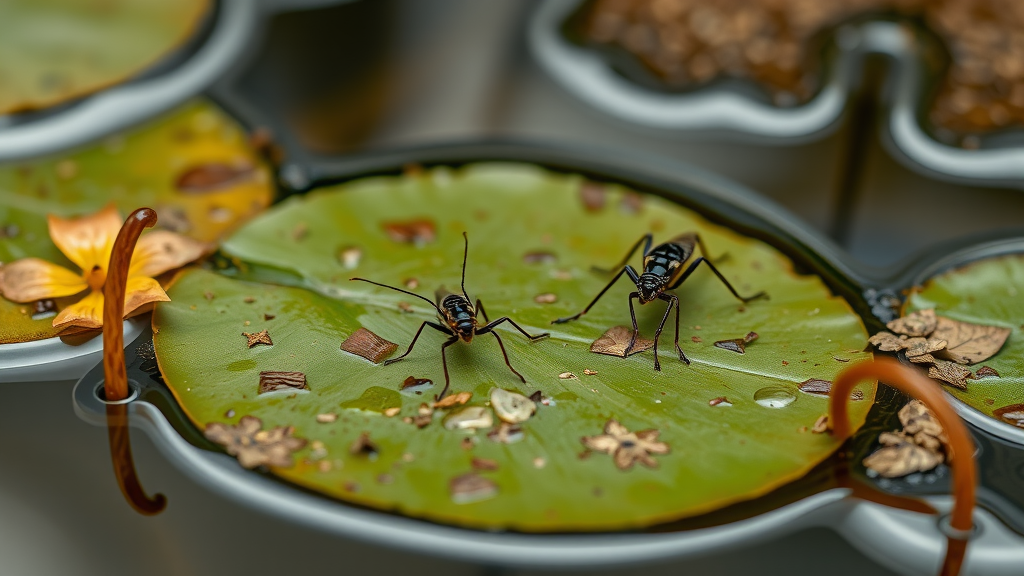
In the heart of Prayagraj, India, two unassuming artificial ponds tucked inside botanical gardens have become unlikely sentinels of urban freshwater health. A new six-month study, published in Discover Ecology, shows that the smallest residents of these ponds—benthic macroinvertebrates such as insect larvae, snails, and worms—can tell a far richer story about water quality than chemical probes alone. By combining monthly biological surveys with physicochemical measurements from November 2023 to April 2024, researchers uncovered a striking paradox: the pond with worse water chemistry often hosted healthier biological communities, a finding that challenges how scientists and city planners monitor small urban water bodies worldwide.
The research team, led by Simoni Singhal and Jyoti Verma of CMP Degree College, University of Allahabad, focused on two ponds separated by barely a kilometer: one in the botanical garden of CMP Degree College (Site S1) and another in the University of Allahabad’s botanical garden (Site S2). Despite their geographic proximity, the ponds differed sharply in size, surrounding land use, and management. S1 sat amid organic farming and vegetated grounds, while S2 was dominated by lilies and bordered by access pathways. The team hypothesized that these contrasting microenvironments would shape entirely different communities of bottom-dwelling organisms—and they were right.
Sampling followed a rigorous design intended to capture hidden variability. Each pond was divided into three stratified zones reflecting distinct microhabitats: vegetated margins, open water, and detritus-rich bottoms. Using the kick-stir-sweep technique, researchers dislodged organisms from sediments and collected them through a D-frame net with a 0.5-millimeter mesh, preserving specimens in 4 percent formalin for laboratory sorting under dissecting microscopes. Crucially, the team identified organisms to the lowest practicable taxonomic level—genus or species where possible—rather than relying on coarse family-level groupings that can blur subtle ecological signals. Simultaneously, calibrated field probes recorded pH, total dissolved solids, electrical conductivity, and dissolved oxygen at every visit.
The physicochemical results painted two very different portraits. Site S1 remained stable and well-aerated, with dissolved oxygen between 9.1 and 9.8 milligrams per liter, slightly alkaline pH, and low nutrient concentrations. Site S2 told a more troubled story: dissolved oxygen dropped to 4.1 to 4.7 milligrams per liter, total dissolved solids climbed as high as 874 parts per million, phosphate reached 0.14 parts per million, and dissolved ammonia ranged from 0.12 to 0.23 grams per liter—signatures consistent with untreated urban effluent and organic enrichment. Temperature at S2 also swung widely, from 14.1 to 23.5 degrees Celsius, reflecting shallow water and increased solar exposure during the hot pre-monsoon months.
Yet when the researchers turned to the organisms themselves, the picture inverted. Across both ponds, they recorded ten orders and eighteen families of macroinvertebrates spanning arthropods, annelids, and mollusks, with insects dominating—67.33 percent of the assemblage at S1 and 75.43 percent at S2. Pollution-sensitive families such as the mayfly Ephemerellidae, the caddisfly Hydropsychidae, and the stonefly Perlidae appeared more frequently at S1, while tolerant groups like Chironomidae, Culicidae, and the snail Planorbidae clustered at S2, especially during the dry March–April interval. But the biotic indices told a subtler tale: the Ephemeroptera–Plecoptera–Trichoptera (EPT) richness at S2 rose from 26 percent in November–December to 36 percent in March–April, crossing into the good water quality category, while S1’s EPT values hovered between 9.8 and 13.3 percent, signaling persistent moderate stress.
The Hilsenhoff Biotic Index, which weights each taxon by its known pollution tolerance, reinforced this divergence. At S1, HBI values climbed sharply from roughly 1.3 in January–February to above 4 by November–December, indicating growing dominance of tolerant organisms and mounting organic pollution. At S2, values stabilized after an early-season rise, suggesting moderate but manageable pressure. Diversity metrics added nuance: Shannon–Wiener values ranged from 2.88 to 3.25 across both sites, with S1 peaking near 3.25 but fluctuating more widely, while S2 maintained steadier diversity and lower Simpson dominance (mean about 0.27 versus 0.31), implying a more evenly balanced community at the chemically degraded pond.
To probe the mechanisms behind these patterns, the team employed canonical correspondence analysis, a multivariate technique that maps species distributions against environmental gradients. The first two canonical axes explained approximately 72 percent of the constrained variation in community composition, with pH, dissolved oxygen, and nitrate loading positively on the first axis and temperature and total dissolved solids loading negatively. Pulmonate snails and dipterans aligned with higher pH and oxygen, while gastropods tracked warmer, more mineralized waters. Pearson correlations revealed additional structure: temperature correlated negatively with dissolved oxygen at both sites, most strongly at S2 (r = −0.62), and Simuliidae and Ceratopogonidae co-occurred strongly at S2 (r = 0.70), hinting at shared ecological preferences or niche overlap.
Functional feeding group analysis added an ecosystem-process dimension to the story. At S1, predators such as diving beetles and damselfly larvae made up 44.37 percent of the assemblage, scrapers—mainly Planorbidae snails grazing on algae—accounted for 30.28 percent, and collector-gatherers contributed 12.65 percent, together painting a detritus-rich, prey-abundant food web. At S2, predators still led at 38.46 percent, but passive filter feeders, dominated by net-spinning Hydropsychidae caddisflies, reached 11.11 percent compared with just 2.82 percent at S1—a shift consistent with better water circulation and a steady supply of suspended organic particles. Shredders were scarce at both sites, reflecting limited coarse leaf-litter input typical of managed pond environments.
The study’s most consequential insight is methodological: chemistry and biology can disagree, and that disagreement is itself informative. The authors attribute the mismatch at S2 to episodic pollution pulses, legacy populations persisting from earlier conditions, lagged biological responses, and microhabitat buffering provided by macrophytes, shade, and substrate complexity. Chemical snapshots taken at a single point in time can miss transient pollution events, while macroinvertebrate communities integrate stress over weeks and months. Neither pond was found to be critically degraded, but seasonal stress—particularly during March–April—warrants targeted pollution control, habitat enrichment, and sustained monitoring. The researchers argue that urban artificial ponds, long overlooked in conservation policy, deserve recognition as genuine biodiversity reservoirs, and that future assessments should embrace multi-metric bioassessment, fine-scale taxonomy, spatially replicated sampling, and real-time physicochemical monitoring to safeguard these small but ecologically potent waters.
Subject of Research: Integrated bioassessment of urban artificial pond health using benthic macroinvertebrates and physicochemical water quality in Prayagraj, India
Article Title: Deciphering urban freshwater health through integrated assessment of benthic macroinvertebrate assemblage and physicochemical dynamics in artificial ponds of Prayagraj, India
Article References: Singhal, S., Srivastava, A., Srivastava, P., & Verma, J. (2026). Deciphering urban freshwater health through integrated assessment of benthic macroinvertebrate assemblage and physicochemical dynamics in artificial ponds of Prayagraj, India. Discover Ecology, 2(1), Article 5. https://doi.org/10.1007/s44396-025-00020-x
Image Credits: AI Generated
DOI: 10.1007/s44396-025-00020-x
Keywords: benthic macroinvertebrates, urban ponds, water quality, bioindicators, Hilsenhoff Biotic Index, EPT richness, functional feeding groups, dissolved oxygen, organic pollution, Prayagraj, freshwater ecology, biomonitoring
Cite Scienmag News
Gavin Prescott. (September 24, 2026). Tiny Pond Insects Reveal Hidden Health Secrets of India’s Urban Waters. Scienmag. https://scienmag.com/tiny-pond-insects-reveal-hidden-health-secrets-of-indias-urban-waters/
Gavin Prescott. "Tiny Pond Insects Reveal Hidden Health Secrets of India’s Urban Waters." Scienmag, 24 September 2026, https://scienmag.com/tiny-pond-insects-reveal-hidden-health-secrets-of-indias-urban-waters/. Accessed 24 September 2026.
Gavin Prescott. "Tiny Pond Insects Reveal Hidden Health Secrets of India’s Urban Waters." Scienmag. September 24, 2026. https://scienmag.com/tiny-pond-insects-reveal-hidden-health-secrets-of-indias-urban-waters/


