


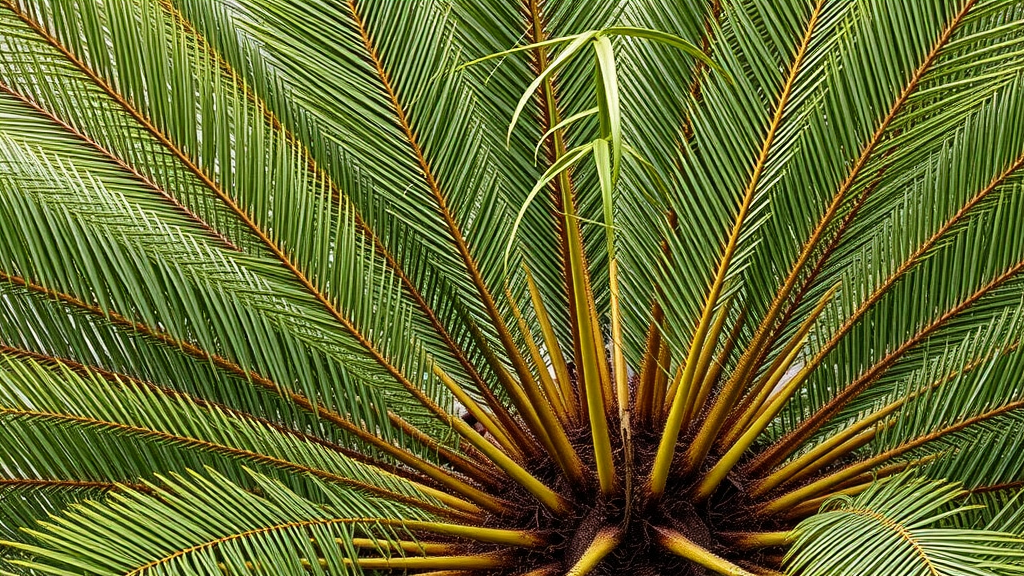
On the small island of Rota in the Commonwealth of the Northern Mariana Islands, one of the world’s most ancient lineages of plants has been all but erased in a single human generation. A new long-term study published in Discover Conservation documents how the armored scale insect Aulacaspis yasumatsui, an invasive herbivore barely visible to the naked eye, reduced the native cycad Cycas micronesica from a thriving population of more than 11,000 stems per hectare to just 149 stems per hectare over fifteen years. The research, led by Thomas E. Marler together with Michael Calonje, Pablo Y. Rosiles-Loeza, Robert Neil F. Leong, and Angélica Cibrián-Jaramillo, is the first in any cycad species to combine population genetics with long-term demographic monitoring across an invasive insect invasion, and it delivers one of the starkest quantitative portraits of invasion-driven plant decline ever assembled.
Cycads are often described as living fossils, a lineage of gymnosperms that has persisted for roughly 280 million years, and they now hold the grim distinction of being the most threatened plant group on Earth. Cycas micronesica is the only cycad in Micronesia and the only gymnosperm on Rota, an 85-square-kilometer island whose tropical climate receives nearly 3,550 millimeters of rain each year. Until 2007, the species flourished across the island’s coastal forests and uplifted karst benches. That year, the armored scale A. yasumatsui, native to mainland Southeast Asia where it coexists harmlessly with its local Cycas hosts, was first recorded in Rota’s northeastern littoral forests. Within three years, three separate invasion fronts had spread across the island, and by 2011 every cycad habitat on Rota was infested.
The researchers were unusually well prepared for the catastrophe. In December 2007, before the scale had reached most of the island, the team collected leaflet tissue from 116 cycads across seven localities, sampling along transects that captured the full environmental and geographic range of the species on Rota. Using ten microsatellite loci developed specifically for this species, they characterized the pre-invasion genetic structure of the population. The genetic work revealed considerable variation, with 75 percent of alleles occurring at low frequency, and identified four distinct genetic clusters across the island. Pairwise differentiation among sites was moderate to strong, and a Mantel test found no significant isolation-by-distance pattern, suggesting that historical founder events, limited seed dispersal, and localized disturbance rather than simple geography shaped the island’s genetic architecture.
That genetic baseline proved critical for interpreting what came next. In January 2008, the team established 28 permanent monitoring plots across seven sites, each site containing square plots and belt transects covering roughly 100 square meters. At the time of the first census, the population stood at 11,254 stems per hectare, of which 9.2 percent were adult trees. Mean stem height was a mere 30 centimeters, because the population was dominated by seedlings and juveniles, a signature of vigorous regeneration. The seedling-to-juvenile-to-adult ratio of 70:21:9 described a population with a prosperous future. Within a single year of the scale’s arrival at each site, that future had collapsed.
The demographic data collected through 2023 reveal a merciless selective culling ordered by plant size. Seedling mortality was immediate and complete: every seedling in the plots died within roughly a year of local scale arrival, and no seedlings were observed from 2014 through the end of the study. Juveniles followed more slowly but no less surely, with more than 70 percent dead by the 2011 census and 100 percent mortality reached by 2023. Adult trees, buffered by their larger stores of parenchymatous tissue and non-structural carbohydrates, held out longer, but from 2013 to 2023 the island lost an average of 80 adult trees per hectare each year, culminating in 86 percent adult mortality. Across all age classes, total population mortality reached 98.6 percent within fifteen years.
The plant health metrics tell an equally dramatic story. In 2008, adult trees carried an average of 83 leaves, and some individuals bore more than 150. The scale’s herbivory killed standing leaves and then each new flush of foliage as it emerged, driving the mean down to just 8 leaves per tree by 2013. A slow recovery began around 2017, and by 2023 surviving adults averaged 20 leaves, a 2.5-fold improvement over 2013 but still only 24 percent of the pre-invasion benchmark. Mean stem height, meanwhile, rose from 30 centimeters to 245 centimeters, an eightfold increase that reflects not growth but the selective death of every small plant, a severe left-truncation of the population’s size distribution that the authors describe as an irreversible reduction in future survival potential.
Infestation intensity followed a characteristic invasion curve. Scores rose sharply to a peak around 2011, when the mean infestation score reached 8.4 on a 10-point scale and 100 percent of the island’s cycad habitats were colonized. Scores then declined and stabilized at roughly 3 to 4 from 2016 onward. The authors caution against reading this apparent easing as recovery, noting that the cause of the reduced scale damage remains unidentified and that the healthier appearance of surviving adults in 2023 conceals the absence of any regeneration whatsoever. In 2008, Rota’s habitats held more than 10,000 cycads under 100 centimeters in height per hectare; in 2023, there were none.
Comparisons with neighboring Guam, where the scale arrived in 2003, show strikingly parallel outcomes despite different ecological contexts. Guam’s population suffered 96 percent total mortality by 2020, with adult mortality of 87 percent, closely matching Rota’s figures. The main difference was demographic: Rota’s higher density of seedlings and juveniles produced faster initial population-level losses. The timing of a second invader, the cycad blue butterfly Luthrodes pandava, which was already established on Rota before the scale arrived but reached Guam two years after the scale, appears to have made little difference, indicating that the timing of the A. yasumatsui invasion alone governs plant mortality. The consistency across islands demonstrates that the scale is the dominant driver of decline, overwhelming any buffering effect of genetic diversity, since even sites with high expected heterozygosity suffered extreme mortality.
The genetic findings carry profound implications for conservation. Because most variation is partitioned within populations and several sites harbor unique private alleles, each extirpated habitat represents an irreversible loss of evolutionary potential. Site 7, an isolated western peninsula fragment that was the last to be infested and the only site to reach 100 percent extirpation before 2023, exemplifies the stakes. The authors argue that ex situ seed collections, such as the established conservation program on Tinian, are now essential for any reintroduction, and that provenance integrity must be maintained to preserve Rota’s fine-scale genetic structure. They further identify effective biological control of A. yasumatsui, something repeatedly urged by the IUCN Cycad Specialist Group since 2003 but never formally funded and achieved, as the single most critical intervention. As a foundation species central to island ecosystems and CHamoru cultural traditions, the selective removal of C. micronesica threatens cascading consequences for dependent insects, fruit bats, and human communities alike, making this study both a eulogy and a roadmap for what remains.
Subject of Research: Population genetics and demographic collapse of the cycad Cycas micronesica following invasion by the armored scale Aulacaspis yasumatsui on Rota Island
Article Title: Genetics, survival, and demographic decline of Cycas micronesica due to invasive insect species on an oceanic island
Article References: Marler, T. E., Calonje, M., Rosiles-Loeza, P. Y., Leong, R. N. F., & Cibrián-Jaramillo, A. (2026). Genetics, survival, and demographic decline of Cycas micronesica due to invasive insect species on an oceanic island. Discover Conservation, 3(1), Article 19. https://doi.org/10.1007/s44353-026-00089-9
Image Credits: AI Generated
DOI: 10.1007/s44353-026-00089-9
Keywords: Cycas micronesica, Aulacaspis yasumatsui, cycad conservation, invasive species, population genetics, Rota Island, demography, seedling mortality, microsatellites, biological control, island ecology, extinction risk
Cite Scienmag News
Gavin Prescott. (September 24, 2026). Invasive Scale Insect Wiped Out 99% of a Remote Island’s Ancient Cycads in 15 Years. Scienmag. https://scienmag.com/invasive-scale-insect-wiped-out-99-of-a-remote-islands-ancient-cycads-in-15-years/
Gavin Prescott. "Invasive Scale Insect Wiped Out 99% of a Remote Island’s Ancient Cycads in 15 Years." Scienmag, 24 September 2026, https://scienmag.com/invasive-scale-insect-wiped-out-99-of-a-remote-islands-ancient-cycads-in-15-years/. Accessed 5 October 2026.
Gavin Prescott. "Invasive Scale Insect Wiped Out 99% of a Remote Island’s Ancient Cycads in 15 Years." Scienmag. September 24, 2026. https://scienmag.com/invasive-scale-insect-wiped-out-99-of-a-remote-islands-ancient-cycads-in-15-years/


