


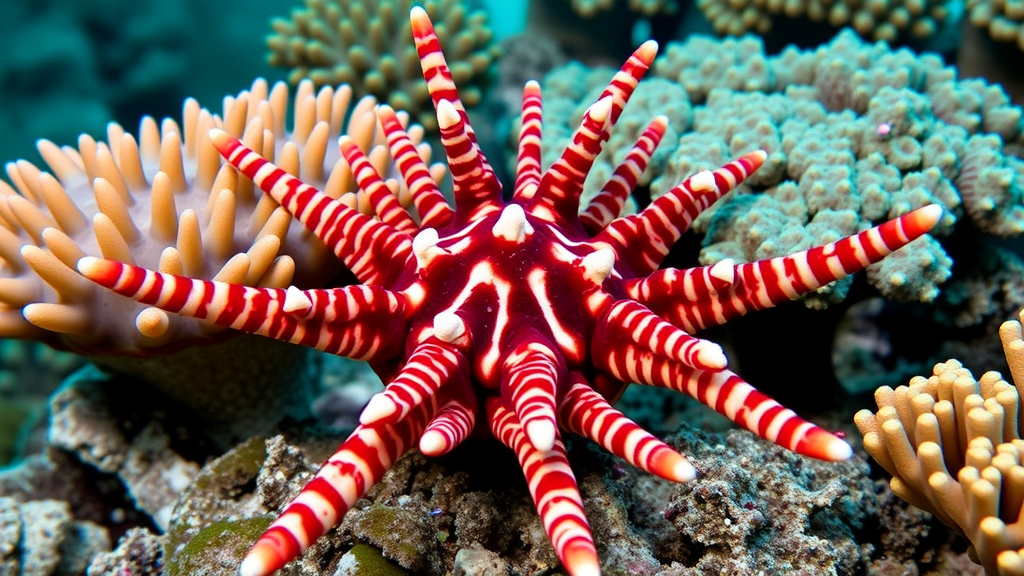
Few marine animals carry a reputation as fearsome as the crown-of-thorns starfish. Armed with long, venom-laden spines and a voracious appetite for coral tissue, the species has long been cast as the villain of the Great Barrier Reef, capable of stripping vast swaths of living coral from tropical seascapes. Yet new research from the University of Sydney suggests this notoriety tells only half the story. When their numbers are kept in check, crown-of-thorns starfish may actually play a constructive role on coral reefs, helping to maintain the very diversity that makes these ecosystems resilient.
The study, published in the journal Ecology and Evolution, reports the results of a survey tracking coral feeding scars and surviving coral tissue after predation by individual crown-of-thorns starfish. The fieldwork was carried out at the University of Sydney’s One Tree Island Research Station on the southern Great Barrier Reef, in protected areas where healthy populations of fish and other predators keep the starfish at naturally low densities. In these balanced conditions, the researchers found something surprising: living coral tissue remained after almost 75 percent of the starfish feeding events they examined.
Dr Shawna Foo, a University of Sydney Horizon Fellow in the School of Life and Environmental Sciences who led the research, explained that the starfish at One Tree Reef behave very differently from the destructive swarms that have plagued other parts of the Great Barrier Reef. Rather than demolishing an entire coral colony in a single assault, starfish at low density appear to consume a relatively consistent amount of coral during each meal before moving on to another colony. This grazing pattern frequently leaves live coral tissue remnants behind, giving the corals a chance to recover.
That distinction matters enormously for how scientists and reef managers understand the species. Crown-of-thorns starfish are native to the Great Barrier Reef, where they have long been part of the ecological fabric. Since the 1960s, however, the reef has experienced four major outbreaks, erupting at intervals of approximately 15 years, each capable of causing mass coral destruction. The new findings do not diminish the significance of these devastating events, which coral populations struggle to recover from. Instead, they highlight an overlooked upside of low-density starfish populations functioning within a healthy marine ecosystem.
The mechanism behind the starfish’s constructive role lies in the competitive hierarchy of corals themselves. On many reefs, fast-growing species in the family Acroporidae, which includes the familiar branching and table corals of the genus Acropora, can rapidly colonize available space and shade out slower competitors. The study found that remnants of these fast-growing Acroporidae corals did not regenerate over the feeding scars left by starfish. Regeneration occurred mostly among much slower-growing Montipora and massive Porites corals, which gradually reclaimed the damaged areas. By preferentially trimming back the dominant, fast-growing species, low-density starfish populations open space for slower-growing corals to persist.
In effect, the starfish act as reluctant gardeners, pruning the most aggressive competitors and preventing any single coral species from monopolizing the reef. This increases the structural and taxonomic diversity of the coral community, a quality widely associated with healthier, more resilient reef ecosystems. Foo noted that by feeding on fast-growing corals such as Acropora, low-density populations create space for slower-growing species, helping to increase overall coral diversity across the reef.
The results align closely with a foundational concept in ecology known as the intermediate disturbance hypothesis. Professor Maria Byrne, a co-author of the study, said the findings are consistent with this important framework in ecology and conservation. The hypothesis proposes that occasional, moderate disturbance within an ecosystem can actually help maintain biodiversity, because it prevents dominant species from excluding others while stopping short of the catastrophic damage that eliminates species altogether. Crown-of-thorns starfish feeding at low densities appear to fit this pattern precisely, applying a measured pressure that keeps coral competition in balance without pushing the system toward collapse.
Understanding when starfish shift from ecological regulators to reef destroyers is a central question for conservation. The balance appears to hinge on predation. Diminishing populations of crown-of-thorns predators, including the giant triton snail and multiple species of coral reef fishes, heighten the vulnerability of the Great Barrier Reef and marine environments worldwide to outbreaks. Where those predators thrive, as in the protected zones surveyed at One Tree Reef, starfish numbers remain low and their feeding becomes a modest, even beneficial, component of reef dynamics. Where predator populations have collapsed, starfish can multiply into swarms that consume coral faster than it can regrow.
The research also carries practical implications for how managers respond to outbreaks. Current control efforts rely heavily on culling programs in which divers inject starfish to remove them from affected reefs. Foo emphasized that the new findings can help determine when and why culling should occur, and what the ecological endpoint of a cull should be. Once an outbreak has been suppressed, she argued, the goal should not necessarily be to eliminate crown-of-thorns starfish entirely. Instead, culling needs to be complemented by strong marine management that protects the starfish’s natural predators and keeps populations in check, allowing the species to resume its natural role rather than tipping back toward destructive abundance.
The study, an observational survey of coral feeding scars conducted on the Great Barrier Reef, reframes one of the ocean’s most feared invertebrates as a species whose impact depends entirely on context. In a functioning ecosystem with its predators intact, the crown-of-thorns starfish is a native coral predator performing a role that has shaped reef communities for millennia. Only when that balance is disrupted does it become the reef-wrecker of popular imagination. For a Great Barrier Reef facing warming waters, bleaching and repeated outbreaks, the message from One Tree Island is a nuanced one: the enemy of corals can, in the right numbers, be part of their salvation, and conservation strategies that restore ecological balance may prove more powerful than eradication alone.
Subject of Research: The ecological role of crown-of-thorns starfish predation in maintaining coral reef biodiversity
Article Title: Crown-of-thorns starfish can help reefs thrive
Article References: Crown-of-thorns starfish can help reefs thrive. (n.d.). Original publication
Image Credits: AI Generated
DOI: Not provided
Keywords: crown-of-thorns starfish, coral reefs, Great Barrier Reef, biodiversity, intermediate disturbance hypothesis, marine ecology, coral predation, One Tree Island, reef management, culling, Acropora, University of Sydney
Cite Scienmag News
Gavin Prescott. (September 24, 2026). Crown-of-Thorns Starfish, Reef Villains, May Actually Boost Coral Diversity. Scienmag. https://scienmag.com/crown-of-thorns-starfish-reef-villains-may-actually-boost-coral-diversity/
Gavin Prescott. "Crown-of-Thorns Starfish, Reef Villains, May Actually Boost Coral Diversity." Scienmag, 24 September 2026, https://scienmag.com/crown-of-thorns-starfish-reef-villains-may-actually-boost-coral-diversity/. Accessed 24 September 2026.
Gavin Prescott. "Crown-of-Thorns Starfish, Reef Villains, May Actually Boost Coral Diversity." Scienmag. September 24, 2026. https://scienmag.com/crown-of-thorns-starfish-reef-villains-may-actually-boost-coral-diversity/


