


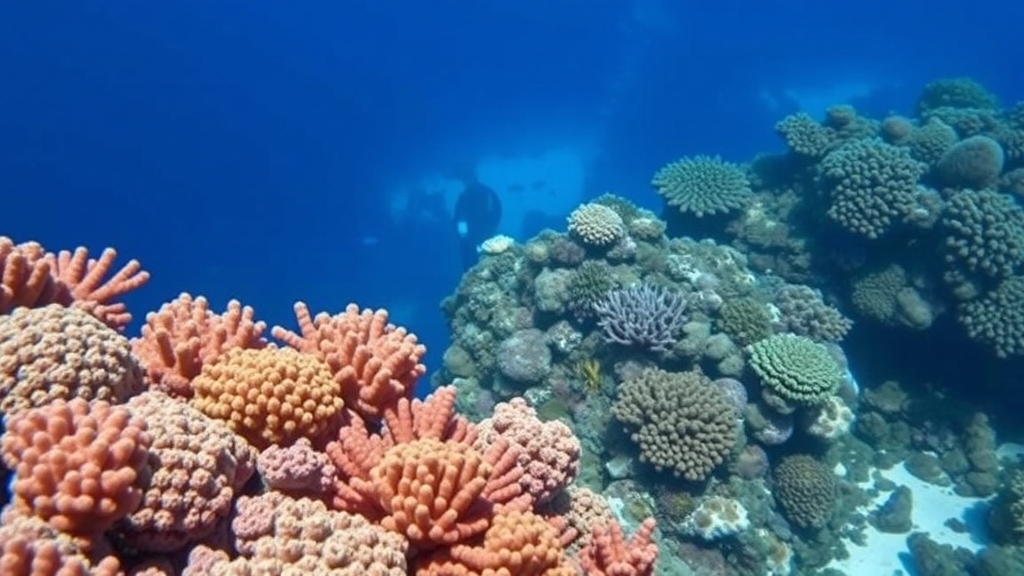
A debate currently convulsing the coral reef science community has moved far beyond the usual disputes over methods and budgets, arriving at a question most researchers would rather avoid: what, exactly, is a coral reef worth, and what kind of worth are we talking about? The controversy began when Camacho and colleagues argued in PNAS that Caribbean coral reefs have degraded so severely that conventional restoration can no longer achieve meaningful outcomes, and that the region’s reefs should therefore be considered candidates for ecological replacement—the deliberate translocation of Indo-Pacific coral species to re-establish the ecosystem services that native Caribbean assemblages can no longer sustain. Writing in the journal Coral Reefs, R. Scott Winters of the Coral Restoration Foundation has now stepped into the fray with a perspective essay that neither endorses nor simply condemns the proposal. Instead, he dissects the assumption buried inside it: that coral reefs are valuable primarily for the services they deliver to humans, a framing that, if accepted, makes wholesale substitution of one reef for another not merely thinkable but logically consistent.
The distinction matters because restoration and conservation are not value-neutral sciences. Winters emphasizes that they are normative practices, conjoining empirical facts with value judgments to determine what ought to be done in a particular circumstance. Every decision about what counts as success, what losses are tolerable, and what interventions are permissible already embeds normative commitments, whether or not practitioners acknowledge them. When Camacho and co-authors propose replacing Caribbean corals with Pacific species, they are not simply offering a technical fix; they are making an implicit axiological claim about what a reef is and why it merits protection. The essay’s provocation, Winters argues, lies less in the unorthodox intervention itself than in the challenge it poses to how the field conceptualizes a coral reef in the first place.
Environmental philosophers have long distinguished among instrumental, relational, and intrinsic value, a framework developed in influential work by Chan and colleagues and systematically reviewed by Himes and colleagues. Instrumental value treats nature as a means to human ends: reefs matter because they supply fisheries, shoreline protection, tourism revenue, and livelihoods. Relational value rests on the connections between people and particular places—cultural identity, heritage, and the continuity of a community’s relationship with a specific reef. Intrinsic value, by contrast, holds that reefs possess worth independent of any utility, derived benefit, or human relationship whatsoever. The argument for ecological replacement rests squarely on the instrumental frame: if the value of a reef is derived from the benefits it provides, then any object delivering comparable benefits can, in principle, substitute for it. Caribbean corals become interchangeable parts.
Under that logic, Camacho and colleagues contend that if the goal is to preserve the ecosystem services of Caribbean reefs—complex three-dimensional structure supporting fisheries, coastal protection, and tourism—then importing Indo-Pacific corals capable of surviving escalating thermal stress is a rational, perhaps necessary, response. Winters is careful to state that he is not advocating or even condoning ecological replacement. His aim is to force the discussion that the proposal’s value assumption demands: why preserve or restore coral reefs at all, and what is the nature of their value? The answer, he argues, is not academic hair-splitting, because the type of value a reef holds directly determines which interventions are acceptable. If reefs have only instrumental value, substitution is permissible—even, in an absurd limiting case, the construction of an ecosystem-services machine. If value is relational, modification may be allowed but not replacement. If value is intrinsic, then anything altering the reef’s nature may be unacceptable.
The broader context makes the stakes concrete. Tropical reefs worldwide face escalating bleaching events driven by rising ocean temperatures, declining coral cover, and structural erosion as dead corals crumble. The causes are a complex interplay of local and global stressors, and the risks are both deterministic—increasingly frequent thermal anomalies—and stochastic, as small, fragmented populations spiral into extinction vortices, a dynamic described in classic work by Shaffer and by Gilpin and Soulé. For the better part of a decade, the dominant response has been to scale up coral repopulation locally, aiming to increase coral coverage at lower cost. But critics have questioned the expense, scalability, and efficacy of these efforts, with recent analyses by Hughes and colleagues, Streit and colleagues, and Mulà and colleagues arguing that restoration cannot be scaled globally to compensate for climate-driven loss. Others, including Peixoto and colleagues, dispute the premise that active intervention no longer improves outcomes.
Much restoration discourse frames the work as buying time—not to return reefs to a historical baseline, which most now regard as illusory given a century of climatic and ecological change, but to help extant populations endure intensifying thermal stress. Within that framing, addressing stochastic risk means preserving remnant genetic diversity, for example through genetic rescue, an approach advanced by Baums and colleagues and, most recently, by Baker and colleagues in Science, who argue for proactive assisted gene flow for Caribbean corals. Addressing deterministic risk, by contrast, is often imagined as requiring technological interventions: passive protection such as shading or cloud brightening, or enhancement of thermal tolerance through assisted evolution. Winters observes that these approaches share an implicit physical conceptualization of the reef—the goal is to keep the actual, historically contingent assemblage alive. Ecological replacement abandons that conceptualization entirely, decoupling the reef’s physical manifestation from its perceived function for humans.
The tension is not new. Earlier debates over the ecological and social value of artificial reefs, and the long-running controversy within conservation biology over grounding protection in ecosystem services rather than biodiversity—famously crystallized in McCauley’s ‘Selling out on nature’—turned on similar questions about what counts as the thing being saved. What Camacho and colleagues add is the sharpest possible version of the question: whether a reef’s identity can be substituted entirely and the result still count as restoration. Their proposal has generated strongly polarized responses, with Ritson-Williams, Mumby, and Steneck arguing in PNAS that introduced species will not save Caribbean reefs, Loya and van Woesik countering with a case for process-based recovery over ecological replacement, and Camacho’s team replying that replacement research is vital precisely because of uncertainty and unprecedented stress.
Beyond the philosophical dispute, Winters takes seriously the ecological and ethical objections. An introduced coral capable of persisting where native corals cannot could disperse via larvae far beyond any introduction site, placing countries that never consented to the intervention at risk—a procedural injustice in itself. The risk of unwanted spread has ample precedent in the assisted colonization literature, notably Ricciardi and Simberloff’s critique of assisted colonization as a conservation strategy. Winters judges these objections compelling enough to warrant considerable caution before any field trial proceeds. But he also insists that resolving the ecological risks would not settle the underlying question: by what standard of value should any restoration intervention be judged a success? A monitoring metric appropriate to instrumental value, such as restored service delivery, is not interchangeable with one appropriate to intrinsic value, such as the persistence of a specific evolutionary lineage, or relational value, such as a community’s continuing bond with a particular reef.
Winters ultimately concludes that the argument for ecological replacement, resting on instrumental value, either abandons the notion that reefs have intrinsic worth or assumes Caribbean reefs have already eroded past the point of retaining any—and he considers that a bridge too far at present, not because it may prove false, but because the field has neglected sustained analysis of reef value. If we accept the instrumental framing, ecological replacement becomes one of many options requiring comparative evaluation; if we believe reefs hold intrinsic value that cannot be recovered to a historical state, we face the older philosophical worry articulated by Elliot as faking nature. The practical implication is direct: restoration programs, funders, and agencies should be explicit about which type of value each intervention is meant to secure, because limited resources and intended beneficiaries can only be assessed in light of the value sought. Determining what is being preserved, for whom, and at the expense of what alternatives, Winters writes, is not a scientific or technical question at all. It is an ethical one, and the future of the Caribbean’s reefs may depend on answering it before the next intervention is deployed.
Subject of Research: The normative value frameworks underlying proposed ecological replacement of Caribbean coral reefs with Indo-Pacific coral species.
Article Title: Why bother? What kind of value do Caribbean coral reefs have?
Article References: Why bother? What kind of value do Caribbean coral reefs have?. (n.d.). https://doi.org/10.1007/s00338-026-02960-6
Image Credits: AI Generated
DOI: 10.1007/s00338-026-02960-6
Keywords: coral reefs, Caribbean, ecological replacement, coral restoration, ecosystem services, intrinsic value, instrumental value, relational values, conservation ethics, assisted colonization, climate change, biodiversity
Cite Scienmag News
Margaret Porter. (September 22, 2026). What Are Caribbean Coral Reefs Worth? A Radically Uncomfortable Question Divides Scientists. Scienmag. https://scienmag.com/what-are-caribbean-coral-reefs-worth-a-radically-uncomfortable-question-divides-scientists/
Margaret Porter. "What Are Caribbean Coral Reefs Worth? A Radically Uncomfortable Question Divides Scientists." Scienmag, 22 September 2026, https://scienmag.com/what-are-caribbean-coral-reefs-worth-a-radically-uncomfortable-question-divides-scientists/. Accessed 22 September 2026.
Margaret Porter. "What Are Caribbean Coral Reefs Worth? A Radically Uncomfortable Question Divides Scientists." Scienmag. September 22, 2026. https://scienmag.com/what-are-caribbean-coral-reefs-worth-a-radically-uncomfortable-question-divides-scientists/


