


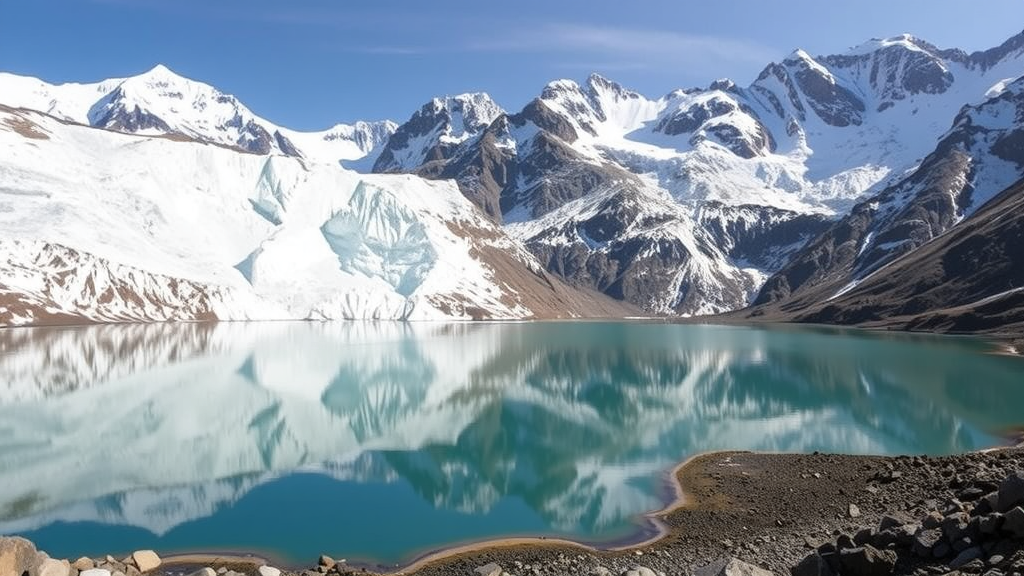
High in the mountains of the Tibetan Plateau, a new generation of lakes is quietly forming as glaciers retreat, and scientists are discovering that these sparkling blue waters may harbor a far more consequential story than their serene appearance suggests. A new study published in the journal Microbiome reveals that the microbial communities dwelling in these young proglacial lakes undergo a dramatic seasonal reorganization that governs whether the lakes store methane beneath their winter ice or release it into the atmosphere during the summer melt season. The findings carry unsettling implications, because as the climate continues to warm, the delicate microbial balance that currently limits methane escape may tip in favor of the microbes that produce it.
Proglacial lakes form when meltwater pools in depressions left behind by retreating glaciers. They are among the fastest expanding aquatic ecosystems on Earth, and because glacial sediments contain abundant organic carbon that can be converted to methane by anaerobic microbes, these lakes are increasingly recognized as potentially significant sources of this potent greenhouse gas. Yet until now, the microbial machinery controlling when and how much methane escapes from these systems has remained poorly understood, particularly in high-altitude settings where lakes remain ice-covered for much of the year.
To unravel these dynamics, a research team led by scientists from Tianjin University and collaborating institutions across China integrated an unusually comprehensive set of approaches. They carried out multi-season field observations in newly formed high-altitude proglacial lakes on the Tibetan Plateau, measuring dissolved methane concentrations in the water column and sediments under both ice-covered and open-water conditions. They complemented these measurements with stable isotope analyses capable of distinguishing between methane production and methane consumption, metagenomic sequencing to profile the full genetic potential of the lake microbiomes, and laboratory incubation experiments to test how the communities respond to changing conditions.
The first major surprise came from beneath the ice. Even during the ice-covered period, when the lakes are sealed off from the atmosphere and conditions are cold and dim, the researchers documented substantial accumulation of dissolved methane throughout the water column. This was unexpected in part because sequencing revealed an enrichment of anaerobic methane-oxidizing microbes belonging to the phylum Candidatus Methylomirabilota in the sediments, organisms that should, in principle, be consuming methane rather than allowing it to build up. The presence of these methane scavengers suggested the lakes had a built-in defense against methane accumulation, yet the gas was accumulating anyway.
Stable isotope analysis helped resolve the puzzle. The data showed that methane oxidation was indeed active during the early part of the ice-covered period, meaning microbes were breaking down methane as it was produced. But as the ice-covered season progressed into its late phase, oxidation became limited, and the balance shifted decisively toward accumulation. In effect, the lakes spent the winter banking methane beneath the ice, with the microbial oxidizers unable to keep pace with production during the coldest, most oxygen-starved months. This stage of the annual cycle transforms the lakes into temporary methane reservoirs whose contents await the spring thaw.
When the ice finally gave way and the ablation period began, the microbial landscape transformed. In the bottom sediments, acetoclastic methanogens of the genus Methanosarcina, which generate methane from acetate, rapidly recovered, ramping up production. At the same time, a significant population of aerobic methane-oxidizing bacteria of the genus Methylobacter became established in the surface sediments, where oxygen from the overlying water was now available. The result was a striking simultaneous activation of both methane production at depth and methane consumption at the surface, a layered arrangement that determines how much of the winter’s accumulated gas actually reaches the atmosphere.
Statistical analysis pointed to temperature as the strongest factor associated with the shift in methanogenic and methanotrophic communities between the ice-covered and ablation periods. The microbial reorganization was accompanied by a marked increase in the relative abundance of genes involved in methane metabolism, and by enhanced functional coupling among the pathways cycling methane, nitrogen, and sulfur. This interconnectedness suggests that these elemental cycles in proglacial lakes do not operate in isolation; instead, the microbes that process methane are woven into a broader metabolic network whose structure changes seasonally as thermal conditions evolve.
Taken together, the findings demonstrate that microbial succession drives the seasonal transition from net methane accumulation beneath the ice to net methane consumption during open-water conditions. For now, the oxidizing microbes that flourish during the summer provide a natural buffer, consuming a substantial share of the methane produced in the sediments before it can escape. But that buffer has limits, and the study’s authors caution that it may be eroding. Because methanogenesis appears to be more sensitive to rising temperatures than methanotrophy, continued climate warming could disrupt the balance between production and consumption, tilting it toward the producers.
The implications extend well beyond the Tibetan Plateau. Proglacial lakes are multiplying across every major mountain range on the planet as glaciers retreat, from the Andes to the Himalayas to Alaska, and the newly exposed sediments they flood contain carbon that microbes can convert to methane. If warming systematically favors methane-producing archaea over methane-consuming bacteria in these systems, the world’s swelling population of young glacier-fed lakes could shift from being modest, partially buffered emitters into substantially stronger sources of atmospheric methane, adding a feedback loop to global warming that current climate models have only begun to account for.
The study also underscores the power of combining long-term field observation with genomics and isotope chemistry to understand ecosystem processes that no single method can capture alone. By tracking the seasonal choreography of specific microbial taxa, including Methanosarcina, Methylobacter, and Candidatus Methylomirabilota, and linking them to measurable fluxes of methane, the researchers have provided one of the clearest pictures yet of how life beneath and beyond the ice regulates a greenhouse gas with more than eighty times the near-term warming power of carbon dioxide. As deglaciation accelerates, monitoring these microbial gatekeepers may prove essential to forecasting how high mountain ecosystems will influence the planet’s climate in the decades ahead.
Subject of Research: Microbial regulation of seasonal methane cycling in newly formed high-altitude proglacial lakes on the Tibetan Plateau
Article Title: From under-ice accumulation to open-water oxidation: microbial regulation of methane emissions in high-altitude proglacial lakes
Article References: From under-ice accumulation to open-water oxidation: microbial regulation of methane emissions in high-altitude proglacial lakes. (n.d.). https://doi.org/10.1186/s40168-026-02537-z
Image Credits: AI Generated
DOI: 10.1186/s40168-026-02537-z
Keywords: proglacial lakes, methane emissions, Tibetan Plateau, microbial ecology, methanogenesis, methanotrophy, glacial retreat, climate warming, metagenomics, greenhouse gases, cryosphere, seasonal dynamics
Cite Scienmag News
Morgan Morrow. (September 22, 2026). Hidden Microbes May Turn Himalayan Glacier Lakes Into Potent Methane Factories. Scienmag. https://scienmag.com/hidden-microbes-may-turn-himalayan-glacier-lakes-into-potent-methane-factories/
Morgan Morrow. "Hidden Microbes May Turn Himalayan Glacier Lakes Into Potent Methane Factories." Scienmag, 22 September 2026, https://scienmag.com/hidden-microbes-may-turn-himalayan-glacier-lakes-into-potent-methane-factories/. Accessed 22 September 2026.
Morgan Morrow. "Hidden Microbes May Turn Himalayan Glacier Lakes Into Potent Methane Factories." Scienmag. September 22, 2026. https://scienmag.com/hidden-microbes-may-turn-himalayan-glacier-lakes-into-potent-methane-factories/


