


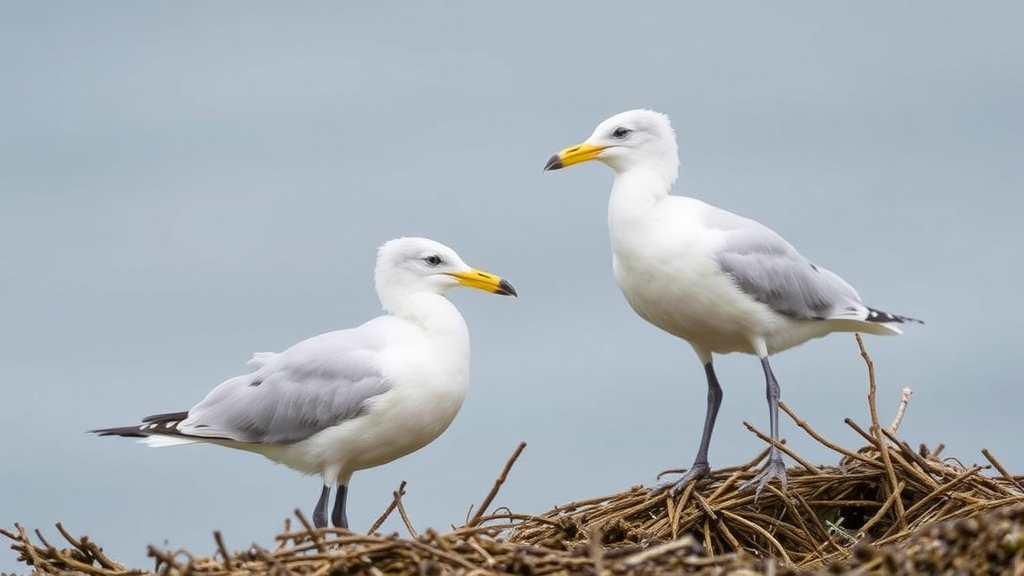
Deep inside the nasal passages of one of the southern hemisphere’s most familiar seabirds, a tiny blood-feeding mite has been quietly building up populations that dwarf anything previously recorded for its genus. A new study of Kelp Gulls (Larus dominicanus) collected along the Brazilian coast has revealed that nearly a third of these birds carry the nasal mite Larinyssus orbicularis, and that a single gull can harbor as many as 197 of the microscopic parasites — a figure far exceeding every previous record for mites of this genus. The findings, published in the journal Acta Parasitologica, provide the most detailed parasitological baseline yet assembled for this host-parasite pairing and suggest that nasal mite infections may be a significantly underappreciated component of seabird health.
The research team, led by Silvia Bainy Gastal of the Federal University of Rio Grande (FURG), together with Carolina Silveira Mascarenhas and Leandro Bugoni, examined the nasal cavities of 171 Kelp Gulls collected between 2015 and 2022 in the Brazilian states of Rio Grande do Sul, Santa Catarina, São Paulo and Rio de Janeiro. Most of the birds (146 individuals) had died under care at marine animal rehabilitation centers, while 25 were recovered during routine beach surveys. All carcasses were collected within 24 hours of the animal’s death, and none of the examined birds had received any antiparasitic treatment, ensuring that the mite counts reflected natural infection levels rather than the effects of medication.
Of the 171 gulls dissected, 56 — or 32.7 percent — were parasitized by rhinonyssid mites, and every specimen identified in the analyzed subsample proved to be Larinyssus orbicularis, a species first described in 1948 and known to specialize on gulls and terns. In total, the researchers recovered 2,224 mites, with a mean abundance of 13.0 mites per host across the whole sample and a mean intensity of 39.7 mites per parasitized bird. The species was confirmed using both light microscopy and scanning electron microscopy, the latter proving essential because the dorsal plates that serve as the mite’s diagnostic features were difficult to resolve with conventional optical equipment. Supplementary characters, including the shape and dimensions of the idiosoma, leg length, and the chaetotaxy of the dorsum, venter and gnathosoma, all matched the original description of L. orbicularis.
One of the study’s most striking results concerns infection intensity. Individual burdens ranged from a single mite to the record-setting 197, and because no standardized classification of Larinyssus infections in gulls existed before, the team proposed a semi-quantitative scheme based on the distribution of counts they observed: low infections of 1 to 20 mites, moderate infections of 21 to 50, and heavy infections exceeding 50 mites. Under this framework, 48.2 percent of parasitized gulls fell into the low category, 30.3 percent into the moderate category, and 21.5 percent carried heavy infections — meaning that roughly one in five infected birds hosted a substantial parasite load capable of occupying much of the nasal cavity.
Anatomically, the mites occupied the full length of the upper respiratory tract, from the rostral nasal conchae through the middle and caudal conchae. In heavily parasitized birds, the parasites were also found around the choana — the nasal opening of the palate — and very close to the nostrils, in some cases visible externally through the nares. Gross pathological examination revealed that most mites adhered to host tissue with only limited mucus, but in some individuals the researchers observed accumulated mucoid material, including tenacious mucus and bloody tenacious mucus surrounding the parasites. These observations echo earlier findings in Gouldian Finches infected with the related mite Sternostoma tracheacolum, suggesting that respiratory mite infections may produce similar mucosal changes across widely divergent bird groups.
Statistical analysis of the parasitological indices revealed a clear age-related pattern. Prevalence did not differ between male and female gulls, a result consistent with studies of Rhinonyssidae in other hosts such as the Rosy-billed Pochard and the Magellanic Penguin, and one that the authors interpret as evidence that transmission — whether during parental care or after fledging — is carried out equally by both sexes in these monogamous birds. Age, however, mattered significantly: only 11.8 percent of juveniles were infected, compared with 43.3 percent of immatures and 36.4 percent of adults. This mirrors the classic pattern reported by TerBush in 1963 for Herring Gulls in the United States, where juveniles showed similarly low infection rates, and supports the hypothesis that mite transmission to young gulls occurs predominantly after chicks have left the nest rather than inside the colony.
Geographically, the picture was equally telling. Of the 56 parasitized hosts, 55 were collected in Santa Catarina and just one in Rio Grande do Sul, while no mites were found in any of the gulls from São Paulo or Rio de Janeiro, despite those states contributing a smaller but meaningful number of carcasses. The authors caution that limited sampling in the northern states may partly explain the absence of positive records there, but they also point to host ecology as a plausible driver. In Brazil, Kelp Gulls breed on coastal islands along roughly 850 kilometers of shoreline, from Laguna in Santa Catarina northward to Rio de Janeiro, and the species relies on the coastal zone for foraging and resting. Because gulls gather in groups — including mixed flocks with tern species known to carry the same mite species — areas of high host density and overlapping species distributions may foster both intra- and interspecific mite transmission, shaping the observed latitudinal gradient in prevalence.
The transmission biology of rhinonyssid mites adds further ecological context. These obligate, blood-feeding endoparasites typically disperse through direct contact, moving between hosts when infected adults regurgitate food to nestlings or during courtship, although indirect transmission across water, perches and contaminated surfaces has also been documented. The researchers suggest that L. orbicularis, naturally associated with Kelp Gulls, may occasionally spill over into terns that share the same coastal environments, much as captive canaries have become secondarily infected with other rhinonyssids in regions where they were introduced. Such dynamics could help explain why the same mite species shows markedly different prevalence in different hosts — 9.1 percent in South American Terns and 50 percent in Cabot’s Terns in an earlier Brazilian study, versus 32.7 percent in Kelp Gulls here, and 24.8 percent and 4.5 percent in Herring Gulls previously examined in the United States and Russia respectively.
While rhinonyssids are generally considered to cause limited harm, the literature documents a range of potential pathologies: injury to the nasal epithelium and blood vessels, pulmonary congestion, rhinitis and sinusitis, and in captive birds even anorexia, aphonia, cachexia, air-sac inflammation, tracheitis and pneumonia that can prove fatal. The authors emphasize that future work should incorporate histopathological analysis of nasal tissues in parasitized gulls to determine whether L. orbicularis infections are associated with tissue lesions or respiratory disease, and they advocate for observations of clinical signs during rehabilitation combined with postmortem examinations as a practical pathway for studying live-host interactions. Because nasal mite infections cannot yet be readily diagnosed in living birds, carcasses from rehabilitation centers represent an invaluable but underused window into this hidden facet of avian health.
Ultimately, the study expands the known geographic distribution of L. orbicularis in Brazil, delivers the largest parasitological dataset ever compiled for nasal mites in gulls, and sets a methodological benchmark by demonstrating the value of scanning electron microscopy for species-level identification. The record intensity of 197 mites in a single bird, and the substantial proportion of heavily infected hosts, together make a compelling case that these minute inhabitants of the nasal cavity deserve far greater attention from ornithologists, parasitologists and wildlife rehabilitators alike. Whether Kelp Gulls have simply learned to tolerate their tenacious tenants, or whether the heaviest burdens carry hidden costs to survival and reproduction, remains an open question — but one that this new baseline now makes possible to answer.
Subject of Research: Prevalence, geographic distribution and parasitological indices of the nasal mite Larinyssus orbicularis in Kelp Gulls (Larus dominicanus) in Brazil
Article Title: Nasal Mites of Kelp Gulls (Larus dominicanus) in Brazil: Geographic Distribution and Parasitological Indices
Article References: Nasal Mites of Kelp Gulls (Larus dominicanus) in Brazil: Geographic Distribution and Parasitological Indices. (n.d.). https://doi.org/10.1007/s11686-026-01396-w
Image Credits: AI Generated
DOI: 10.1007/s11686-026-01396-w
Keywords: Kelp Gull, Larus dominicanus, nasal mites, Larinyssus orbicularis, Rhinonyssidae, parasitology, seabirds, Brazil, infection intensity, prevalence, scanning electron microscopy, host-parasite interaction
Cite Scienmag News
Drew Townsend. (September 22, 2026). Record-Breaking Nasal Mite Burdens Found in Kelp Gulls Along Southern Brazil. Scienmag. https://scienmag.com/record-breaking-nasal-mite-burdens-found-in-kelp-gulls-along-southern-brazil/
Drew Townsend. "Record-Breaking Nasal Mite Burdens Found in Kelp Gulls Along Southern Brazil." Scienmag, 22 September 2026, https://scienmag.com/record-breaking-nasal-mite-burdens-found-in-kelp-gulls-along-southern-brazil/. Accessed 5 October 2026.
Drew Townsend. "Record-Breaking Nasal Mite Burdens Found in Kelp Gulls Along Southern Brazil." Scienmag. September 22, 2026. https://scienmag.com/record-breaking-nasal-mite-burdens-found-in-kelp-gulls-along-southern-brazil/


