


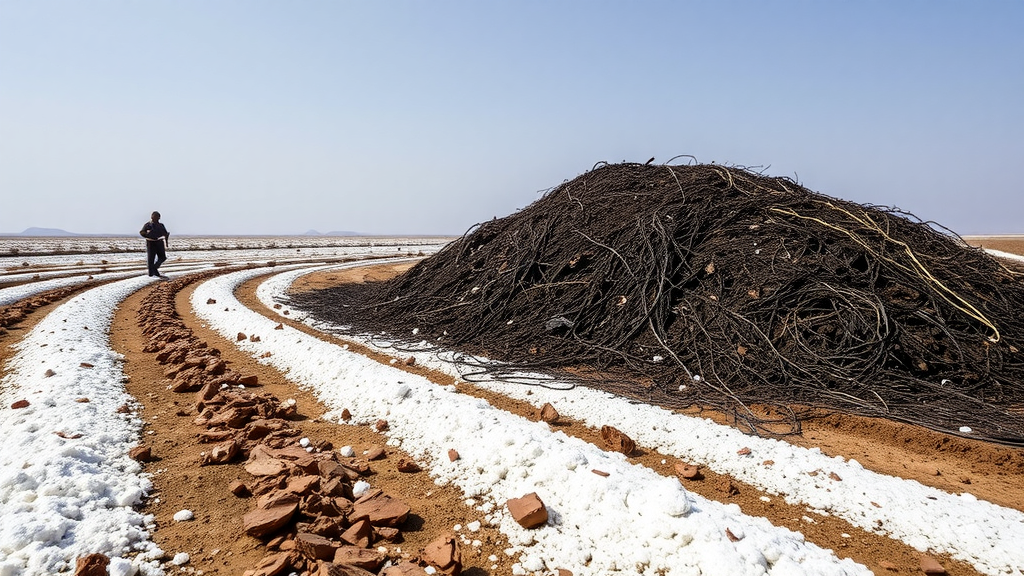
In the scorching lowlands of Asaita District, in Ethiopia’s northeastern Afar region, the soil is slowly being poisoned by its own water. Irrigation drawn from the Awash River carries dissolved salts into fields that receive barely 222 millimeters of rain each year, while evaporation rates among the highest on the continent pull moisture upward and leave the salt behind. For farmers in the Lower Awash Basin, the result is land that grows steadily less productive: soils classified as saline-sodic, simultaneously loaded with excess soluble salts and saturated with exchangeable sodium that destroys soil structure. Now, a two-year field experiment conducted under real farm conditions suggests that a low-cost pairing of a common mineral and an industrial waste product can begin to undo the damage, cutting soil salinity by more than half in a single season.
The study, carried out by Habtamu Admas and Tesfahun Kassahun of Injibara University and published in Environmental Earth Sciences, tested two complementary strategies for reclaiming salt-affected soils across two experimental sites in Asaita District, roughly 670 kilometers northeast of Addis Ababa. The first strategy was biological: growing salt-tolerant forage species, alone and in combination with filter-cake compost, a byproduct of sugar processing rich in organic matter and nutrients. The second was chemical-organic: applying gypsum, a calcium sulfate mineral, at rates of zero, five, and ten tonnes per hectare, factorially combined with the same compost rates. Both experiments were laid out in randomized complete block designs with three replications, producing 54 plots in total under genuine farmers’ field conditions rather than the more forgiving environment of a research station.
The chemistry behind the approach is elegantly simple. Salinity, measured as electrical conductivity, reflects the concentration of soluble salts, chiefly chlorides and sulfates of sodium, calcium, and magnesium, that raise the osmotic stress on plants and impair their ability to take up water. Sodicity is a different problem altogether: an excess of sodium ions clinging to the soil’s cation-exchange sites, where they cause clay particles to disperse, aggregates to collapse, and water infiltration to grind to a halt. Gypsum attacks the sodic half of the problem directly. When it dissolves, its calcium ions swap places with sodium on the exchange complex, releasing sodium into the soil solution, where a well-managed irrigation and drainage system can flush it below the root zone. Compost, meanwhile, works on the physical side, feeding microbes, building aggregates, improving porosity, and releasing its own basic cations that help displace sodium.
The results at the second experimental site, where baseline conditions were more severely degraded with an electrical conductivity of 7.1 decisiemens per meter and an exchangeable sodium percentage of 19.2 percent, delivered the study’s most striking numbers. The combined application of ten tonnes per hectare of gypsum and ten tonnes per hectare of filter-cake compost reduced electrical conductivity from 6.56 to 2.85 decisiemens per meter, a drop of 56.6 percent, and cut the exchangeable sodium percentage from 13.17 to 5.79 percent, a reduction of 56.0 percent. Soil pH fell by 0.60 units, from 8.25 to 7.65, pushing the soil out of strongly alkaline territory. Exchangeable sodium dropped from 9.64 to 4.61 centimoles of charge per kilogram, and bulk density, a key indicator of soil compaction, fell from 1.37 to 1.01 grams per cubic centimeter, signaling a soil that had reopened its pore spaces to water and roots.
Just as importantly, the integrated treatment improved the soil’s capacity to hold and exchange nutrients. Cation exchange capacity, a measure of the soil’s ability to retain positively charged nutrients, rose from 73.2 to 79.6 centimoles of charge per kilogram under the combined gypsum-compost treatment. Total nitrogen, organic carbon, available phosphorus, and available sulfur all increased relative to the untreated control, and extractable micronutrients including iron, manganese, zinc, copper, and boron rose in parallel, a critical finding in alkaline soils where these elements are often locked away from plant roots. The authors attribute these gains to the mineralization of nutrients from the compost by soil microbes and to the improved root environment created as sodium was displaced and leached.
At the first experimental site, where the biological approach was tested, Blue panic grass (Panicum antidotale) combined with ten tonnes per hectare of compost proved the standout performer, producing the lowest bulk density at 1.01 grams per cubic centimeter and the lowest pH at 7.77, compared with 1.31 grams per cubic centimeter and 8.32 in the untreated control. Plots planted with Sesbania sesban and the same compost rate recorded the lowest electrical conductivity among the forage treatments, at 3.17 decisiemens per meter against 9.5 in the control, alongside the lowest exchangeable sodium percentage at 6.29 percent. The mechanism is part extraction and part facilitation: deep-rooted, salt-tolerant plants absorb sodium and other salt ions through their tissues, while their roots and the decomposing compost open channels for water to move dissolved salts downward, out of the root zone.
The broader context makes these findings more than an academic curiosity. Soils developed from volcanic and lacustrine deposits in the Awash valley include substantial areas of Solonetz, Solonchaks, and other salt-affected units, and agriculture in Asaita depends almost entirely on irrigation because rainfall is too erratic to support reliable rain-fed cropping. Mean monthly evapotranspiration in the area ranges from 222 millimeters in November to 375 in July, a relentless evaporative pump that concentrates salts at the soil surface. In a region where roughly 90 percent of the Afar population depends on livestock and small-scale irrigated cropping along river basins, each hectare lost to salinity directly undermines household income and regional food security. The forage-based reclamation route carries a bonus: the grasses and legumes themselves become fodder for penned animals, turning a remediation cost into a source of income.
The study is also candid about its limits. The researchers calculated gypsum requirements using a standard formula based on cation exchange capacity, actual and target exchangeable sodium percentages, bulk density, and reclamation depth, applying rates appropriate to the upper 30 centimeters of soil. Adequate drainage was maintained throughout, which the authors stress is essential; without it, the sodium displaced by gypsum would simply accumulate again. They note that available phosphorus actually declined at the highest gypsum rates, likely because abundant calcium ions react with phosphate to form less-soluble calcium phosphate compounds, a trade-off that farmers and agronomists will need to manage. The irrigation water’s own electrical conductivity and sodium adsorption ratio were not recorded, and no combined statistical analysis across the two sites was possible because the experiments had different treatment structures.
Perhaps the most important caveat concerns scale. The authors explicitly warn that the findings should not be generalized to the entire Afar Region, since soil properties, irrigation conditions, and agro-ecological characteristics vary considerably from place to place. They also flag that the economic assessment in the study is qualitative rather than a formal cost-benefit analysis, and that the viability of hauling gypsum and compost to remote fields will depend on local prices, transport distances, and labor. Still, both raw materials have appealing characteristics: filter cake is an agro-industrial residue that would otherwise require disposal, it contains 1.5 to 2.0 percent nitrogen, 0.8 to 1.2 percent available phosphorus, and 1.2 to 1.8 percent potassium with a favorable carbon-to-nitrogen ratio, and its low electrical conductivity and near-neutral pH make it safe for use on already salt-stressed land.
For a world losing farmland to salt at an accelerating pace as irrigation expands and climates dry, the Asaita results offer a concrete, field-verified recipe: where salinity and sodicity co-occur, neither gypsum alone nor compost alone is enough, but ten tonnes per hectare of each, applied together under sound irrigation and drainage, can push a degraded saline-sodic soil back toward productivity within a single growing season. The recommendation carries a condition, not a promise. It works where water can be applied in the right amounts and drained away, carrying the displaced sodium with it. In the Lower Awash Basin, where the river supplies the water and the desert supplies the heat, that combination of chemistry, biology, and careful water management may be the most practical lifeline available to the farmers watching their fields turn white.
Subject of Research: Field evaluation of gypsum and compost amendments for reclaiming saline-sodic soils in Asaita District, Northeastern Ethiopia
Article Title: Application of compost and gypsum to improve physicochemical properties of saline-sodic soil conditions in Asaita District, Northeastern Ethiopia
Article References: Admas, H., & Kassahun, T. (2026). Application of compost and gypsum to improve physicochemical properties of saline-sodic soil conditions in Asaita District, Northeastern Ethiopia. Environmental Earth Sciences, 85(16), Article 408. https://doi.org/10.1007/s12665-026-13143-5
Image Credits: AI Generated
DOI: 10.1007/s12665-026-13143-5
Keywords: soil salinity, sodicity, gypsum, compost, saline-sodic soil, soil reclamation, phytoremediation, Lower Awash Basin, Ethiopia, soil physics, soil chemistry, irrigated agriculture
Cite Scienmag News
Alan Morgan. (September 22, 2026). Gypsum and Compost Combo Strips Salt From Ethiopia’s Ravaged Farmland. Scienmag. https://scienmag.com/gypsum-and-compost-combo-strips-salt-from-ethiopias-ravaged-farmland/
Alan Morgan. "Gypsum and Compost Combo Strips Salt From Ethiopia’s Ravaged Farmland." Scienmag, 22 September 2026, https://scienmag.com/gypsum-and-compost-combo-strips-salt-from-ethiopias-ravaged-farmland/. Accessed 22 September 2026.
Alan Morgan. "Gypsum and Compost Combo Strips Salt From Ethiopia’s Ravaged Farmland." Scienmag. September 22, 2026. https://scienmag.com/gypsum-and-compost-combo-strips-salt-from-ethiopias-ravaged-farmland/


