


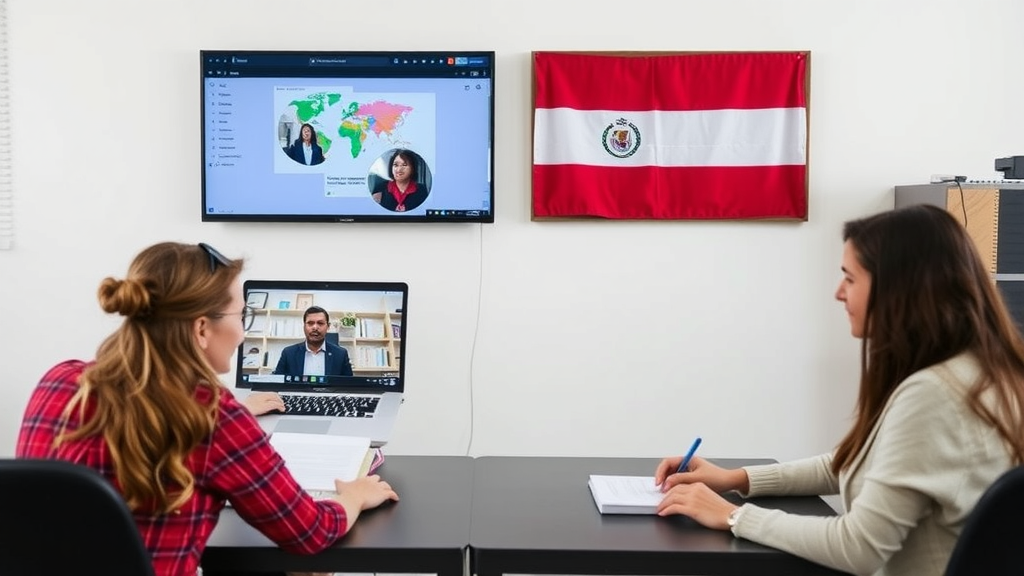
A seven-week online collaboration between future teachers in Spain and Costa Rica has produced some of the most detailed evidence yet on what virtual exchange can and cannot do for intercultural competence. In a quasi-experimental study published in the Journal of New Approaches in Educational Research, researchers tracked 207 undergraduate teacher education students from the University of Granada and the Distance State University (Universidad Estatal a Distancia, UNED) as they worked together in mixed international teams to design learning situations that integrated 3D printing as a didactic resource for Primary Education. The results paint a nuanced picture: statistically significant gains in several dimensions of intercultural skill, a surprising decline in one affective measure, and hints that online collaboration may help equalise differences between institutions.
The methodology behind the intervention, known as Collaborative Online International Learning, or COIL, originated at the State University of New York, which established its COIL Center in 2004 to give students opportunities to develop intercultural skills through international online interaction. Unlike a traditional exchange, COIL does not require students to travel. Instead, it embeds a shared academic project into existing courses, so that two classes in different countries jointly produce a common deliverable. Because it operates entirely within the curriculum, it is often described as a form of internationalisation at home, bringing global contact to students who might never afford or attempt physical mobility.
In the Spanish-Costa Rican experience, the seven weeks were tightly structured. In the first week, participants created short introductory videos on Padlet, sharing their personal profiles, interests and motivations. In the second week, mixed teams of up to five students, with a maximum of three from UNED and two from Granada, formed themselves based on the interests revealed in the icebreaker activity. From weeks three to six, the teams collaborated on designing a Primary Education learning situation that used 3D printing as a teaching resource, communicating through a Moodle forum and instant messaging tools such as WhatsApp and Telegram. The final week was devoted to submitting the finished learning situation in PDF and audiovisual formats to a shared Padlet wall and to completing a reflective closing exercise alongside the posttest questionnaire.
Measuring intercultural competence is notoriously difficult because the construct spans cognition, affect and behaviour. The research team therefore triangulated three validated instruments. Intercultural sensitivity was assessed with the 16-item Intercultural Sensitivity Scale, covering respect for cultural differences, interaction attentiveness and interaction confidence. Cultural intelligence was measured with the 20-item Cultural Intelligence Scale, spanning metacognitive, cognitive, motivational and behavioural dimensions. Multicultural personality was evaluated with the abbreviated Multicultural Personality Questionnaire, which captures cultural empathy, social initiative, open-mindedness, emotional stability and flexibility. All three scales have validated Spanish versions, and internal consistency coefficients in this study ranged from 0.737 to 0.912, indicating acceptable to excellent reliability. Data were collected before the intervention on 18 September 2025 and after it on 17 November 2025.
Because the score distributions deviated from normality, the researchers relied on non-parametric statistics. Within-group pre-post changes were tested with the Wilcoxon signed-ranks test, and between-university differences with the Mann-Whitney U test, with effect sizes estimated using Cliff’s delta and the Vargha and Delaney A statistic. Crucially, the team applied the Benjamini-Hochberg False Discovery Rate correction to control the inflated risk of false positives that arises when many comparisons are performed. This methodological rigour mattered: after correction, only a subset of dimensions retained both statistical significance and at least small effect sizes, namely interaction confidence, cognitive cultural intelligence, social initiative and open-mindedness. The remaining statistically visible changes shrank to trivial practical magnitude once multiple comparisons were accounted for.
The gains that survived scrutiny were concentrated in interactional and cognitive-dispositional territory. Interaction confidence rose across the whole sample from a mean of 3.89 to 4.18 on a five-point scale, with a stronger increase at UNED, where scores climbed from 3.87 to 4.24. Cognitive cultural intelligence, which reflects explicit knowledge about cultures, increased from 3.32 to 3.67 overall, and most dramatically at UNED, where the mean jumped from 3.04 to 3.60. Social initiative rose from 3.86 to 4.16 and open-mindedness from 4.04 to 4.24, with both institutions showing parallel gains. These are exactly the components one would expect a short, project-based collaboration to strengthen: students gained concrete knowledge about another culture, grew more willing to initiate contact, and became more confident interacting across cultural boundaries.
The most provocative finding was a decline in respect for cultural differences and enjoyment of interaction, particularly at the University of Granada, where the mean fell from 1.41 to 1.31, while the dimension stayed essentially flat at UNED. Rather than reading this as a failure of the intervention, the authors interpret it through theoretical models of intercultural sensitivity development, which describe non-linear and sometimes regressive phases during initial significant intercultural contact. Ethnorelative frameworks suggest that early exposure to diversity can shatter idealised perceptions and provoke a more demanding, more realistic appraisal of cultural complexity. In other words, students may have become more culturally realistic, recognising that difference is genuinely challenging rather than superficially charming. The researchers caution, however, that alternative explanations cannot be excluded and that longitudinal work is needed to confirm this interpretation.
The comparative analysis between the two institutions added another layer of interest. Before the intervention, Granada students scored significantly higher on metacognitive cultural intelligence, while UNED students started higher on cognitive cultural intelligence. After the seven weeks, the cognitive gap between the universities was reduced to statistical and practical insignificance, a pattern the authors describe as a possible equalising effect of the COIL experience. The metacognitive advantage for Granada persisted, although its magnitude shrank from medium to small. This suggests that international collaborative work can help homogenise certain components of intercultural competence across very different educational contexts, but that deeply rooted metacognitive dispositions, shaped by prior curricular and structural factors, resist short-term correction. A posttest difference in open-mindedness favouring UNED also emerged, with a small effect size.
The study is candid about its limits. The absence of a control group means maturation effects or concurrent learning experiences cannot be ruled out as alternative causes of the observed changes. Participation was voluntary and self-selected, potentially biasing the sample toward students already inclined toward intercultural engagement, which may inflate the apparent impact. The sample, drawn from Primary Education and General Basic Education programmes and comprising 48 men and 159 women aged 18 to 60, was obtained through convenience sampling. The authors also note that they did not formally test measurement invariance of the three instruments across the two institutions, a caveat for cross-institutional comparisons, and they flag the seven-week duration as structurally insufficient for developing stable affective traits such as cultural empathy, emotional stability and flexibility, which showed only trivial changes.
The practical implications are clear. The findings argue for COIL designs of greater duration and structural intentionality, combining collaborative tasks with explicit affective training, structured reflection and pedagogical scaffolding aimed at the dimensions least amenable to short-term change. They also argue for a more honest public conversation about virtual exchange, one that resists celebrating statistical significance alone and instead asks what actually changed, by how much, and for whom. As universities worldwide search for scalable alternatives to physical mobility, this Spanish-Costa Rican experiment offers both encouragement and a warning: online international collaboration can genuinely move the needle on confidence, cultural knowledge and openness, but respect, empathy and emotional stability demand longer, deeper and more deliberately designed encounters.
Subject of Research: Development of intercultural competence in pre-service teachers through a COIL virtual exchange between Spanish and Costa Rican universities.
Article Title: Intercultural competence in teacher training: a COIL virtual exchange between Spain and Costa Rica universities
Article References: Romero-Rodríguez, J.-M., López-Gamboa, J.-E., Aguilera-Jinesta, R., & Victoria-Maldonado, J.-J. (2026). Intercultural competence in teacher training: a COIL virtual exchange between Spain and Costa Rica universities. Journal of New Approaches in Educational Research, 15(1), Article 25. https://doi.org/10.1007/s44322-026-00073-0
Image Credits: AI Generated
DOI: 10.1007/s44322-026-00073-0
Keywords: COIL, virtual exchange, intercultural competence, teacher training, pre-service teachers, cultural intelligence, intercultural sensitivity, multicultural personality, University of Granada, UNED Costa Rica, internationalisation at home, 3D printing in education
Cite Scienmag News
Courtney Benton. (September 22, 2026). Virtual Exchange Between Spanish and Costa Rican Universities Boosts Teacher Intercultural Skills. Scienmag. https://scienmag.com/virtual-exchange-between-spanish-and-costa-rican-universities-boosts-teacher-intercultural-skills/
Courtney Benton. "Virtual Exchange Between Spanish and Costa Rican Universities Boosts Teacher Intercultural Skills." Scienmag, 22 September 2026, https://scienmag.com/virtual-exchange-between-spanish-and-costa-rican-universities-boosts-teacher-intercultural-skills/. Accessed 22 September 2026.
Courtney Benton. "Virtual Exchange Between Spanish and Costa Rican Universities Boosts Teacher Intercultural Skills." Scienmag. September 22, 2026. https://scienmag.com/virtual-exchange-between-spanish-and-costa-rican-universities-boosts-teacher-intercultural-skills/


