


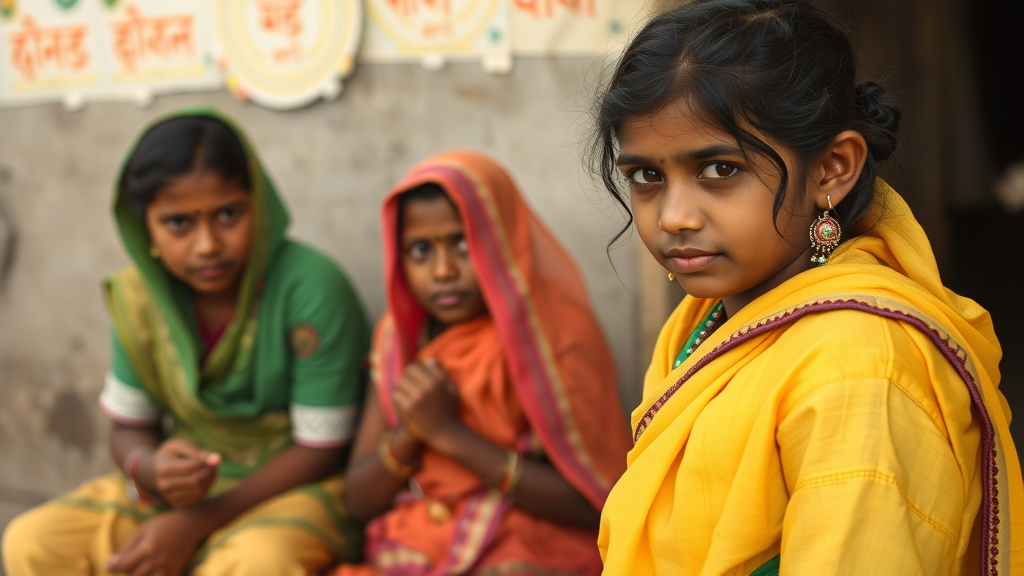
Child marriage in India is steadily becoming less common, yet new research shows that the practice remains deeply bound to poverty, with girls from the country’s poorest households still more than twice as likely to marry before adulthood as their wealthier peers. A study published in Discover Social Science and Health has used nationally representative survey data and a formal statistical framework for measuring health inequality to show that, while the national trend is moving in the right direction, the socioeconomic gap in child marriage has not closed at the same pace. The findings carry significant implications for how policymakers design interventions aimed at eliminating a practice that affects millions of girls and shapes their health, education, and economic futures.
The research, conducted by Susanta Sen, Asif Ali, Amit Banerjee, and Namita Chakma of the Department of Geography at The University of Burdwan in West Bengal, drew on two rounds of India’s National Family Health Survey: the fourth round, conducted in 2015–16 with 122,955 women, and the fifth round, conducted in 2019–21 with 118,700 women. The analysis focused on women aged 20 to 24 years, the standard age group used to assess child marriage prevalence under international indicators, since these women had passed beyond the age at which a legal marriage before 18 could have occurred. By comparing the two survey rounds, the researchers were able to track both the level of child marriage and the distribution of that practice across the wealth spectrum over roughly a five-year interval.
To measure inequality rigorously, the team employed the Erreygers Concentration Index, a widely used summary measure in health equity research that captures whether a health or social outcome is systematically concentrated among richer or poorer groups. A negative value of the index indicates that the outcome is concentrated among the economically disadvantaged. In both survey rounds, the Erreygers Concentration Index for child marriage was negative and statistically significant, confirming that the burden of marrying before 18 falls disproportionately on girls from poorer households. The index moved from −0.281, with a 95 percent confidence interval of −0.289 to −0.273, in the fourth round to −0.257, with a 95 percent confidence interval of −0.265 to −0.249, in the fifth round, indicating a modest narrowing of wealth-related inequality but no fundamental change in its direction or magnitude.
The absolute picture tells a similarly nuanced story. The absolute gap in child marriage prevalence between the poorest and richest groups narrowed from 20.65 percentage points in NFHS-4 to 19.04 percentage points in NFHS-5. Yet the relative measure moved in the opposite direction: the ratio of child marriage prevalence among the poor compared with the non-poor actually increased, from 2.07 to 2.20. This combination of a shrinking absolute gap and a widening relative gap is a classic pattern in epidemiology and social statistics, arising when prevalence declines faster in absolute terms among groups that already have lower baseline levels. In practical terms, even though fewer girls overall are marrying as children, a girl born into a poor household today remains substantially more exposed to the risk of early marriage than one born into affluence, and in relative terms that exposure has grown.
Beyond describing the inequality, the study’s central methodological contribution lies in its use of regression-based decomposition analysis, a technique that partitions the observed concentration index into contributions attributable to individual socio-demographic characteristics. Rather than simply noting that child marriage correlates with poverty, decomposition analysis quantifies how much of the measured inequality each factor statistically explains. The results were striking in their consistency: educational attainment dominated the explained component of wealth-related inequality in both survey rounds, accounting for 77.06 percent in NFHS-4 and 77.41 percent in NFHS-5. In other words, differences in schooling levels between rich and poor women are by far the largest statistical driver of why early marriage clusters among the disadvantaged.
The composition of the remaining explained inequality shifted over time in ways that offer clues about the changing social landscape. In the fourth survey round, place of residence, meaning the divide between urban and rural areas, was the second-largest contributor to wealth-related inequality in child marriage. By the fifth round, however, the contribution of mass media exposure had risen substantially, overtaking residential location as a key explanatory factor. This shift suggests that access to information, whether through television, radio, newspapers, or increasingly digital channels, has become a more salient axis of inequality as connectivity spreads unevenly across Indian society. It also implies that the messages, norms, and alternatives that media exposure conveys about marriage, gender roles, and women’s life courses play a measurable role in shaping when and whether girls marry.
The study also documented substantial variation across India’s states and Union Territories, underscoring that child marriage is not a uniform national phenomenon but one embedded in highly diverse regional contexts of culture, economy, and policy implementation. States differ enormously in baseline prevalence, in the steepness of the wealth gradient, and in the pace of change between the two survey rounds. This heterogeneity means that a single national policy lever, applied uniformly, is unlikely to produce equitable results. Regions where the wealth gradient is steepest may require intensively targeted approaches, while regions with lower but persistent prevalence may benefit more from broad norm-change campaigns and enforcement of existing legal prohibitions on marriage below the age of 18.
The public health significance of these findings extends well beyond the institution of marriage itself. Child marriage is internationally recognized as a driver of adverse outcomes including early pregnancy, elevated maternal and infant mortality risks, interrupted schooling, restricted economic agency, and increased vulnerability to domestic violence. When the burden of child marriage concentrates among the poorest girls, it functions as a mechanism through which poverty and disadvantage reproduce themselves across generations. The study’s conclusion that reductions in overall prevalence have not been matched by equivalent reductions in socioeconomic inequality echoes a broader theme in development research: aggregate progress can mask persistent, and sometimes widening, disparities that demand explicit equity-oriented policy attention.
The authors point toward a set of policy directions grounded in their decomposition results. Because education explains such an overwhelming share of the inequality, interventions that support girls’ secondary education, reduce the economic pressures that push families to withdraw daughters from school, and keep adolescents enrolled through the years when marriage decisions are typically made stand out as the highest-leverage options. The growing contribution of mass media exposure suggests that improving access to information, and using media channels deliberately to shift social norms around early marriage, could complement educational investments. The researchers also highlight strengthening social protection for economically disadvantaged households and explicitly prioritizing the poorest families in programmatic targeting, since the data confirm that the risk of child marriage remains most intense at the bottom of the wealth distribution.
Ultimately, the study delivers a message that is both encouraging and cautionary. India has made genuine progress: child marriage prevalence declined measurably between 2015–16 and 2019–21, and the concentration index softened slightly. But the persistence of a large absolute wealth gap, the rise in the poor-to-non-poor prevalence ratio, and the stark regional differences all indicate that the finish line remains distant for the girls whom the practice continues to touch most directly. As India and the global community pursue the elimination of child marriage under international development goals, this research argues that success should be judged not only by how far national averages fall, but by how quickly the gap closes for those at the bottom, where the consequences of marrying too young are felt most severely.
Subject of Research: Wealth-related socioeconomic inequality in child marriage among young women in India
Article Title: Wealth-related inequality in child marriage in India using decomposition analysis
Article References: Sen, S., Ali, A., Banerjee, A., & Chakma, N. (2026). Wealth-related inequality in child marriage in India using decomposition analysis. Discover Social Science and Health. https://doi.org/10.1007/s44155-026-00488-2
Image Credits: AI Generated
DOI: 10.1007/s44155-026-00488-2
Keywords: child marriage, India, wealth inequality, Erreygers Concentration Index, decomposition analysis, National Family Health Survey, girls' education, mass media exposure, social protection, public health, NFHS-5, socioeconomic disparity
Cite Scienmag News
Courtney Benton. (September 21, 2026). Child Marriage in India Is Falling but Still Concentrated Among the Poorest Girls. Scienmag. https://scienmag.com/child-marriage-in-india-is-falling-but-still-concentrated-among-the-poorest-girls/
Courtney Benton. "Child Marriage in India Is Falling but Still Concentrated Among the Poorest Girls." Scienmag, 21 September 2026, https://scienmag.com/child-marriage-in-india-is-falling-but-still-concentrated-among-the-poorest-girls/. Accessed 5 October 2026.
Courtney Benton. "Child Marriage in India Is Falling but Still Concentrated Among the Poorest Girls." Scienmag. September 21, 2026. https://scienmag.com/child-marriage-in-india-is-falling-but-still-concentrated-among-the-poorest-girls/


