


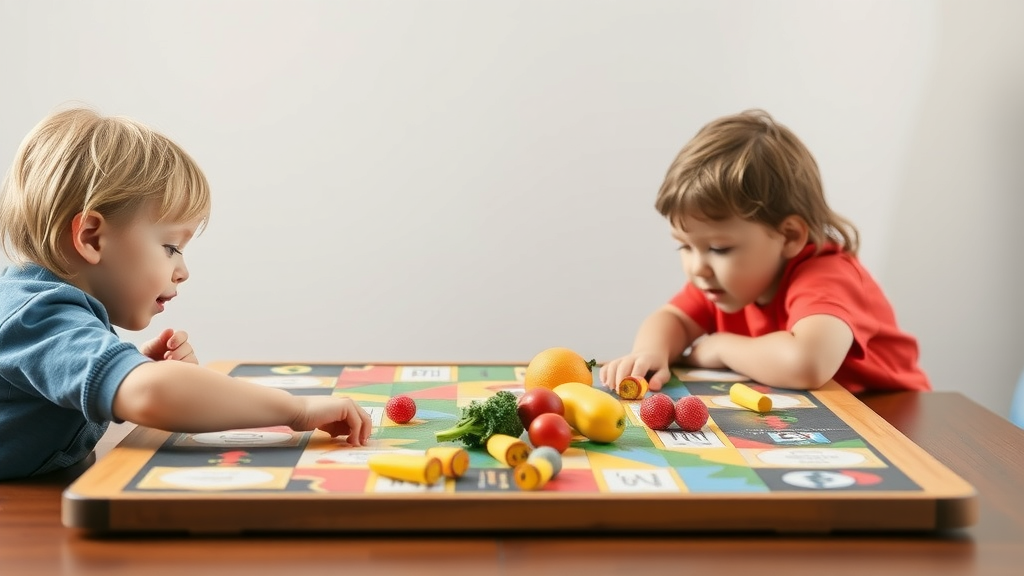
A simple wooden board, a shared shopping list, and a pile of food tiles may sound like ordinary classroom fare, but a new study suggests they can reshape how five-year-old children think about the environmental cost of what they eat. Researchers at the University of Murcia in Spain report that a carefully scaffolded, two-session teaching sequence built around a cooperative board game called Buy Smart shifted young children’s reasoning about waste from a narrow preoccupation with visible leftovers—peels, bones, and skins—toward a more systemic understanding in which transport distance, pollution, and food origin become central criteria for judging environmental impact. The work, published in the International Journal of Early Childhood, addresses a conspicuous gap: while game-based learning has flourished in sustainability education, almost no rigorously designed interventions have targeted children before primary school.
The study emerges from a well-documented tension in early childhood education. Spain’s national curriculum for children aged zero to six explicitly mandates the cultivation of environmentally responsible habits, including responsible consumption, in alignment with the United Nations’ Sustainable Development Goal 12 on responsible consumption and production. Yet classroom-based research indicates that the idea of a “responsible consumer” is conceptually demanding for five-year-olds, even when children can readily name planet-friendly practices. Meanwhile, systematic reviews of game-based sustainability interventions have found that of the fully developed games designed to teach environmental concepts, none were created for early childhood classrooms, and none specifically tackled the responsible consumption of local versus distant foods. Commercially available options tend to reduce the topic to simple recycling-sorting exercises, leaving the deeper conceptual work entirely to the educator.
The research team, led by Miguel Romero Gutiérrez, Francisco Serrano-García, Carlos de Pro Chereguini, and Marina Martínez-Carmona, approached the problem through design-based research, an iterative methodology in which educational tools are tested, refined, and recontextualized based on systematic feedback. An earlier pilot phase had enlisted three practicing early childhood teachers to evaluate the initial Buy Smart prototype. Their recommendations shaped the design criteria that governed the final version: the game had to be cooperative rather than competitive, it had to make waste visually traceable through a simple shared tracker, and it had to foreground the contrast between local and non-local products by loading the board with a higher frequency of locally sourced items.
The mechanics of Buy Smart are deliberately simple. Players share a common shopping list and must collectively gather the required food items from a six-by-six grid of shuffled tiles before the group accumulates too much waste. Each turn, a child rolls a die showing one to three steps and moves a pawn across the board. Landing on a listed item adds it to the collective haul; landing on an unlisted food sends it to a designated waste pile and advances the shared waste marker, making the cumulative consequences of inefficient choices visible to everyone. The group wins by completing the list and returning home before exceeding the waste limit. A wooden board, thirty-four product tiles, ten shopping list cards, four pawns, a house tile, and a die constitute the entire apparatus—an intentionally analogue design that the authors defend as equitable, accessible, and rich in social interaction, in contrast to screen-based alternatives that raise concerns about unequal access and the cognitive effects of early screen exposure.
Crucially, teacher feedback from the pilot indicated that the game worked best for reinforcing rather than introducing sustainability concepts. This insight directly informed the structure of the didactic sequence, which placed the board game in a final application phase after children’s prior ideas had been elicited and confronted. The sequence drew on inquiry-based approaches to early science education and on models of conceptual change, moving children through elicitation, confrontation, restructuring, and application of their ideas across two classroom sessions with twenty-five five-year-olds in a Spanish region famous for its citrus and vegetable production—an agricultural context the researchers exploited by anchoring the lessons in lemons, an emblematic local crop.
The most striking findings concern the evolution of children’s explanatory frameworks. Before the intervention, when asked whether lemons or fish generated waste, children spoke almost exclusively of concrete remains. One child insisted that “lemons don’t make waste,” while others noted that the peel goes in the bin or that fish leave bones and skin. Waste, in their initial understanding, was something you could see and throw away. The turning point came during an embodied activity in which children physically transported foods from their places of origin to a market by jumping through hoops, an experience designed to make the invisible labor and emissions of food transport tangible. When subsequently asked which food polluted more—fish or lemon—twenty-one of twenty-four children, or 88 percent, chose fish, but their justifications had transformed. Children no longer cited bones; they explained that fish produced more waste “because it comes from farther away.”
Quantitative comparisons, though explicitly framed by the authors as exploratory rather than confirmatory given the small sample of nineteen children who completed both assessments, corroborated this shift. The selection of pineapple—a conspicuously non-local food—as the greatest waste generator rose dramatically from 10.5 percent before the intervention to 63.2 percent afterward, a change that reached statistical significance. By the end of the sequence, children consistently explained that foods from farther away “make more smoke” and therefore harm the planet more. The researchers interpret this as evidence that children began to construct relational and causal explanations about sustainability, using proximity and transport as analytic criteria rather than relying on immediate visual cues.
The study also delivers a pointed methodological message. The richest evidence of learning emerged not from the paper-and-pencil worksheets administered before and after the intervention, but from classroom observation and children’s oral discourse during discussions and play. Written responses showed limited change, partly because children grew visibly tired during the post-test and devoted more energy to coloring than to the task itself. The authors argue that this discrepancy validates calls within the field to replace or supplement written assessment with authentic, multimodal, context-sensitive evaluation that captures young children’s competences through action, dialogue, and participation—a stance consistent with sociocultural theories of learning rooted in Vygotsky’s account of knowledge construction through shared social experience.
The affective dimension of the intervention proved equally revealing. Asked to evaluate the game by choosing between a happy face and a sad face, seventeen of twenty children, or 85 percent, chose the happy face. But the three negative responses were, paradoxically, a signature of success: rather than rejecting the activity, the dissenting children objected to the game’s central mechanic, complaining that discarding foods not on the shopping list was wrong because such foods “should be eaten.” The researchers read these comments as an emerging ethical sensitivity to food waste—precisely the disposition the sequence aimed to cultivate. The classroom teacher, interviewed after the intervention, praised the proposal as pedagogically useful and feasible, singling out the movement-based transport activity with its smoke-cloud imagery as especially effective for helping children visualize pollution, while recommending that the board game be implemented in small-group stations where close adult mediation could scaffold play into learning. The authors conclude that educational games in early childhood should never be treated as self-sufficient tools; their value depends on the quality of the surrounding instructional design, the grounding of abstract concepts in familiar local contexts, and sustained opportunities for guided reflection and dialogue.
Subject of Research: A play-based didactic sequence using a cooperative board game to foster responsible consumption understanding in early childhood education.
Article Title: Buy Smart: Introducing Responsible Consumption in Early Childhood Education: A Play-Based Didactic Sequence on Food, Waste, and Environmental Impact
Article References: Romero Gutiérrez, M., Serrano-García, F., de Pro Chereguini, C., & Martínez-Carmona, M. (2026). Buy Smart: Introducing Responsible Consumption in Early Childhood Education: A Play-Based Didactic Sequence on Food, Waste, and Environmental Impact. International Journal of Early Childhood. https://doi.org/10.1007/s13158-026-00549-2
Image Credits: AI Generated
DOI: 10.1007/s13158-026-00549-2
Keywords: game-based learning, responsible consumption, early childhood education, sustainability education, cooperative board game, food miles, food waste, environmental impact, design-based research, preschool science education, Sustainable Development Goal 12, local food
Cite Scienmag News
Courtney Benton. (September 21, 2026). Cooperative Board Game Helps Preschoolers Grasp the Hidden Climate Cost of Food Miles. Scienmag. https://scienmag.com/cooperative-board-game-helps-preschoolers-grasp-the-hidden-climate-cost-of-food-miles/
Courtney Benton. "Cooperative Board Game Helps Preschoolers Grasp the Hidden Climate Cost of Food Miles." Scienmag, 21 September 2026, https://scienmag.com/cooperative-board-game-helps-preschoolers-grasp-the-hidden-climate-cost-of-food-miles/. Accessed 21 September 2026.
Courtney Benton. "Cooperative Board Game Helps Preschoolers Grasp the Hidden Climate Cost of Food Miles." Scienmag. September 21, 2026. https://scienmag.com/cooperative-board-game-helps-preschoolers-grasp-the-hidden-climate-cost-of-food-miles/


