


On the remote Andaman and Nicobar Islands, where the nearest mainland training center lies more than a thousand kilometers away across the Bay of Bengal, chemistry teachers have long worked in professional isolation. A new study now shows what happens when that isolation is broken. Researchers from the Regional Institute of Education in Bhubaneswar, part of India’s National Council of Educational Research and Training, report that a five-day competency-based training workshop held in Port Blair significantly improved both the content knowledge and the teaching confidence of 23 senior secondary chemistry teachers. The program, approved by NCERT in New Delhi under the Ministry of Education, was designed as a direct response to the National Education Policy of 2020, which calls for a nationwide shift away from rote memorization toward competency-based education, critical thinking, and authentic assessment. The findings, published in Discover Education, offer a template for reaching educationally underserved regions that global reform agendas often struggle to penetrate.
The challenge the program addressed is structural as much as pedagogical. Although the islands have capable and experienced teachers, geographic distance and limited infrastructure make regular attendance at academic forums, government-sponsored training, and exposure to novel classroom practices difficult. Even expertly trained educators, the researchers note, stagnate without continuous professional learning. Senior secondary chemistry compounds the problem, because it demands deep conceptual understanding and the ability to connect abstract theory to real-world phenomena. A needs assessment conducted in island schools identified specific pain points: IUPAC nomenclature, stereochemistry, acid-base theories, thermodynamics, and electrochemistry were repeatedly flagged as topics that teachers found difficult to teach and students found difficult to grasp. These findings shaped the workshop’s four core objectives: strengthening conceptual clarity on complex topics, modeling competency-based assessment techniques, aligning classroom practice with NEP 2020 and the National Curriculum Framework for School Education 2023, and cultivating local resource persons who could lead reform within their own institutions.
The workshop ran from February 10 to 14, 2025, and was deliberately structured to balance content mastery with pedagogical innovation. Sessions were delivered by NCERT and RIE Bhubaneswar faculty together with invited experts from premier academic research institutions. Rather than relying on conventional lectures, facilitators deployed case-based learning, concept mapping, and an emphasis on real-life chemical phenomena. The modules progressed logically, beginning with policy frameworks and curriculum goals, moving into intensive content immersion, then shifting to pedagogy, and concluding with assessment design. Each day ended with reflection and peer feedback, practices the organizers wanted teachers to carry back to their own classrooms. Participants worked in groups of three to five, developed one to three lesson activities with accompanying assessment tools and rubrics for the senior secondary chemistry curriculum, and practiced the new strategies through micro-teaching episodes in which they could immediately test and refine what they had learned.
The pedagogical innovations introduced during the week read like a catalog of contemporary science education reform. Teachers learned to structure open-ended, inquiry-based investigations designed to provoke curiosity and independent thought. Flipped classroom techniques were demonstrated, in which pre-class assignments and concept videos free up precious class time for problem solving and discussion. Project-based learning modules encouraged collaborative activities that connect chemistry to everyday phenomena, from corrosion to cooking. Perhaps most concretely, teachers were trained in information and communication technology tools including Chemsketch, Jmol, and virtual laboratories, which allow students to conduct experiments and visualize molecular structures that would otherwise remain confined to textbook diagrams. Formative feedback loops, including peer review, reflection journals, and group presentations, were modeled as mechanisms for continuous improvement. By the end of the week, participants had collectively created sample rubrics for evaluating learning objectives, which were shared and critiqued in structured reflection sessions.
Assessment reform occupied a central place in the training, reflecting a key pillar of NEP 2020. The organizers argued that meaningful competency-based education requires moving beyond tests of factual recall toward instruments that probe conceptual understanding, problem solving, and critical thinking. Teachers engaged in hands-on sessions designing competency-based learning and evaluation materials mapped to specific curriculum objectives. They produced example question papers built around real-life scenarios that require students to analyze situations, apply chemical principles, and synthesize information across chemistry subtopics. They also learned to construct rubrics capable of quantifying different cognitive abilities, paving the way for holistic assessment. On the final day, a culminating workshop had teachers collaborate on full-length competency-based test items, which were then peer-reviewed in small groups with facilitator feedback. This recursive design-build-critique cycle, the researchers argue, reinforced the essential link between assessment, teaching, and learning objectives.
To measure whether any of this worked, the study employed a one-group pre-test and post-test quasi-experimental design. All 23 participating Post Graduate Teachers, recruited through total enumeration sampling with informed consent, completed a 28-question multiple-choice assessment before and after the training. The instrument, developed by the research team and reviewed by subject experts for content validity, covered stereochemistry, acid-base chemistry, electrochemistry, organic reaction mechanisms, functional groups, thermodynamics, and chemical kinetics. Descriptive analysis of the score distributions showed a clear shift toward higher performance categories after the intervention, suggesting that the training contributed to genuine gains in conceptual understanding. The researchers are careful to frame these results descriptively, noting that no formal psychometric reliability analysis was performed because the instrument was built specifically for program evaluation, but the pattern of improvement was consistent across the cohort.
The self-reported outcomes were striking. According to the post-training feedback survey, 95 percent of participants reported increased confidence in applying competency-based assessment strategies in their classrooms, and the same proportion said the training improved their understanding of complex chemistry concepts. Eighty-seven percent reported greater confidence in competency-based assessment methodologies, while 92 percent expressed willingness to integrate virtual laboratory tools into their teaching. Qualitative feedback highlighted the value of real-life examples, effective integration of digital tools, and collaborative module development. Teachers particularly appreciated the well-structured conceptual modules that unpacked difficult topics in a coherent sequence, as well as the interactive, participatory style of the sessions, which allowed them to learn from one another. Many recommended regularly scheduled follow-up workshops to maintain momentum, a suggestion the researchers take seriously in their recommendations.
What may prove most consequential, however, is what happened after the teachers flew home. A WhatsApp group connecting all participants with the resource persons was created immediately after the training, becoming a channel for sharing exemplar lesson plans, rubrics, and assessment tools, and for troubleshooting classroom challenges. Informal follow-up interactions three months later indicated that teachers were still using competency-based planning and assessment after returning to their schools, even though no formal monitoring mechanism was in place. Several participants were identified as key resource persons, positioned to train colleagues across the islands in the future. This multiplier effect, the researchers argue, is what makes the program scalable, both within the island school system and potentially across other subjects and other geographically remote regions of India. The digital mentoring network, they suggest, proved to be a viable and cost-effective system for sustaining professional support well beyond the training period itself.
The study’s authors position the Port Blair workshop as a model with implications far beyond one archipelago. They recommend periodic follow-up workshops, online communities of practice, the incorporation of competency-based instruction into pre-service teacher education, and formal mentoring frameworks in which trained teachers support peers in other schools and districts. They also situate the work in a global context, noting that NEP 2020’s emphasis on competency-based and experiential learning parallels reforms embedded in the Next Generation Science Standards in the United States, the OECD Learning Compass 2030, and UNESCO’s Education for Sustainable Development framework. Previous NCERT capacity-building programs in Sikkim, Meghalaya, and Odisha showed similar gains in teaching effectiveness, suggesting the model is replicable. For a union territory where teachers once had few opportunities to refresh their practice, the message of the study is straightforward: focused, locally designed professional development, combined with sustained digital support, can break professional isolation and turn even the most challenging chemistry topics from roadblocks into opportunities for creative, student-centered teaching.
Subject of Research: Competency-based professional development training for senior secondary chemistry teachers in the Andaman and Nicobar Islands, India
Article Title: Empowering chemistry teachers through competency based training for effective teaching in the Andaman and Nicobar Islands India
Article References: Rathi, K., Bhardwaj, A., Kumar, A., Agarwal, P. C., & Verma, V. P. (2026). Empowering chemistry teachers through competency based training for effective teaching in the Andaman and Nicobar Islands India. Discover Education, 5(1), Article 954. https://doi.org/10.1007/s44217-026-02059-8
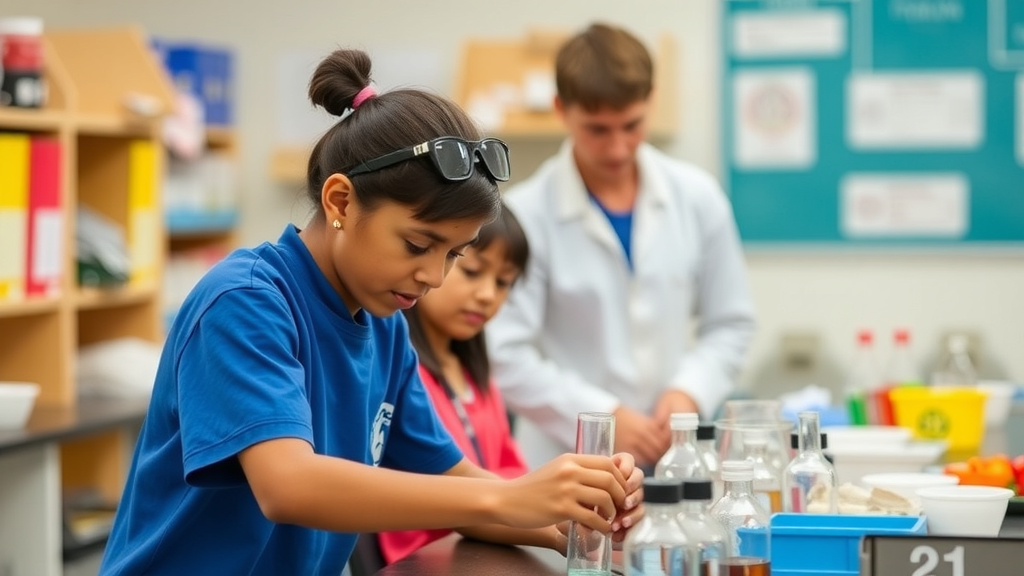
Image Credits: AI Generated
DOI: 10.1007/s44217-026-02059-8
Keywords: chemistry education, competency-based education, teacher training, NEP 2020, Andaman and Nicobar Islands, NCERT, inquiry-based learning, assessment reform, flipped classroom, virtual labs, professional development, Discover Education
Cite Scienmag News
Bethany Barker. (September 21, 2026). Five-Day Chemistry Bootcamp Transforms Island Teachers’ Classrooms. Scienmag. https://scienmag.com/five-day-chemistry-bootcamp-transforms-island-teachers-classrooms/
Bethany Barker. "Five-Day Chemistry Bootcamp Transforms Island Teachers’ Classrooms." Scienmag, 21 September 2026, https://scienmag.com/five-day-chemistry-bootcamp-transforms-island-teachers-classrooms/. Accessed 21 September 2026.
Bethany Barker. "Five-Day Chemistry Bootcamp Transforms Island Teachers’ Classrooms." Scienmag. September 21, 2026. https://scienmag.com/five-day-chemistry-bootcamp-transforms-island-teachers-classrooms/


