


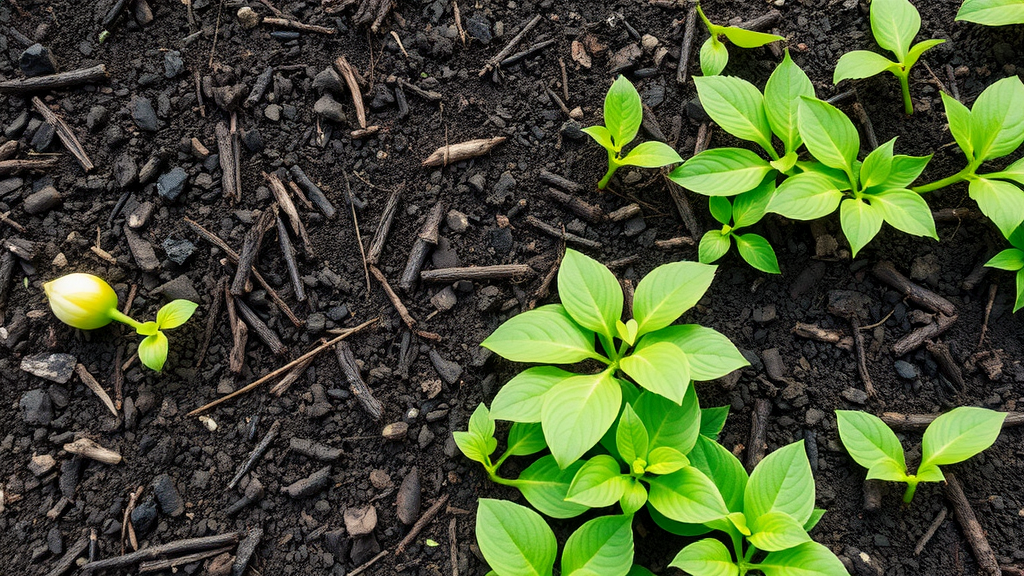
Intensive vegetable farming in Southern China is famous for its remarkable productivity, supplying bustling urban markets with leafy greens grown in rapid, near-continuous rotations. Yet behind those impressive harvests lies a stubborn problem that has plagued agricultural scientists for decades: farmers apply enormous quantities of nitrogen fertilizer, but only a fraction of that nutrient ever reaches the crop. The rest is lost to leaching, volatilization, and microbial transformations, polluting waterways, releasing greenhouse gases, and wasting money. Now, a two-year field experiment conducted in Guangdong Province offers compelling evidence that a single, carefully calibrated intervention—biochar made from rice straw—can simultaneously raise yields, tighten nitrogen cycling, and rebuild degraded soil health. Crucially, the study shows that the dose makes the medicine, with a moderate application of 20 metric tons per hectare outperforming both no amendment and heavier treatments.
The research, published in the journal Nitrogen Cycling, was carried out by a team led by Zonghai Chen and corresponding author Bo Li of South China Agricultural University, together with colleagues including Yige Liu, Jiashuai Hu, Ying Lu, and Lars Elsgaard. The investigators set up an intensive vegetable field planted with lettuce varieties, a cropping system typical of the humid subtropical conditions that dominate much of Southern China’s vegetable belt. Five biochar application rates were compared, spanning from zero as a control up to 40 metric tons per hectare, all under conventional nitrogen fertilization. The biochar itself was produced from rice straw, an abundant agricultural residue, through pyrolysis at 500 degrees Celsius, a thermal conversion process that locks carbon and mineral nutrients into a porous, charcoal-like material prized for its ability to alter soil physical and chemical properties.
The results were striking. Over the two-year experiment, the 20-ton-per-hectare treatment increased vegetable yields by 10 to 29 percent compared with plots that received no biochar. Nitrogen use efficiency, the proportion of applied fertilizer nitrogen actually captured by the crop, improved by 18 to 160 percent, a range that reflects year-to-year variability but consistently favors the moderate dose. Plant nitrogen uptake rose by 14 to 33 percent, meaning the lettuce not only grew larger but also accumulated more of the nutrient that drives leafy growth. In a sector where nitrogen use efficiency often languishes well below 40 percent, gains of this magnitude represent a meaningful step toward both economic and environmental sustainability, reducing the fertilizer inputs farmers must purchase while cutting the nutrient losses that degrade rivers and groundwater across the region.
What happens underground proved just as important as what happens above it. Biochar transformed the physical architecture of the soil, promoting the formation and stability of water-resistant aggregates—the small, crumb-like structures that give healthy soils their spongy texture, allowing them to hold moisture during dry spells yet drain freely after heavy rains. This aggregate stability matters enormously in Guangdong’s climate, where intense monsoonal downpours can sluice nutrients out of poorly structured soils. The amendment also increased microbial biomass, swelling the populations of bacteria and fungi that mediate decomposition, nutrient mineralization, and nitrogen transformations. At the optimal rate, the researchers’ composite soil quality index climbed 39.7 percent above the control in the first year and 50.6 percent higher in the second year, indicating that the benefits were not a fleeting first-season flush but a persistent improvement that actually strengthened with time.
To understand how these soil changes translated into better crops, the team employed statistical modeling that traced the pathways linking biochar to plant performance. Their analysis indicated that biochar influenced vegetable production and nitrogen utilization largely through three interlocking channels: altered soil nutrient availability, shifts in microbial communities, and improved soil structure. Higher soil quality scores were positively associated with vegetable yield, nitrogen uptake, and nitrogen use efficiency, suggesting a coherent causal chain in which the amendment acts first on the soil environment and only subsequently on the plant. This mechanistic clarity is valuable because it distinguishes biochar from a simple fertilizer substitute. Rather than directly feeding the crop, the material appears to function as a soil ecosystem engineer, creating conditions under which native nutrient cycles and microbial processes operate more effectively in partnership with conventional fertilization.
Perhaps the most consequential finding, however, is what did not happen at high application rates. The response of vegetable yield and nitrogen-related indicators was decidedly non-linear, rising steadily as biochar application climbed toward roughly 20 tons per hectare and then declining beyond that threshold. Plots amended with 30 or 40 tons per hectare showed no additional yield benefit, and the researchers caution that excessive rates could disturb nutrient balance or disrupt microbial conditions. In other acidic or nutrient-poor soils, very high biochar doses can immobilize nitrogen, raise pH beyond optimal ranges for some crops, or dilute mineral nutrient concentrations in ways that undermine rather than enhance fertility. The message for practitioners is unambiguous: more biochar is not necessarily better, and the amendment behaves as a dose-responsive tool rather than a cure-all to be applied liberally.
The dose-response relationship also carries significant economic weight. Biochar is not free; producing, transporting, and incorporating tens of tons of material per hectare represents a substantial investment, particularly for smallholder vegetable growers operating on thin margins. When the research team weighed crop benefits against biochar costs under the conditions of their experiment, 20 tons per hectare emerged as the most favorable amendment rate, delivering the strongest combination of yield gains, nitrogen savings, and soil improvement per unit of material applied. This kind of cost-benefit framing is essential if biochar is to move from research plots into the fields of working farms. An intervention that performs brilliantly in a scientific trial but fails an economic test will remain a curiosity; one that pays for itself through higher yields and reduced fertilizer waste has a realistic path to adoption.
Bo Li, the corresponding author, emphasized this balanced perspective in discussing the findings. According to the study team, a moderate application rate provided the best balance between improving soil conditions, supporting soil microorganisms, and helping vegetable crops use nitrogen more efficiently. That framing captures a broader shift in soil science away from viewing amendments as single-purpose inputs and toward managing them as components of an integrated system. In the Guangdong experiment, biochar did not replace nitrogen fertilizer; it made conventional fertilization more effective by reshaping the soil matrix in which nutrient transformations occur. For policymakers and extension services promoting low-carbon agriculture, this synergy matters, because biochar also sequesters carbon in a stable form, meaning a practice that boosts farm profitability may simultaneously contribute to climate mitigation.
The authors are careful to note the limits of their evidence. The experiment spanned only two years, a short window in the life of a soil system, and longer-term studies will be needed to determine how long the observed benefits persist and whether repeated moderate applications are required in warm, high-rainfall regions where biochar may decompose faster and nutrients cycle rapidly. Tropical and subtropical conditions can accelerate the aging of biochar particles, potentially altering their effects on nutrient retention over time. Questions also remain about how the optimal rate might shift across different soil types, crops, and management regimes beyond the lettuce rotations studied here. Still, the consistency of the improvements across two growing seasons, the strong mechanistic support linking soil quality to crop performance, and the clear identification of a cost-effective optimum give the findings practical credibility.
Taken together, the study positions carefully optimized biochar application as a realistic route toward more productive, nitrogen-efficient intensive vegetable farming in Southern China and potentially in comparable systems worldwide. By pinpointing 20 tons per hectare as the sweet spot, the research converts a broad enthusiasm for soil amendments into an actionable prescription, one that acknowledges the economics of farming and the complexity of soil ecology in equal measure. As demands on intensive vegetable systems continue to grow alongside the region’s population, strategies that squeeze more food from every kilogram of applied nitrogen—while restoring the structural and biological foundations of the soil itself—will only become more valuable. This experiment suggests that, with the right dose, rice straw that once might have been burned or discarded can become a cornerstone of that effort.
Subject of Research: Effects of rice-straw biochar application rates on vegetable yields, nitrogen use efficiency, and soil quality in intensive vegetable fields in Southern China
Article Title: Right dose of biochar boosts vegetable yields and nitrogen efficiency in Southern China
Article References: Right dose of biochar boosts vegetable yields and nitrogen efficiency in Southern China. (n.d.). Original publication
Image Credits: AI Generated
DOI: Not provided
Keywords: biochar, nitrogen use efficiency, vegetable production, soil quality, soil aggregates, microbial biomass, rice straw pyrolysis, intensive farming, Guangdong Province, soil amendments, nutrient availability, sustainable agriculture
Cite Scienmag News
Alan Morgan. (September 20, 2026). Moderate Biochar Rates Unlock Higher Vegetable Yields and Nitrogen Efficiency in Southern China. Scienmag. https://scienmag.com/moderate-biochar-rates-unlock-higher-vegetable-yields-and-nitrogen-efficiency-in-southern-china/
Alan Morgan. "Moderate Biochar Rates Unlock Higher Vegetable Yields and Nitrogen Efficiency in Southern China." Scienmag, 20 September 2026, https://scienmag.com/moderate-biochar-rates-unlock-higher-vegetable-yields-and-nitrogen-efficiency-in-southern-china/. Accessed 20 September 2026.
Alan Morgan. "Moderate Biochar Rates Unlock Higher Vegetable Yields and Nitrogen Efficiency in Southern China." Scienmag. September 20, 2026. https://scienmag.com/moderate-biochar-rates-unlock-higher-vegetable-yields-and-nitrogen-efficiency-in-southern-china/


