


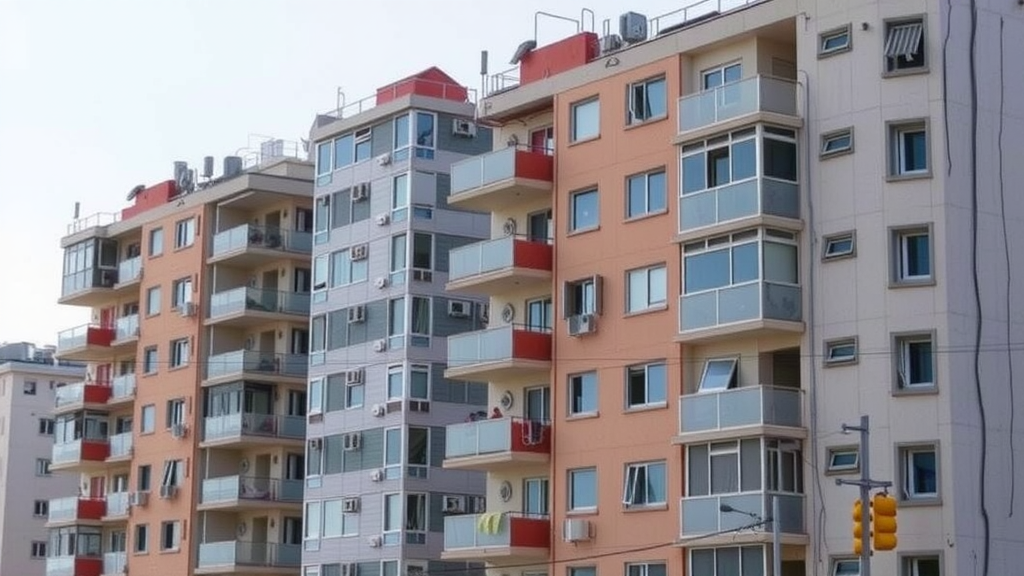
When two devastating earthquakes struck southern Türkiye on February 6, 2023, they did more than level entire neighborhoods in Antakya and Nurdağı. They exposed a blind spot in the way engineers classify and assess building vulnerability. A new study published in the Bulletin of Earthquake Engineering argues that a large class of low-rise buildings, often lumped together with conventional reinforced concrete or masonry structures, may in fact behave so differently during strong shaking that they deserve their own category in regional seismic risk models. The research, led by Abdullah Türer of Ankara Yıldırım Beyazıt University together with Fazıl Abdulkadir Çağlar and Yusuf Bahçacı, offers the first empirical fragility assessment of these so-called hybrid or semi-frame buildings based on field damage data from the Kahramanmaraş earthquake sequence.
Hybrid buildings occupy an awkward middle ground in structural engineering. They combine reinforced concrete frame elements, columns and beams, with load-bearing masonry walls in ways that do not fit the textbook definitions of either a pure concrete frame or a pure masonry structure. In these buildings, the stiff masonry walls and the more flexible concrete frames share the task of resisting lateral earthquake forces, producing complex load transfer paths and highly uneven stiffness distributions. Engineers have long known from laboratory studies that infill masonry walls can dramatically alter how a concrete frame responds to shaking, sometimes protecting it and sometimes triggering brittle failures. But when it comes to regional risk assessments, buildings like these are typically forced into one of the two standard categories, and their distinctive behavior is effectively erased from the statistics.
The February 2023 sequence made the cost of that simplification painfully visible. The magnitude 7.8 Pazarcık earthquake and the magnitude 7.6 Elbistan event struck hours apart, subjecting cities across Hatay, Gaziantep, and Kahramanmaraş provinces to some of the strongest ground motions ever recorded in Türkiye. In the aftermath, teams from the Ministry of Environment, Urbanization and Climate Change carried out rapid visual damage inspections across hundreds of thousands of structures, tagging each building with a damage class. That enormous dataset, normally used simply to prioritize demolitions and aid, became the raw material for the new analysis.
From the official field assessments, the researchers filtered out 169 low-rise hybrid buildings of one to three stories located in the Antakya and Nurdağı regions. For each building, they derived a coordinate-based estimate of short-period spectral acceleration, a standard measure of ground shaking intensity at the periods relevant to stiff, low-rise structures. The values came from the USGS ShakeMap rasters for both main shocks, and for every building the team adopted the larger of the two estimates as the maximum envelope demand, a conservative choice that reflects the cumulative assault of the two events on the same structure.
The damage picture in the sample was grim. Nearly 60 percent of the 169 buildings, 59.76 percent exactly, had been classified as heavily damaged, requiring urgent demolition, or had collapsed outright. The authors are careful to stress that this figure describes their filtered sample, not the region as a whole. Because the representativeness of the field data could not be established, the proportion should not be read as an estimate of how widespread severe damage was across all hybrid buildings in the affected areas. Still, the sheer concentration of severe outcomes in a dataset drawn from official inspections underscores why the researchers felt these structures warranted dedicated analysis.
To convert the paired observations of shaking intensity and damage into something predictive, the team turned to binary logistic regression, a statistical technique widely used in empirical fragility work. For each of three damage thresholds, slight-or-worse, moderate-or-worse, and heavy-or-worse, they fitted a continuous fragility function that expresses the probability of exceeding that threshold as a function of the spectral acceleration demand. Fragility curves of this kind are the workhorses of earthquake loss estimation: feed in an expected ground motion and the curve returns the likelihood that a typical building of the class will sustain at least a given level of damage.
The resulting median capacities are strikingly close together. The spectral acceleration at 0.3 seconds corresponding to a 50 percent probability of exceedance came out at 1.238 g for the slight-or-worse threshold, 1.405 g for moderate-or-worse, and 1.490 g for heavy-or-worse. In many building classes, these medians would be spread much further apart, reflecting a gradual progression from cosmetic cracking to structural distress. The tight clustering here suggests that once short-period shaking in these hybrid buildings crosses a certain band, damage can escalate rapidly from mild or moderate levels to heavy damage, leaving little margin between repairable and irreparable states. The authors caution that part of this pattern may also reflect uncertainties in the dataset, including the coarse binary and rapid visual damage classifications on which the models rest, and they note that the relationship for the lowest threshold showed only marginal statistical significance.
Even with those caveats, the implications for seismic risk assessment are significant. If hybrid buildings can jump from moderate to severe damage within a narrow range of demand, then treating them as ordinary reinforced concrete frames or as masonry buildings could seriously misestimate both expected losses and the number of structures likely to need demolition after a major event. The study argues that low-rise hybrid structures should be evaluated as a candidate separate vulnerability group, one whose models explicitly account for infill-wall and frame interaction, stiffness mismatch between the two structural materials, and discontinuities in the load path. Such an approach would bring regional risk models closer to the behavior that laboratory experiments on infilled frames have documented for decades, from the pioneering experimental evaluations of masonry-infilled concrete frames to recent work on confined masonry and mixed construction.
The methodology itself is a template for post-earthquake science. Rather than waiting years for detailed structural surveys, the researchers showed that official rapid assessment data, when combined with coordinate-matched ShakeMap intensity values, can yield usable fragility functions for a building class that would otherwise remain invisible. This approach echoes statistical procedures developed for earthquake damage fragility curves over the past two decades and complements recent empirical fragility studies of reinforced concrete buildings in the same earthquake. It also aligns with a broader movement toward faster, data-driven damage assessment, including machine learning frameworks that infer ground-level damage from aerial imagery.
The authors are explicit about the limits of their findings. The dataset is geographically concentrated in two districts, and the ground motions it reflects carry the specific signature of the 2023 sequence, including directivity effects and site conditions particular to the region. The fragility curves should therefore be interpreted as broad statistical indicators of relative vulnerability rather than precise predictive tools for any individual building. Data availability is also constrained: the underlying damage records can be obtained from the corresponding author upon reasonable request, subject to permission from the Turkish ministry that collected them. Nevertheless, as Türkiye rebuilds and as other earthquake-prone countries confront their own stocks of informal, mixed-construction buildings, the message of the study is hard to ignore. The buildings that defy easy classification are precisely the ones that risk models most often get wrong, and the 2023 Kahramanmaraş earthquakes have now provided the empirical evidence to prove it.
Subject of Research: Empirical seismic fragility assessment of low-rise hybrid concrete-masonry buildings damaged in the 2023 Kahramanmaraş earthquake sequence in Türkiye
Article Title: Empirical fragility assessment of low-rise hybrid buildings following the 2023 Kahramanmaraş earthquake sequence
Article References: Türer, A., Çağlar, F. A., & Bahçacı, Y. (2026). Empirical fragility assessment of low-rise hybrid buildings following the 2023 Kahramanmaraş earthquake sequence. Bulletin of Earthquake Engineering. https://doi.org/10.1007/s10518-026-02689-1
Image Credits: AI Generated
DOI: 10.1007/s10518-026-02689-1
Keywords: hybrid buildings, empirical fragility, Kahramanmaraş earthquakes, seismic vulnerability, spectral acceleration, logistic regression, infill walls, rapid visual screening, Antakya, Nurdağı, ShakeMap, earthquake damage assessment
Cite Scienmag News
Violet Maxwell. (September 20, 2026). Hybrid Buildings Emerge as Hidden Seismic Risk After 2023 Kahramanmaraş Earthquakes. Scienmag. https://scienmag.com/hybrid-buildings-emerge-as-hidden-seismic-risk-after-2023-kahramanmaras-earthquakes/
Violet Maxwell. "Hybrid Buildings Emerge as Hidden Seismic Risk After 2023 Kahramanmaraş Earthquakes." Scienmag, 20 September 2026, https://scienmag.com/hybrid-buildings-emerge-as-hidden-seismic-risk-after-2023-kahramanmaras-earthquakes/. Accessed 4 October 2026.
Violet Maxwell. "Hybrid Buildings Emerge as Hidden Seismic Risk After 2023 Kahramanmaraş Earthquakes." Scienmag. September 20, 2026. https://scienmag.com/hybrid-buildings-emerge-as-hidden-seismic-risk-after-2023-kahramanmaras-earthquakes/


