


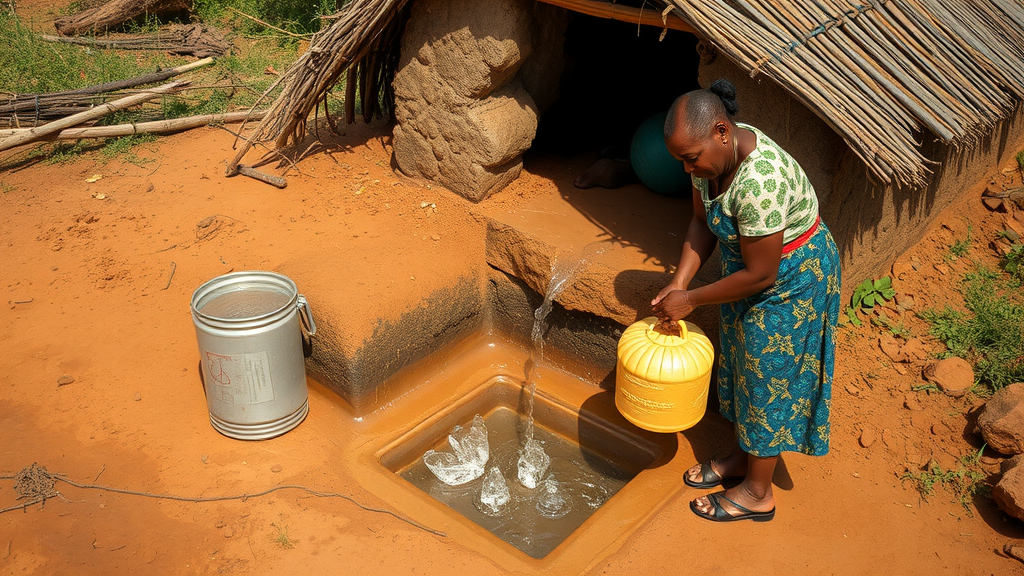
For millions of women in rural Kenya, the day does not begin with a cup of tea or a moment of quiet. It begins with a mental rehearsal, often before sunrise, of everything that must be done: preparing school-going children, lighting the fire, milking the goats, and then lifting a jerrican for a walk to a distant water point that may be crowded, contaminated, or watched by elephants. A new study argues that this invisible mental work—planning, worrying, deciding, and monitoring—constitutes a substantial and unrecognized dimension of the global water crisis, one that sits alongside the better-documented physical toll of hauling water across arid landscapes.
The research, published in SSM – Mental Health, draws on ten focus group discussions with 80 adult women in five rural communities in Isiolo and Samburu Counties, arid and semi-arid regions that were in the grip of severe drought when data were collected between June and July 2023. The interviews were conducted in the Samburu language by local research assistants and analyzed by a team from Emory University working with St. Paul’s University and World Vision Kenya as part of a multi-country initiative called Strong Women, Strong World: Beyond Access. The analysts used a modified grounded theory approach, applying established frameworks on cognitive labor and mental load to accounts that emerged spontaneously during broader conversations about water, time use, and economic life.
What the team found is striking in its consistency. Across every focus group, women described water collection not as a discrete physical chore but as a continuous cognitive project composed of four interlocking components: anticipation, identification, decision-making, and monitoring. Anticipation began in sleep. As one participant put it, even while sleeping women would start planning for the next day, calculating whether they would have water and how to fit collection into an already packed schedule. Upon waking, the mental sequencing resumed immediately—deciding what could be postponed, what demanded attention, and how the day’s chores could be arranged so that the long trip for water did not derail everything else.
Identification, the second component, involved continuously evaluating which water sources were viable, safe, and accessible under shifting conditions. During the rainy season, temporary sources such as water pans, gullies, and shallow dug wells appeared nearby, offering brief relief that might last only a week or two before drying up. In the dry season, women weighed distant sources that offered cleaner water against closer points contaminated by livestock and wildlife. They layered other tasks onto water trips—washing clothes, watering animals, shopping on market days—to conserve time and energy, and they adjusted plans when husbands requested extra water or when children’s needs intervened.
Decision-making, in turn, was not a single choice but a constantly revised calculation. Women chose whether to leave at dawn, before water points grew crowded and before livestock arrived, even though leaving early meant sacrificing time for school preparation and breakfast. They decided how much to carry, when to make a second trip, how to ration what they had collected across drinking, cooking, bathing, and cleaning, and when it was safe to walk routes where elephants had been spotted. Fatigue shaped these decisions in tangible ways: some women reported carrying smaller volumes of water or returning home earlier than planned because the cognitive and physical demands of the morning had already depleted them—a detail the researchers note adds empirical nuance to behavioral science, which increasingly recognizes that mental burden directly affects the performance of physically demanding tasks.
Monitoring, the fourth component, extended the labor well beyond the journey itself. Once home, women tracked water levels throughout the day, restricted household consumption, ensured children and livestock were supplied, and observed whether sources were drying, lowering, or becoming contaminated—observations that triggered fresh rounds of anticipation and planning. This vigilance was largely invisible within the household, unobservable to those who benefited from it, and therefore unrecognized and unshared. Women emphasized that the mental work of tracking what remained continued long after the physical labor of collection had ended, keeping water permanently on their minds.
Woven through all of this was emotional labor: regulating fear, suppressing frustration, buffering family members from scarcity, and absorbing responsibility for everyone’s wellbeing at the expense of their own. Women described the anguish of rationing, of giving the last water to others while going without bathing themselves, and the shame of borrowing food from neighbors after a long water journey. They described painful trade-offs between fetching water and preparing food, protecting children and earning income. They also described the emotional weight of watching daughters begin to shoulder the same burdens, and their determination to send girls to school to break the cycle. Women persistently subordinated their own needs—eating last, skipping meals, continuing to cook and care for others after reaching physical and emotional depletion.
The cumulative consequence, the researchers argue, is what they call the mental load of water collection: neither the sum of cognitive and emotional labor nor a synonym for stress, but the distinct product of their sustained co-occurrence. It manifested as sleepless nights, constant perseveration, headaches and lightheadedness, exhaustion, and neglected self-care. One woman summed it up: us women get sleepless nights knowing that in the morning you have to go and fetch water. The load was continuous, present day and night; boundaryless, following women across cooking, farming, childcare, and rest; and invisible, sustained by gender norms that frame water collection as women’s natural, unquestioned duty. Men’s participation was widely viewed as culturally inappropriate, with men risking social shame even for carrying a container a short distance, so women performed the work without household support—even as pregnant women faced risks including miscarriage from the weight of jerricans or sudden flight from wildlife.
The findings place rural Kenyan women’s experiences within a growing global literature linking water insecurity to anxiety, depression, and psychosocial distress, from Bolivia and Ethiopia to Uganda and India. But they extend that literature by demonstrating that the four components of cognitive labor documented in higher-income household research intensify under conditions of scarcity, seasonal variability, physical danger, and infrastructure failure, demanding constant recalibration that comparatively stable domestic settings do not. The burden, the authors stress, is not incidental but structurally produced by the gendered assignment of water responsibility, and it accumulates across the life course, beginning in childhood and intensifying during pregnancy and postpartum periods.
Yet the study also found buffers. Social networks softened the load: women walked to the river in groups, chatting, sharing information about water availability, coordinating decisions, and releasing stress through companionship that sometimes offered the only social connection in isolated homesteads. Membership in women’s groups provided practical help and belonging. These supports did not eliminate the hardship, the researchers note, but they made daily water work more bearable and emotionally sustainable.
The implications reach beyond Kenya. Globally, 1.8 billion people rely on off-premises water sources, and in seven out of ten households that must collect water, women and girls bear primary responsibility. Prior research using smartwatches and scales found that women in four countries walked an average of 3.5 kilometers and expended 231 kilocalories per collection trip; separate survey data show women have 1.5 times higher odds than men of reporting a water-fetching injury, with falls on dangerous terrain the predominant mechanism. The new study insists that the true burden cannot be measured in distance walked or weight carried alone. Improving water access through infrastructure that delivers safe water to the household could substantially reduce physical, cognitive, and emotional labor, and the authors argue for greater representation of women in water governance and leadership, alongside the application of frameworks such as the International Labour Organization’s 5Rs—recognizing, reducing, redistributing, rewarding, and representing unpaid care work. Until such change arrives, the researchers conclude, water collection must be recognized as a complex, gendered system of labor that shapes women’s time, energy, identities, and mental health—a burden they carry because, as they said repeatedly, everything depends on them.
Subject of Research: The cognitive and emotional labor of water collection and management among women in rural Kenya
Article Title: ‘Everything depends on us’: The cognitive and emotional labor of water collection and management in rural kenya
Article References: Dessalegn, B., Ogutu, E., Mink, T., Patrick, M., Sinharoy, S. S., Atandi, E., Mwangi, P., Koome, P., Onyango, R. O., Otuya, P., Ruto, P., & Caruso, B. A. (2026). ‘Everything depends on us’: The cognitive and emotional labor of water collection and management in rural kenya. SSM – Mental Health, 10, Article 100702. https://doi.org/10.1016/j.ssmmh.2026.100702
Image Credits: AI Generated
DOI: 10.1016/j.ssmmh.2026.100702
Keywords: water insecurity, cognitive labor, emotional labor, mental load, gender norms, rural Kenya, water collection, unpaid care work, mental health, WASH, Samburu, drought
Cite Scienmag News
Glenn Wilkins. (September 20, 2026). Water Collection in Rural Kenya Is Also a Heavy Mental Burden. Scienmag. https://scienmag.com/water-collection-in-rural-kenya-is-also-a-heavy-mental-burden/
Glenn Wilkins. "Water Collection in Rural Kenya Is Also a Heavy Mental Burden." Scienmag, 20 September 2026, https://scienmag.com/water-collection-in-rural-kenya-is-also-a-heavy-mental-burden/. Accessed 20 September 2026.
Glenn Wilkins. "Water Collection in Rural Kenya Is Also a Heavy Mental Burden." Scienmag. September 20, 2026. https://scienmag.com/water-collection-in-rural-kenya-is-also-a-heavy-mental-burden/


