


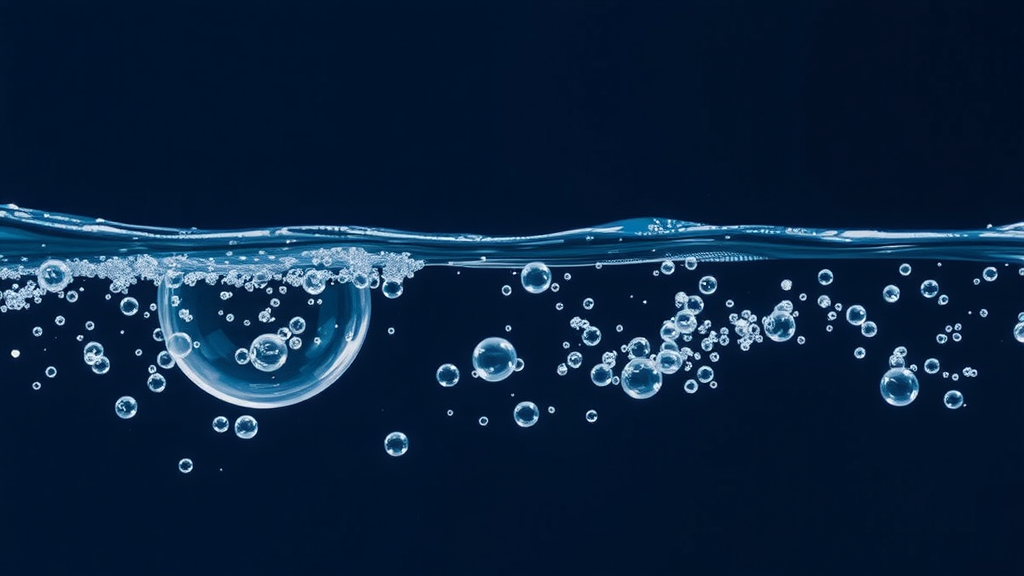
Air bubble curtains have quickly captured the public imagination as a low-tech, chemical-free way to stop plastic pollution in rivers and harbors, but a new laboratory study provides the most detailed look yet at how these devices actually interact with the microscopic end of the plastic spectrum. The research, published in the journal Microplastics and Nanoplastics, tested a bubble barrier under carefully controlled flume conditions and found a striking split in performance: the system proved remarkably effective at trapping large, buoyant microplastics, yet largely failed to retain small, dense particles that simply rode the current past the rising wall of air. The findings offer both reassurance and a warning for engineers hoping to deploy bubble barriers as the last line of defense before rivers reach the sea.
The study was led by César Santos of the University of Beira Interior in Portugal, together with Marco La Capra of the University of Bayreuth, Sven Frei of Wageningen University and Research, Benjamin Gilfedder of the University of Trier, and Cristina Fael of the University of Beira Interior. Bubble barriers work by pumping compressed air through a perforated hose or diffuser laid across a waterway, generating a continuous curtain of bubbles that rises to the surface. The upward flow of air drags water with it, creating a vertical circulation cell that, in principle, deflects floating debris toward a collection point at the bank. The technology has already attracted attention in pilot projects in Europe for intercepting macroplastics, but whether it could meaningfully stem the flow of particles smaller than five millimeters remained an open question.
To answer it, the team built a laboratory flume experiment designed to reproduce realistic open-channel hydraulics. Flow conditions were turbulent and subcritical, with a Reynolds number of approximately 4.7 × 10³ and a Froude number of about 0.03, meaning the water was slow and deep enough that gravitational effects on the free surface were modest. They ran the bubble barrier at three air pressures, 500, 750, and 1000 mbar, and tracked two things simultaneously: how the water itself moved, and how different classes of microplastic particles traveled through the system. The hydrodynamic analysis combined velocity field measurements, including particle image velocimetry, with particle tracking techniques, giving the researchers a full picture of the turbulent structure the bubbles imposed on the water column.
A key innovation of the experimental design was the use of fluorescein, a fluorescent dye that acts as a conservative tracer, meaning it moves with the water without decaying or reacting. By injecting the tracer upstream and measuring breakthrough curves downstream, the team could quantify exactly how the bubble barrier changed the timing and distribution of water transport. The results were unambiguous: the barrier created both preferential flow paths, where water was channeled more quickly through certain regions, and recirculation zones, where water was trapped and recirculated in slow-moving eddies. Together, these effects extended the residence time of fluorescein in the flume by up to 24 percent, a clear demonstration that the bubble curtain fundamentally rewires local mass and momentum transfer rather than merely aerating the water.
Velocity contour analysis confirmed and visualized these mechanisms. The bubble stream drove strong upward convection, pulling water from the depths toward the surface and generating localized turbulence that redistributed velocities around the barrier. This vertical flow component turned out to be the crucial variable for particle capture. Naturally buoyant microplastics, represented by low-density polyethylene and high-density polyethylene, were swept upward along the rising current and accumulated at the water surface near the bubble curtain. Downstream recovery of these buoyant particles dropped to less than 20 percent, meaning that more than four-fifths of them were effectively retained by the barrier. For a passive technology that consumes only compressed air, that level of capture for floating microplastics is a significant result.
The picture changed dramatically for polystyrene, which is denser than water and therefore non-buoyant. The smallest polystyrene particles tested, ranging from 75 to 125 micrometers, behaved almost exactly like the fluorescein tracer. Because of their tiny size and low inertia, these particles were so strongly coupled to the surrounding flow that the turbulent structures generated by the barrier had essentially no trapping effect; downstream recoveries reached 80 percent, indicating that the vast majority sailed straight through the bubble curtain. Mid-sized particles between 200 and 400 micrometers showed moderate interaction with the barrier-induced turbulence, occupying an intermediate zone between flow-following and inertial behavior, while the largest polystyrene particles, at 600 to 1000 micrometers, were governed mainly by gravitational settling. For that largest fraction, the low downstream recovery was attributed primarily to early deposition on the flume bed rather than to retention by the barrier itself.
One of the most intriguing findings concerns the role of air pressure. Velocity contours measured at the higher experimental pressures revealed that strong upward convection near the bubble stream can remobilize smaller, non-buoyant microplastics that had already settled into the sediments. In other words, the same force that lifts buoyant plastics to the surface can also pluck tiny sunken particles back into the water column, where they might be exposed to further transport. This observation cuts both ways. On one hand, it suggests that carefully tuned bubble systems could help resuspend trapped microplastics and give a second chance at capturing them. On the other hand, it raises the possibility that a poorly designed barrier could re-entrain sediment-stored contamination rather than locking it away, a risk that future field deployments will need to quantify.
The broader significance of the study lies in its mechanistic approach. Rather than reporting a simple capture efficiency, the researchers mapped how the bubble barrier modulates the flow field and connected those hydrodynamic changes directly to particle fate. This pressure-dependent control of the local flow field is what gives bubble barriers their versatility, and also what limits them. The upward convective currents are exquisitely suited to intercepting materials with a tendency to rise, which is why the technology performs so well for buoyant polyethylene particles and for macroplastics floating at the surface. Dense, small particles, however, follow the streamlines of the flow almost perfectly, and no amount of gentle turbulence will separate them out unless the flow itself is interrupted by settling zones, filtration, or secondary treatment steps downstream.
The authors emphasize that the results should guide the next generation of barrier designs. To expand the technology’s reach beyond buoyant plastics, future systems will need to optimize turbulent interactions, particularly the vertical flow components, so that non-buoyant particles experience enough drag and lift to be diverted rather than bypassed. That could mean adjusting bubble density, diffuser geometry, air pressure, or even combining bubble curtains with sediment traps or collection booms that exploit the recirculation zones the barrier naturally creates. The study also highlights the value of tracer-based diagnostics: because the fluorescein breakthrough curves predicted the behavior of the smallest particles so accurately, dye tracing could become a cheap field technique for estimating whether a given barrier is likely to retain fine microplastics at a real site.
As concern grows over microplastic pollution in rivers, lakes, and coastal waters, and as bubble barriers move from novelty to infrastructure, this work provides a rigorous scientific foundation for deciding where the technology belongs in the treatment chain. It confirms that bubble curtains are genuine hydrodynamic tools, capable of reshaping how water and particles move through a channel, and that they can deliver impressive retention of large buoyant microplastics before runoff reaches marine environments or effluent exits wastewater treatment plants. At the same time, it delivers an honest accounting of their blind spot: the smallest, densest fragments of plastic pollution, which are also among the most abundant and hardest to remove, remain largely beyond their grasp. Closing that gap, the researchers conclude, will require refined designs that intentionally sculpt the turbulence itself, turning the invisible architecture of the flow into an active filter.
Subject of Research: Laboratory evaluation of air bubble barrier hydrodynamics and their capacity to retain microplastic particles of varying size and buoyancy in flowing water.
Article Title: Can bubble barriers retain microplastics? An evaluation using laboratory and hydrodynamic analysis of transport and retention
Article References: Santos, C., La Capra, M., Frei, S., Gilfedder, B., & Fael, C. (2026). Can bubble barriers retain microplastics? An evaluation using laboratory and hydrodynamic analysis of transport and retention. Microplastics and Nanoplastics. https://doi.org/10.1186/s43591-026-00230-4
Image Credits: AI Generated
DOI: 10.1186/s43591-026-00230-4
Keywords: bubble barrier, microplastics, polyethylene, polystyrene, particle tracking, flow hydrodynamics, fluorescein tracer, turbulence, microplastic retention, air pressure, wastewater treatment, river pollution
Cite Scienmag News
Denise Maddox. (September 20, 2026). Bubble Barriers Catch Floating Microplastics but Let Smaller Particles Slip Through. Scienmag. https://scienmag.com/bubble-barriers-catch-floating-microplastics-but-let-smaller-particles-slip-through/
Denise Maddox. "Bubble Barriers Catch Floating Microplastics but Let Smaller Particles Slip Through." Scienmag, 20 September 2026, https://scienmag.com/bubble-barriers-catch-floating-microplastics-but-let-smaller-particles-slip-through/. Accessed 20 September 2026.
Denise Maddox. "Bubble Barriers Catch Floating Microplastics but Let Smaller Particles Slip Through." Scienmag. September 20, 2026. https://scienmag.com/bubble-barriers-catch-floating-microplastics-but-let-smaller-particles-slip-through/


