


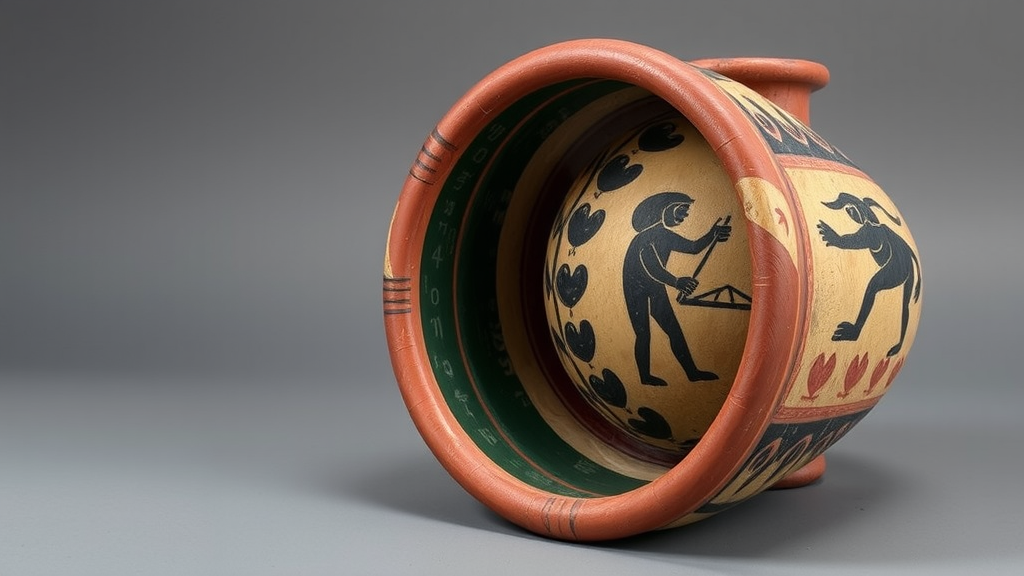
Some of the most intriguing artworks of Neolithic China were never meant to be seen from the outside. A new study published in Asian Archaeology argues that pottery vessels decorated on their interior surfaces, a phenomenon known as interior-painted pottery, represent one of the earliest and most distinctive decorative traditions of the region along China’s eastern coast. According to researchers Luyao Pan and Binfu Zhao of the School of Archaeology at Jilin University, the systematic analysis of excavated specimens shows that the eastern coastal zone was not a peripheral recipient of artistic ideas flowing from the interior of China, as older narratives often suggested, but one of the earliest areas to adopt interior painting and to develop an independent aesthetic orientation of its own. The finding reframes the developmental history of Chinese painted pottery and underscores the creative dynamism of Neolithic communities living along the coast.
Painted pottery occupies a central place in the archaeology of prehistoric China. For decades, scholarly attention concentrated on the great painted-pottery traditions of the Yellow River basin, particularly the Yangshao culture and its spectacular Miaodigou phase, often described as an art wave that swept across much of the Chinese Neolithic world. In that familiar story, decoration flowed outward from the central plains, and regions such as the eastern coast were treated as distant echoes. The new study challenges this diffusionist picture by assembling the evidence for interior-painted vessels from Neolithic sites along the eastern seaboard and subjecting it to formal typological and stylistic analysis, tracing how motifs, techniques, and vessel forms changed through time across the region.
The technique itself is technically demanding in ways that distinguish it from conventional exterior painting. When a potter decorates the inside of a vessel, the working surface is concave, often narrow at the mouth, and frequently curved steeply toward the base. Applying pigment evenly requires controlling brush angle and paint load in a confined space, and the decorator frequently works without the natural light and comfortable wrist positions available when painting a convex outer wall. Moreover, interior decoration is largely hidden in daily use, visible only when a viewer looks directly into the vessel or when the pot is tilted or emptied. This raises an interpretive puzzle that the authors address directly: if the designs were hard to see, why invest labor in them? The answer, they suggest, lies in the symbolic and ritual significance of the vessel interior, where the act of decoration mattered as much as its visibility.
Typological analysis formed the methodological backbone of the research. The researchers classified the excavated interior-painted vessels according to vessel shape, rim and mouth morphology, paint color, motif structure, and the placement of decoration within the interior. This classification allowed them to reconstruct an evolutionary sequence showing how the tradition emerged, matured, and spread. The results indicate recognizable regional styles: communities in different pockets of the eastern coastal zone developed their own repertoires of lines, bands, and symbolic motifs executed inside bowls, basins, and other open forms, while sharing enough common features to be recognized as participants in a broader tradition. That combination of local flavor and shared grammar, the authors argue, is the signature of an active, internally creative decorative school rather than passive imitation of foreign fashions.
The chronological picture that emerges is striking. Interior painting appears early in the Neolithic sequence of the eastern coast, at sites spanning the lower Yangtze region and the Jianghuai area, including well-known excavations such as Kuahuqiao in Zhejiang Province and Shuangdun and Houjiazhai in Anhui. From these early expressions, the study traces a continuous developmental lineage into later periods, intersecting with traditions documented at sites such as Beiyinyangying, Liulin, Dadunzi, Longqiuzhuang, and the celebrated Dawenkou cemetery complex in Shandong. The breadth of the sample, drawn from excavation reports and museum-grade publications spanning several provinces, gives the reconstruction an unusually solid empirical foundation for a phenomenon that is easy to overlook because it is literally concealed within the pots.
Beyond chronology and style, the study frames interior-painted pottery as evidence of cultural interaction and innovative reworking among Neolithic regional societies. The eastern coastal corridor, with its river systems, wetlands, and accessible shoreline, formed a natural axis of communication connecting the lower Yangtze with the Jianghuai plain and the Haidai region to the north. Ideas and techniques traveled along this corridor, but, crucially, they did not travel unchanged. When exterior painting traditions encountered eastern communities already experimenting with interior surfaces, the result was not simple borrowing but transformation: motifs were recombined, techniques adapted, and new vessel-decor relationships invented. The authors describe this as dynamic integration and innovation among regional cultures, a process in which the coast contributed original aesthetics to the larger story of Chinese painted pottery instead of merely receiving them.
The cultural interpretation of hidden decoration opens a fascinating window into Neolithic cognition and ritual practice. Vessels painted on the inside may have served in feasting, libation, or burial contexts in which the act of pouring, offering, or viewing into the vessel activated the design. In mortuary settings especially, where pottery accompanied the dead, an interior image could have been intended for symbolic or spiritual purposes rather than public display. The study’s emphasis on the aesthetic orientation of the decoration, its deliberate composition around the interior volume and the viewer’s downward gaze, suggests that Neolithic potters conceived of the vessel interior as a meaningful canvas in its own right, a conceptual shift with implications for how archaeologists read the visual culture of early sedentary societies.
The research also carries methodological lessons for the wider discipline. Because interior decoration is easy to miss in field records, especially where vessels are stored rim-down or reconstructed with the interior inaccessible, the true frequency of the practice may be underestimated in many collections. The authors’ systematic typological treatment of published specimens demonstrates how much information can be extracted from existing excavation reports when interior surfaces are examined deliberately. Their work encourages archaeologists across China and beyond to re-inspect museum holdings and site archives for concealed decoration, a low-cost form of research that could significantly revise distribution maps for painted pottery traditions worldwide.
The significance of the findings extends to debates about the origins of Chinese civilization and the character of early cultural exchange. The traditional center-periphery model, in which artistic innovation radiated from the Central Plains, increasingly gives way to a multi-centered vision in which several regions contributed independent traditions that later intertwined. Interior-painted pottery from the eastern coast provides concrete evidence for this pluralistic picture: an early adoption date, an autonomous decorative lineage, and demonstrable interaction with neighboring cultures all point to a coastal zone that was an engine of Neolithic creativity. As excavation and analysis continue, the hidden art inside these ancient vessels may prove to be one of the most revealing archives of social life, belief, and identity that Neolithic eastern China has left behind.
Subject of Research: Interior-painted pottery and its artistic and cultural significance in Neolithic Eastern China
Article Title: Artistic characteristics and cultural phenomena of interior-painted pottery from Neolithic Eastern China
Article References: Artistic characteristics and cultural phenomena of interior-painted pottery from Neolithic Eastern China. (n.d.). https://doi.org/10.1007/s41826-026-00132-7
Image Credits: AI Generated
DOI: 10.1007/s41826-026-00132-7
Keywords: interior-painted pottery, Neolithic Eastern China, painted pottery, Chinese archaeology, Asian Archaeology, typological analysis, decorative tradition, cultural interaction, Yangshao culture, Dawenkou, prehistoric art, eastern coastal region
Cite Scienmag News
Courtney Benton. (September 20, 2026). Neolithic Potters Painted Inside Their Vessels, Revealing a Hidden Artistic Tradition. Scienmag. https://scienmag.com/neolithic-potters-painted-inside-their-vessels-revealing-a-hidden-artistic-tradition/
Courtney Benton. "Neolithic Potters Painted Inside Their Vessels, Revealing a Hidden Artistic Tradition." Scienmag, 20 September 2026, https://scienmag.com/neolithic-potters-painted-inside-their-vessels-revealing-a-hidden-artistic-tradition/. Accessed 20 September 2026.
Courtney Benton. "Neolithic Potters Painted Inside Their Vessels, Revealing a Hidden Artistic Tradition." Scienmag. September 20, 2026. https://scienmag.com/neolithic-potters-painted-inside-their-vessels-revealing-a-hidden-artistic-tradition/


