


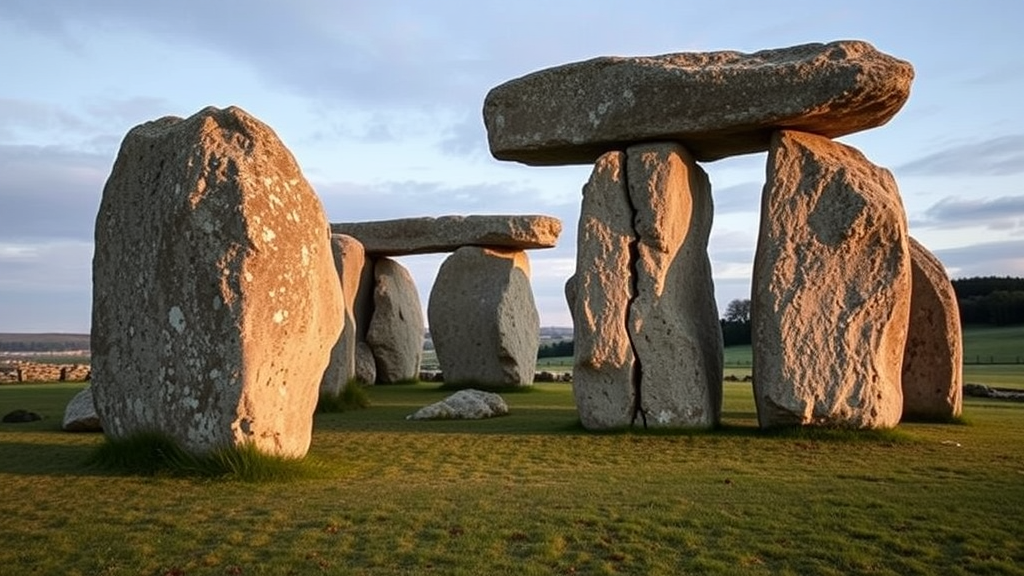
One of Britain’s most enigmatic prehistoric monuments has finally given up one of its closest guarded secrets. The Devil’s Arrows, three colossal standing stones that tower over the outskirts of Boroughbridge in North Yorkshire, were not the accidental leftovers of retreating ice sheets, as long suspected. Instead, new geological research shows they were deliberately quarried, transported and raised by Neolithic communities who hauled blocks weighing around 25 tonnes each across 11 miles, roughly 18 kilometres, of open landscape. The findings transform a familiar local landmark into one of the most extraordinary engineering feats of Neolithic Britain.
The study, led by researchers at the University of York together with geochemists at Curtin University in Australia, applied high-resolution isotopic fingerprinting to microscopic minerals locked inside the megaliths. The Devil’s Arrows are carved from Pennine Basin Millstone Grit, a coarse-grained sandstone deposited during the Namurian period more than 300 million years ago, while the monument itself stands on Triassic Sherwood Sandstone. Crucially, the nearest gritstone outcrops lie only about five kilometres west of Boroughbridge, and other long-suspected sources such as Plumpton Rocks sit around 13 kilometres away. If the stones had simply been glacial erratics dropped by ice, their chemistry should match one of these closer sources.
By mapping the unique mineral age profiles of zircon and apatite crystals extracted from the stones, the team traced the monoliths’ exact geological birthplace to Brimham Rocks, a dramatic gritstone landscape 18 kilometres to the west in North Yorkshire. The isotopic signatures ruled out every local and intermediate candidate, settling a debate that has run for decades over whether human effort or glaciers were responsible for positioning the giants. The answer is unambiguous: Neolithic builders knowingly bypassed convenient stone in favour of a specific, distant and presumably sacred source.
Dr Jim Leary of the University of York’s Department of Archaeology noted that megalithic architecture ranks among the most visually striking features of the Neolithic landscape across Britain and Ireland, from vast ceremonial complexes such as Avebury and Stonehenge to solitary standing stones. Yet while sites in southern England and Scotland attract considerable scholarly attention, monuments like the Devil’s Arrows have remained comparatively understudied despite their obvious significance. The new results, he said, prove that Neolithic communities moved several 25-tonne stones across Yorkshire, turning a familiar site into an epic quest to create a sacred landscape.
The scale of the monument alone justifies that description. At almost seven metres tall, the three surviving pillars form the tallest standing stone row in Britain, dwarfing the sarsens of Stonehenge. The southern stone is the second-tallest megalith in the country after the Rudston Monolith, and the central stone ranks third. The three unevenly spaced monoliths stretch across 174 metres on gently sloping ground aligned toward a possible prehistoric ford on the River Ure, and historical records indicate the row once contained at least five stones and probably more.
The study also solved a centuries-old local mystery by confirming that one of the lost Arrows is hiding in plain sight. The Tudor antiquarian John Leland recorded a fourth standing stone in the mid-16th century, but decades later it had vanished. In 1687 it was reported that locals broke up a fallen stone, using part of it to build Peg Bridge over the River Tutt and carrying the top segment to Aldborough manor. In the 19th century, antiquarian J.R. Walbran proposed that another fallen monolith had been recycled into the Battle Cross, a 5.5-metre monument created in the 15th century to commemorate the 1322 Battle of Boroughbridge. The mineral fingerprinting has now proved Walbran right: the medieval cross still standing in Aldborough is a carved segment of a long-lost Arrow.
The find also reframes the monument’s place in the wider prehistoric landscape. Extensive Neolithic remains lie west of the stones, suggesting they formed the southern gateway to a vast sacred region between the Rivers Swale and Ure. That corridor contains seven late-Neolithic henges, the densest concentration in Britain, and the Arrows appear to have anchored its southern entrance. Choosing stone from Brimham Rocks, another striking natural landmark within that ritual geography, may have been as much a symbolic act as a practical one, physically connecting two extraordinary places in a single ceremonial network.
For the National Trust, which cares for Brimham Rocks, the research draws a direct and unexpected line between two of Yorkshire’s most celebrated landscapes. Justin Scully, general manager for Fountains Abbey and Studley Royal and Brimham Rocks, observed that the stones have inspired stories and curiosity for generations, including the much-loved legend of the Devil standing on How Hill and hurling giant stone arrows toward Boroughbridge, only for them to fall short where they stand today. The science, he noted, shows the real journey behind the folklore is every bit as extraordinary.
Heritage bodies hope the findings will support the monument’s long-term protection. Jess Tipper, Historic England’s North Region Inspector of Ancient Monuments, described the Arrows as a much-loved part of Boroughbridge’s rich heritage and welcomed the scientific discoveries that deepen understanding of their history, adding that further research will help safeguard them for everyone to enjoy.
Beyond Yorkshire, the study carries broader implications for how archaeologists read megalithic monuments everywhere. Isotopic fingerprinting of zircon and apatite now offers a powerful, non-invasive route to provenance for stones that have resisted conventional geological sourcing for centuries, and it can distinguish human transport from glacial redistribution with unprecedented confidence. As the technique is applied to other stone rows, circles and monoliths, more of Neolithic Britain’s engineered sacred landscapes are likely to emerge from under assumptions of glacial convenience. The research is published in the journal Proceedings of the Royal Society A.
Subject of Research: Provenance analysis of the Neolithic Devil's Arrows standing stones in Yorkshire
Article Title: Neolithic ‘Devil’s Arrow’ stones travelled 11 miles across Yorkshire, study reveals
Article References: Neolithic ‘Devil’s Arrow’ stones travelled 11 miles across Yorkshire, study reveals. (n.d.). Original publication
Image Credits: AI Generated
DOI: Not provided
Keywords: Devil's Arrows, Neolithic, megaliths, Yorkshire, Brimham Rocks, isotopic fingerprinting, standing stones, Boroughbridge, millstone grit, glacial erratics, archaeology, Proceedings of the Royal Society A
Cite Scienmag News
Courtney Benton. (September 12, 2026). Giant Neolithic Stones Hauled 11 Miles Across Yorkshire, Isotopic Study Reveals. Scienmag. https://scienmag.com/giant-neolithic-stones-hauled-11-miles-across-yorkshire-isotopic-study-reveals/
Courtney Benton. "Giant Neolithic Stones Hauled 11 Miles Across Yorkshire, Isotopic Study Reveals." Scienmag, 12 September 2026, https://scienmag.com/giant-neolithic-stones-hauled-11-miles-across-yorkshire-isotopic-study-reveals/. Accessed 4 October 2026.
Courtney Benton. "Giant Neolithic Stones Hauled 11 Miles Across Yorkshire, Isotopic Study Reveals." Scienmag. September 12, 2026. https://scienmag.com/giant-neolithic-stones-hauled-11-miles-across-yorkshire-isotopic-study-reveals/


