


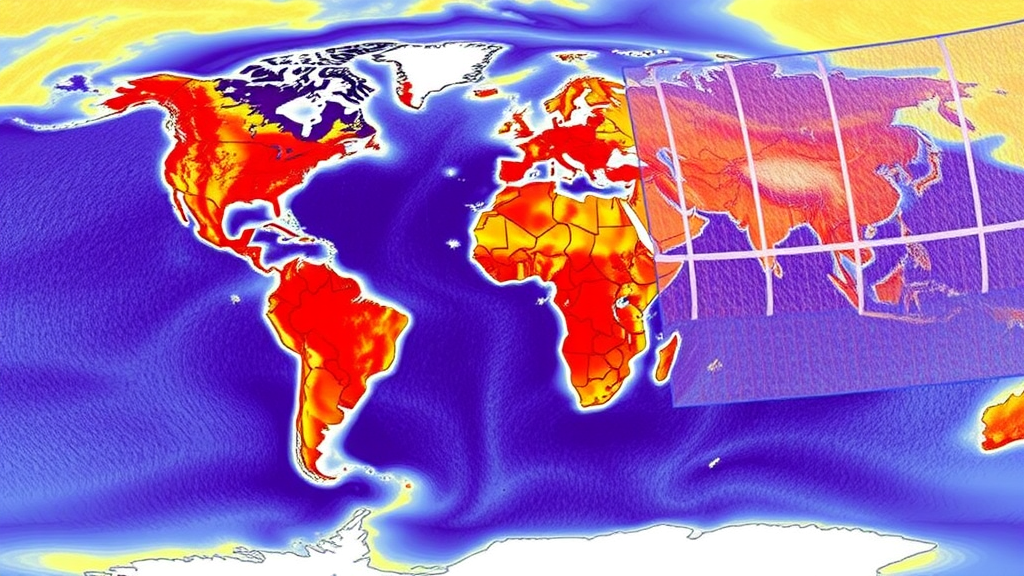
Sea surface temperatures quietly govern much of what happens on our planet. They shape marine ecosystems, steer hurricanes, modulate rainfall across continents and serve as one of the clearest fingerprints of a warming climate. Yet measuring them comprehensively remains a stubborn challenge. Ships, buoys and drifting sensors cover only a tiny fraction of the ocean’s surface, and satellites, despite their global reach, can be misled by clouds, aerosols and atmospheric interference. The result is a data landscape that is accurate where instruments exist and murky everywhere else. A new study from North Carolina State University now offers a way to fill in those gaps with remarkable speed and precision, and it does so with a mathematical approach that outperforms both classical interpolation techniques and a heavyweight artificial intelligence model while training in about a minute.
The research, published in the Journal of Geophysical Research: Machine Learning and Computation, introduces a technique called Sparse Discrete Empirical Interpolation Method, or S-DEIM. It was developed by Mohammad Farazmand, associate professor of mathematics at NC State, together with graduate student Louisa Ebby and a team of undergraduate researchers from institutions across the United States. According to the authors, the method reconstructs high-resolution global sea surface temperature fields from as few as 100 in situ observations, a sampling density that amounts to just 0.2 percent of the full spatial grid. Even with so little direct information, more than 90 percent of the S-DEIM estimates landed within one degree Celsius of the true values in the team’s benchmark tests.
The problem the researchers set out to solve is one that oceanographers and climate scientists have wrestled with for decades. Federal agencies such as the National Oceanic and Atmospheric Administration have long relied on combinations of complicated differential equations to estimate temperatures across the vast unmonitored stretches of ocean. These model-based approaches are rigorous, but they are computationally demanding and depend on physical assumptions that may not hold perfectly across every ocean basin and season. Meanwhile, the explosive growth of machine learning has produced an alternative family of tools that can learn patterns directly from data, but at a steep price: deep neural networks often require hours of training on powerful hardware and enormous quantities of data before they can make a single useful prediction.
Somewhere in between sits the Discrete Empirical Interpolation Method, an established technique that the new work builds upon. Rather than modeling the ocean purely from physical first principles, DEIM specifies a basis, essentially a compact library of spatial patterns that jointly encode the structure of the temperature field being estimated. Given a handful of actual measurements, the method selects which of these patterns to activate and with what weights, producing a full-field estimate from sparse data. The approach is elegant and efficient, but it has a well-known weakness. When the available observations are truly sparse, as they typically are in the open ocean, the estimates it produces degrade considerably, because the method struggles to determine which patterns best explain a scattering of disconnected data points.
The NC State team’s insight was to bring historical information to bear on precisely this weakness. S-DEIM augments the classical framework with a so-called kernel vector, a quantity for which no closed-form mathematical formula exists, estimated instead from the long historical record of observations. In practice, the reconstruction produced by S-DEIM consists of two complementary terms. The first is computed from instantaneous in situ measurements using empirical interpolation, anchoring the estimate to what sensors are actually reporting right now. The second is learned from the historical time series using recurrent neural networks, which are particularly well suited to capturing how patterns in the data evolve over time. The marriage of the two allows the method to lean on decades of accumulated knowledge about ocean behavior while still respecting the fresh, if sparse, observations streaming in.
To train and test the method, the researchers used NOAA’s weekly high-resolution sea surface temperature dataset spanning 1989 through 2021, a record covering more than three decades of global ocean variability. The final year of the record, from January 2022 through January 2023, was withheld from the models entirely and reserved as a blind test. The team then asked S-DEIM, the classical DEIM method and a high-performing convolutional neural network to predict the sea surface temperatures for that unseen year, and compared their outputs against the actual historical data. This head-to-head design provided a rigorous measure of how each technique would perform under realistic conditions, where the future is genuinely unknown and the data available is sparse.
The results were striking. S-DEIM proved roughly 40 percent more accurate than DEIM, a substantial leap over the method it directly extends. More surprisingly, it also edged out the convolutional neural network, delivering estimates about 2 percent more accurate than the best AI model in the comparison. The efficiency gap was even more dramatic. Training the recurrent neural network at the heart of S-DEIM took approximately one minute, a one-time offline step, whereas the convolutional neural network required an hour and a half to train. Once trained, S-DEIM generates its full reconstructions in less than a second, making the approach practical for operational settings where forecasts must be produced continuously and quickly.
The method also displayed a robustness that matters greatly for real-world deployment. Sensor networks in the ocean are rarely arranged optimally; instruments drift, fail and are deployed wherever ships happen to travel. When the researchers distributed the sensors randomly rather than in favorable positions, the reconstruction error deteriorated by only 1 to 2 percent, suggesting that S-DEIM does not depend on carefully engineered measurement placements to deliver its accuracy. That resilience, combined with its computational thrift, makes the method attractive for agencies monitoring the ocean with limited and unevenly distributed instrumentation, and it opens the door to assimilating streaming observations in near real time.
The implications extend in two directions at once. In the short term, accurate and rapidly computed sea surface temperature fields feed directly into weather forecasting, where ocean conditions influence storm tracks, intensity and precipitation patterns on timescales of days to weeks. In the longer term, the same fields underpin climate models that track how the ocean absorbs and redistributes heat over decades. A tool that can deliver high-resolution temperature reconstructions from a sliver of the usual data, at a fraction of the computational cost, could meaningfully lower the barrier to both endeavors. The work also grew out of a National Science Foundation supported Research Experience for Undergraduates, with co-authors Cassidy All of the University of Colorado Boulder, Kevin Ho of Mississippi State University, Maya Magnuski of Bard College and Christopher Nicolaides of Indiana University contributing to the study alongside the NC State team.
Farazmand and his colleagues emphasize that this is not the end of the road. The team hopes to continue improving the accuracy of S-DEIM, and the framework’s flexibility suggests room for refinement, from richer historical models to better handling of measurement noise. For now, the study makes a compelling case that when data is scarce, a thoughtfully designed hybrid of classical interpolation and lightweight learning can beat brute-force deep learning on its own terms. In a field where every degree matters and every observation counts, S-DEIM offers a reminder that sometimes the smartest algorithm is not the biggest one, but the one that knows how to make the most of very little.
Subject of Research: A sparse-data interpolation method for rapidly reconstructing global sea surface temperatures from limited in situ observations.
Article Title: New method estimates sea surface temps quickly and accurately
Article References: New method estimates sea surface temps quickly and accurately. (n.d.). Original publication
Image Credits: AI Generated
DOI: Not provided
Keywords: sea surface temperature, S-DEIM, data assimilation, machine learning, recurrent neural networks, NOAA, climate modeling, oceanography, sparse data, empirical interpolation, weather forecasting, North Carolina State University
Cite Scienmag News
Violet Maxwell. (September 12, 2026). New Sparse-Data Method Maps Ocean Temperatures Faster Than AI. Scienmag. https://scienmag.com/new-sparse-data-method-maps-ocean-temperatures-faster-than-ai/
Violet Maxwell. "New Sparse-Data Method Maps Ocean Temperatures Faster Than AI." Scienmag, 12 September 2026, https://scienmag.com/new-sparse-data-method-maps-ocean-temperatures-faster-than-ai/. Accessed 12 September 2026.
Violet Maxwell. "New Sparse-Data Method Maps Ocean Temperatures Faster Than AI." Scienmag. September 12, 2026. https://scienmag.com/new-sparse-data-method-maps-ocean-temperatures-faster-than-ai/


