


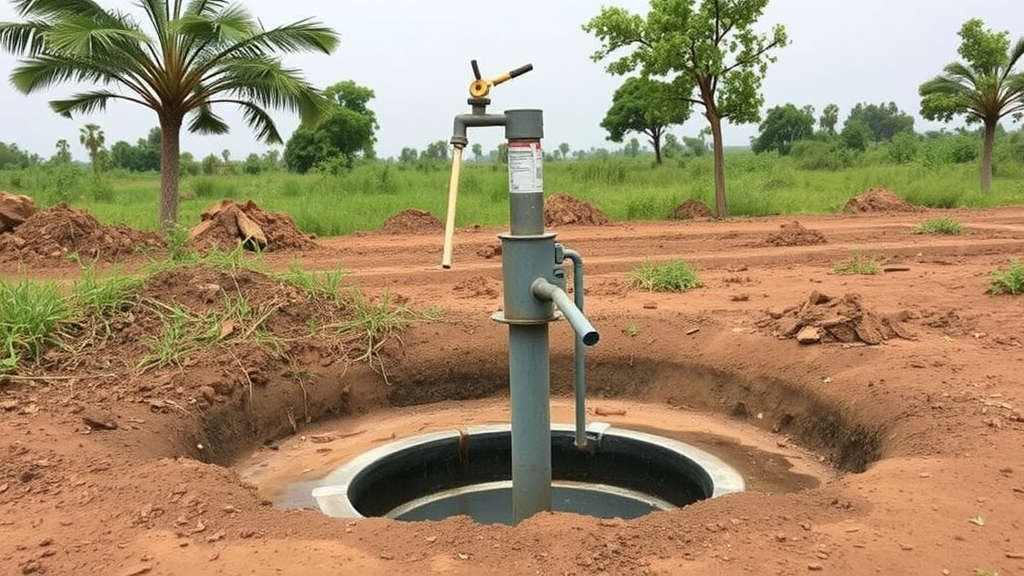
Millions of people in Edo State, Nigeria, rely on borehole water for drinking and domestic use, but a new study suggests that much of that groundwater carries a hidden radiological burden. Researchers Felix A. Popoola of Glorious Vision University and Okhuomaruyi D. Osahon of the University of Benin measured naturally occurring radioactive materials in thirty-five borehole water samples collected across Benin City, the densely populated state capital, and the smaller agricultural town of Ogwa in Esan-West Local Government Area. Their findings, published in BMC Environmental Science, reveal that concentrations of potassium-40 and thorium-232 regularly exceed international drinking water guidelines, and that the annual radiation doses received by consumers of all ages surpass the safety threshold set by the World Health Organization.
The team used gamma-ray spectroscopy with a sodium iodide detector coupled to a multichannel analyser, calibrating the system with traceable reference sources to identify the characteristic energy peaks of potassium-40, uranium-238 and thorium-232. Samples were collected in acid-rinsed containers, treated with concentrated hydrochloric acid to fix the radioactive elements, and stored for four weeks to allow secular equilibrium between the parent radionuclides and their decay products before counting. Background radiation was characterised by counting an empty container for 36,000 seconds, and minimum detectable activities were calculated for each radionuclide to ensure the measurements were statistically meaningful rather than noise.
The results show a consistent pattern of elevated radioactivity. In Benin City, mean activity concentrations were 56.1 plus or minus 1.5 becquerels per litre for potassium-40, 4.3 plus or minus 0.8 becquerels per litre for uranium-238 and 9.3 plus or minus 1.5 becquerels per litre for thorium-232. In Ogwa, potassium-40 averaged even higher at 67.3 plus or minus 1.8 becquerels per litre, while uranium-238 and thorium-232 averaged 2.5 and 6.9 becquerels per litre respectively. Against guideline values of roughly 10, 10 and 1.0 becquerels per litre for these three radionuclides, potassium-40 and thorium-232 were clearly out of bounds, with about ninety-three percent of samples exceeding the safe limits for those isotopes. The highest potassium-40 reading in Benin City reached 132.6 becquerels per litre, while uranium-238 remained within acceptable limits everywhere except two locations.
Dose calculations converted these activity concentrations into annual effective doses using standard ingestion coefficients and age-specific water intake rates for six age categories: infants, one-year-olds, five-year-olds, ten-year-olds, fifteen-year-olds and adults. In Benin City, mean annual effective doses ranged from 3.7 millisieverts per year for infants down to 1.3 millisieverts per year for ten-year-olds, while Ogwa produced values between 3.0 and 1.1 millisieverts per year. Every mean value in every age group exceeded the World Health Organization’s tolerable limit of 0.1 millisieverts per year by more than an order of magnitude, and infants emerged as the most vulnerable group because of their comparatively high water intake per unit body mass.
Thorium-232 proved to be the dominant contributor to the total dose, accounting for roughly eighty-one percent of the annual effective dose for infants in Benin City and nearly eighty percent for adults, followed by potassium-40 and finally uranium-238. This ordering matters because the dose conversion factor for ingested thorium is several times higher than for uranium or potassium, meaning even moderate thorium levels translate into disproportionately large effective doses. The researchers attribute the thorium enrichment to the local geology: the region sits atop the Benin Formation, a sedimentary sequence rich in heavy minerals such as monazite and zircon that host thorium in their crystal lattices. Unlike uranium, which migrates readily as soluble U(VI), thorium exists as highly insoluble Th(IV) and reaches groundwater mainly through colloid-mediated transport of fine particles and alpha recoil during prolonged water-rock interaction.
The study also computed a suite of radiological hazard indices. Radium equivalent activity averaged 21.9 becquerels per litre in Benin City and 17.5 in Ogwa, well below the recommended ceiling of 370 becquerels per litre, and the external and internal hazard indices and the representative gamma index all remained far below unity. The annual gonadal equivalent dose averaged 69.7 and 57.6 for the two locations respectively, beneath the standard reference value. In other words, the acute external hazard posed by the water is modest. The concern centres instead on chronic ingestion: the excess lifetime cancer risk exceeded the global mean of 0.2 times ten to the minus three at every sampling point. Mean ELCR values in Benin City reached 10.0 times ten to the minus three per year for infants and 5.3 for adults, while Ogwa’s values, though lower, remained above the safe benchmark.
One of the most striking findings lies in the statistical structure of the data. In Benin City, all radionuclides and hazard indices showed strong positive correlations, statistically significant at the one percent level, with coefficients approaching one for pairs such as radium equivalent and absorbed dose rate. The researchers interpret this as the signature of a homogeneous hydrogeochemical regime in the sedimentary coastal plain aquifer, where high infiltration rates and uniform leaching move the radionuclides together. Ogwa told a different story. Sitting on the fractured Precambrian Basement Complex of the Esan Plateau, the town’s aquifer produced a negative correlation of minus 0.79 between potassium-40 and thorium-232, and potassium-40 correlated negatively with nearly every hazard index. This suggests that thorium and uranium, locked in accessory minerals like zircon and monazite, follow entirely different mobilisation pathways from potassium released by weathering feldspars, and that agricultural fertiliser use may further elevate potassium levels in the rural setting.
Comparisons with international studies place the Edo State values in an intermediate to high range. Uranium concentrations here fall below those reported for crystalline basement regions of Kwara State and Abuja but exceed levels found in Ghana, Burkina Faso, Brazil, Malaysia, Serbia and Spain. Thorium levels are far above the 1.0 becquerel per litre benchmark and comparable to values in Iraq, Pakistan, Bangladesh and Kenya. Perhaps most tellingly, the estimated ingestion doses for adults, between 1.6 and 2.0 millisieverts per year, exceed exposure pathways usually considered dominant in Nigeria, including seafood consumption in petroleum-impacted Niger Delta communities, indoor exposure near petroleum facilities, vegetable intake in Ilorin and even doses received by artisanal gold miners. Untreated groundwater from thorium-enriched formations, the authors conclude, represents a greater cancer burden than industrial pollution or mining occupations in the populations studied.
The researchers acknowledge that the imbalance between thirty samples from Benin City and only four from Ogwa limits statistical power for the rural site, and they frame the Ogwa findings as preliminary. Nevertheless, they argue the case for action is urgent. They recommend continuous radiological monitoring of borehole water, household-level mitigation using reverse osmosis, activated alumina or ion-exchange systems capable of removing more than ninety-five percent of radionuclides, and the integration of radiological screening into borehole registration and drinking water certification by regulatory bodies such as NAFDAC and the Edo State Ministry of Environment. Future work, they suggest, should examine seasonal variation linked to rainfall and recharge, food chain transfer of the isotopes into crops, and epidemiological studies of cancer incidence among dependent populations. For now, the message for the roughly 1.8 million residents of Benin City and the communities of Esan Land is clear: the aquifer beneath their feet is quietly radioactive, and the water drawn from it deserves systematic scrutiny before long-term exposure turns a geological fingerprint into a public health crisis.
Subject of Research: Natural radionuclide contamination and radiological health risks in borehole drinking water in Benin City and Ogwa, Edo State, Nigeria
Article Title: Assessment of natural radionuclides and radiation hazard indices of borehole water samples collected from selected locations in Benin City and Ogwa, Edo State, Nigeria
Article References: Popoola, F. A., & Osahon, O. D. (2026). Assessment of natural radionuclides and radiation hazard indices of borehole water samples collected from selected locations in Benin City and Ogwa, Edo State, Nigeria. BMC Environmental Science, 3(1), Article 14. https://doi.org/10.1186/s44329-026-00057-7
Image Credits: AI Generated
DOI: 10.1186/s44329-026-00057-7
Keywords: radionuclides, borehole water, groundwater, radiation hazard, thorium-232, potassium-40, uranium-238, annual effective dose, excess lifetime cancer risk, gamma-ray spectroscopy, Benin City, Nigeria
Cite Scienmag News
Sloane Callahan. (September 12, 2026). Radioactive Contaminants Exceed Safety Limits in Nigerian Borehole Water, Study Warns. Scienmag. https://scienmag.com/radioactive-contaminants-exceed-safety-limits-in-nigerian-borehole-water-study-warns/
Sloane Callahan. "Radioactive Contaminants Exceed Safety Limits in Nigerian Borehole Water, Study Warns." Scienmag, 12 September 2026, https://scienmag.com/radioactive-contaminants-exceed-safety-limits-in-nigerian-borehole-water-study-warns/. Accessed 12 September 2026.
Sloane Callahan. "Radioactive Contaminants Exceed Safety Limits in Nigerian Borehole Water, Study Warns." Scienmag. September 12, 2026. https://scienmag.com/radioactive-contaminants-exceed-safety-limits-in-nigerian-borehole-water-study-warns/


