


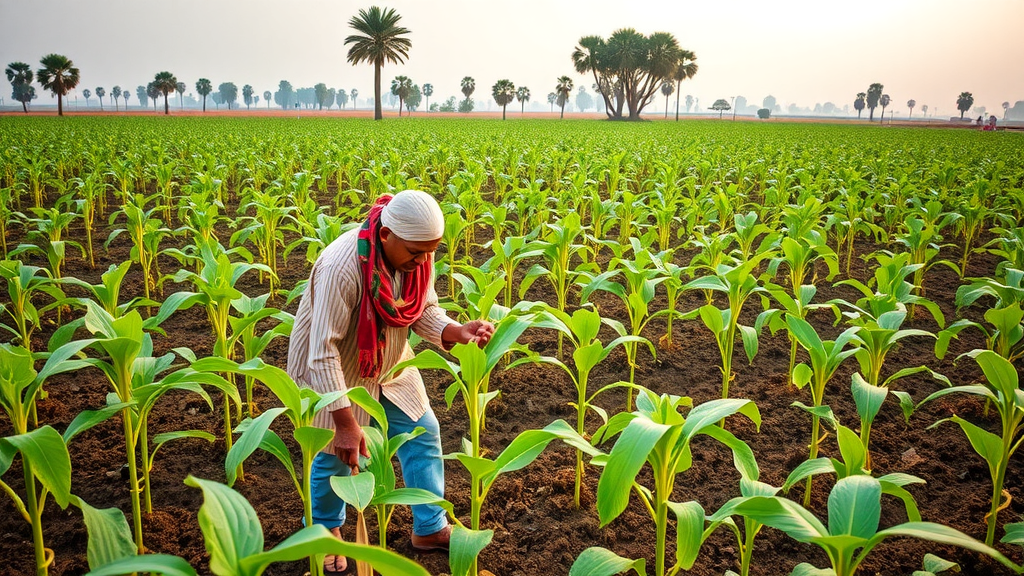
A sweeping analysis of India’s plant variety protection records has revealed a remarkable story of grassroots innovation: individual farmers, not corporations or government research institutions, are the country’s most prolific registrants of new plant varieties. Researchers from the Indian Council of Agricultural Research and the ICAR-Central Citrus Research Institute have carried out an empirical meta-analysis of 8,615 registered varieties spanning 102 crops, uncovering patterns in crop diversity, sectoral contributions, temporal trends and duration of protection that challenge long-held assumptions about who drives innovation in agriculture. Drawing on records from the Protection of Plant Varieties and Farmers’ Rights Registry as of March 2025, the study offers the most detailed quantitative picture yet of how India’s distinctive intellectual property regime for plants operates in practice.
The legal foundation for this system is the Protection of Plant Varieties and Farmers’ Rights Act, enacted in 2001 and generally known as PPVFRA. Unlike plant variety protection regimes in many other countries, the Indian law explicitly recognizes farmers as legitimate breeders, granting them the right to register varieties they have developed, conserved or improved over generations of informal selection. The legislation was designed to balance the incentives needed for formal plant breeding with a recognition that smallholder farmers have long been custodians and creators of India’s agricultural biodiversity. The new study, published in the Indian Journal of Genetics and Plant Breeding, set out to test whether that balance has actually produced the broad participation its architects envisioned.
The answer, on the evidence of the registry data, is a striking affirmation. Descriptive statistics compiled by the research team show that 54.71 percent of the 8,615 registered varieties were submitted by individual farmers, making them the single largest applicant group by a substantial margin. This finding substantiates India’s long-standing claim to have built an inclusive intellectual property framework that values grassroots innovation. Farmers registering traditional landraces, locally adapted selections and farmer-bred lines have collectively outpaced both public research institutions and private seed companies in securing formal legal recognition for their plant breeding work, a result with few parallels anywhere in the world.
To move beyond simple counts, the researchers applied a battery of statistical techniques to the registry data, which they organized into 12 crop groups across the 102 crop species. Their analysis of the relationship between applicant type and crop group revealed statistically significant associations, indicating that different sectors exhibit distinct preferences for particular categories of crops. Public sector institutions concentrated their registration activity in certain crop groups while private companies favored others, and farmers showed their own characteristic patterns. This sector-specific specialization reflects underlying differences in breeding objectives, access to resources, market incentives and institutional mandates, and it provides regulators with a diagnostic tool for identifying where the system may be underperforming.
The temporal dimension of the analysis yielded equally consequential findings. Time series analysis demonstrated a significant increase in the pace of variety registrations after 2013, a break point the researchers attribute to intensified policy support and institutional facilitation. In the early years following the Act’s implementation, registration activity grew slowly, constrained by limited awareness, procedural unfamiliarity and the time required for applicants to prepare the technical documentation and distinctiveness data that registration demands. As the registry matured, awareness campaigns extended into rural communities, and support mechanisms were established to help farmers and public breeders navigate the application process, participation broadened markedly across all applicant categories.
Duration of protection emerged as a third axis of variation. Under the PPVFRA, the term of protection differs according to the nature of the crop, with longer periods available for certain categories, and the study found statistically significant variation in protection periods across both crop groups and applicant categories. This heterogeneity matters for breeding strategy and investment decisions. Longer protection windows can justify sustained breeding programs for crops with slow improvement cycles, while shorter terms may influence whether public institutions and private firms commit resources to variety development in particular crop groups. By mapping these patterns empirically, the study gives policymakers a basis for assessing whether current duration structures align with national agricultural and biodiversity objectives.
The analytical approach itself deserves attention as a model for evidence-based policy evaluation in agricultural innovation systems. The researchers treated the registry not as a static archive of legal records but as a longitudinal dataset amenable to modern statistical analysis, employing descriptive statistics, categorical data methods, time series techniques and non-parametric procedures to extract structure from thousands of individual registration decisions. The work draws on a mature methodological tradition in statistics and data science, and it demonstrates how administrative data generated by intellectual property offices can be repurposed to answer questions about the behavior, incentives and inclusiveness of innovation systems that were previously addressed only through anecdote or case study.
The findings carry significance well beyond India’s borders. Developing countries weighing whether to establish plant variety protection systems, and international bodies negotiating the governance of plant genetic resources, have long debated whether intellectual property frameworks inevitably favor commercial actors at the expense of smallholder farmers. The Indian experience provides a compelling counterexample: a framework that explicitly accommodates farmers as breeders has generated participation across all sectors, with farmers leading. The study also echoes themes articulated by M.S. Swaminathan, the architect of India’s green revolution strategy who later championed an Ever-Green Revolution grounded in farmer knowledge, equitable benefit sharing and ecological sustainability.
At the same time, the analysis exposes areas of concern. The authors highlight the need for stronger support for underrepresented crop groups, noting that registration activity remains unevenly distributed across the 12 crop categories. Crops that attract little commercial attention, including many minor fruits, vegetables, spices and underutilized species, receive comparatively few registrations despite their nutritional, cultural and ecological importance. This imbalance carries real risks for agro-biodiversity. When breeding effort for minor crops stagnates, the genetic base of national food systems narrows, leaving agriculture more vulnerable to pests, diseases and climate shocks. The study’s findings suggest that targeted incentives, simplified procedures and dedicated outreach could help extend the benefits of variety protection to these neglected categories.
For India’s policymakers, the research arrives at a moment when the country is simultaneously pursuing agricultural modernization, climate resilience and the conservation of plant genetic resources. The evidence assembled by Datt, Roy and their colleagues indicates that the PPVFRA has, on its own terms, succeeded in encouraging wide participation, particularly among farmers whose contributions to crop improvement had gone unrecognized for generations. Sustaining and extending that success will require continued institutional facilitation, attention to the crop groups still left behind, and ongoing empirical monitoring of registration behavior. What the study makes unmistakably clear is that India’s farmers, armed with generations of accumulated plant knowledge and empowered by a legal framework built to recognize it, have become the backbone of the nation’s registered plant breeding enterprise, and that inclusive intellectual property design can transform who participates in agricultural innovation.
Subject of Research: Empirical meta-analysis of crop diversity, sectoral contributions, temporal trends and duration patterns in plant variety protection registrations in India under the PPVFRA of 2001.
Article Title: Assessing Crop Diversity, Sectoral Contributions, Temporal Trends and Duration Pattern in Plant Variety Protection: An Empirical Meta-analysis from Indian Perspectives
Article References: Datt, S., Roy, S. S., Gurjar, M., Paliwal, S., Singh, V., Ghosh, D., & Bhooshan, N. (2026). Assessing Crop Diversity, Sectoral Contributions, Temporal Trends and Duration Pattern in Plant Variety Protection: An Empirical Meta-analysis from Indian Perspectives. Indian Journal of Genetics and Plant Breeding, 86(3), 369-380. https://doi.org/10.1007/s44489-026-00038-9
Image Credits: AI Generated
DOI: 10.1007/s44489-026-00038-9
Keywords: plant variety protection, PPVFRA, farmers' rights, India, crop diversity, agro-biodiversity, intellectual property rights, variety registration, plant breeding, seed sector, temporal trends, protection duration
Cite Scienmag News
Alan Morgan. (September 12, 2026). Farmers Lead India’s Plant Variety Protection Boom, Landmark Study Finds. Scienmag. https://scienmag.com/farmers-lead-indias-plant-variety-protection-boom-landmark-study-finds/
Alan Morgan. "Farmers Lead India’s Plant Variety Protection Boom, Landmark Study Finds." Scienmag, 12 September 2026, https://scienmag.com/farmers-lead-indias-plant-variety-protection-boom-landmark-study-finds/. Accessed 12 September 2026.
Alan Morgan. "Farmers Lead India’s Plant Variety Protection Boom, Landmark Study Finds." Scienmag. September 12, 2026. https://scienmag.com/farmers-lead-indias-plant-variety-protection-boom-landmark-study-finds/


