


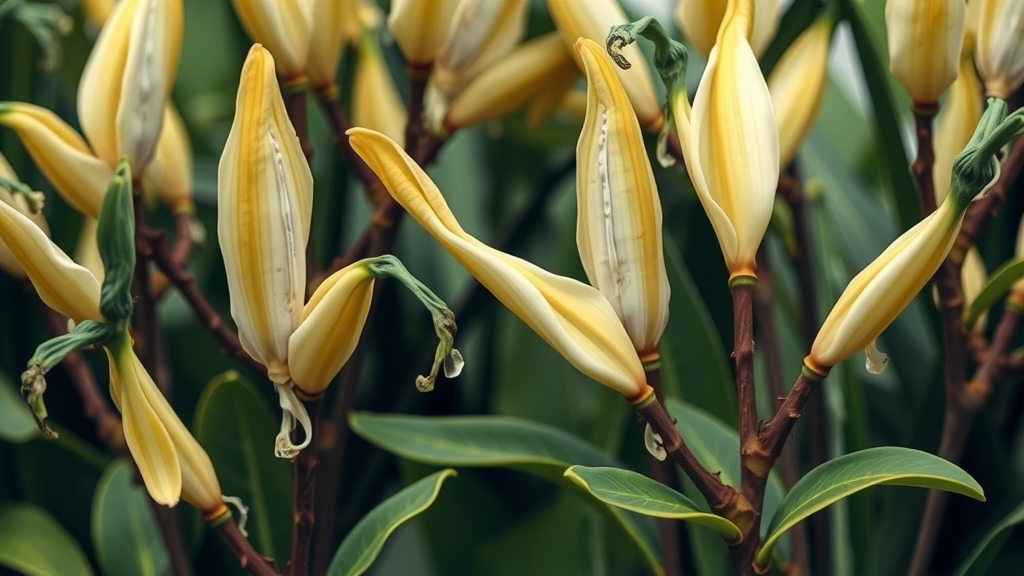
Vanilla is one of the most coveted flavours on Earth, and the world cannot get enough of it. Global demand for natural vanilla beans, projected to climb from roughly 1.1 billion dollars in 2022 to 1.79 billion dollars by 2029, already outstrips a raw production of only about 7,114 tonnes recorded in 2024. Yet for a crop this valuable, the fundamentals of how to feed the plant have remained surprisingly obscure. A new controlled experiment has now delivered the first systematic answer to one of the most basic questions in vanilla nutrition: should growers supply their nitrogen as nitrate, as ammonium, or as a mixture of the two? The verdict is clear. Vanilla planifolia, the climbing orchid behind nearly all natural vanilla, grows best when nitrate dominates the nutrient supply, and the penalty for getting it wrong compounds over time.
The study, conducted by researchers at Hochschule Osnabrück University of Applied Sciences in Germany and published in Discover Plants, assigned ninety-five young vanilla plants to five different nitrate-to-ammonium ratios, ranging from 100 percent nitrate to 100 percent ammonium, all at a constant total nitrogen concentration of 47 milligrams per litre. A tenth group of ten plants received no nitrogen at all as a control. The plants grew in perlite, an inert substrate that allowed the researchers to control the root environment with precision, over a 154-day period under carefully regulated temperature, humidity, carbon dioxide and light. Because perlite suppresses microbial nitrification, the ratio applied was largely the ratio the roots actually experienced, making the experiment an unusually clean test of nitrogen form.
The results were striking. Total dry mass declined linearly as the ammonium share increased, and relative growth rate proved the most sensitive indicator of all, with nitrogen form explaining roughly half of its variation. Compared with plants fed exclusively nitrate, those receiving exclusively ammonium accumulated 28 percent less total dry mass and grew 36 percent more slowly. The pure nitrate treatment produced the highest total dry mass of any nitrogen treatment, 1.73 grams per plant, and was the only nitrogen treatment to differ significantly from both the unfertilised control and the ammonium-only group. A 75:25 nitrate-to-ammonium ratio sustained growth rates statistically indistinguishable from pure nitrate, suggesting growers have a modest window of flexibility at the nitrate-rich end of the spectrum.
Beneath the surface, the chemistry of the root zone told much of the story. As the ammonium proportion rose, the substrate became progressively more acidic, with pH falling by about 1.2 units, from 5.93 under pure nitrate to 4.72 under pure ammonium. This acidification stems from the protons plants release when they take up ammonium, and in a weakly buffered substrate like perlite, watered only every two weeks to avoid waterlogging the vanilla’s sensitive roots, the effect accumulated unchecked. The researchers deliberately avoided corrective pH adjustment, since any neutralising agent would have introduced treatment-specific ions and muddied the comparison. From a practical standpoint, however, the coupled effect is exactly what a grower would encounter: choosing ammonium-rich fertilisers means accepting an increasingly sour root zone along with the nitrogen itself.
The consequences rippled through the plants’ nutrient status. Tissue nitrogen concentrations actually rose in every organ as ammonium increased, with shoot tissue showing the strongest response, but the researchers caution that this reflects lower nitrogen-use efficiency rather than superior nutrition. Because the ammonium-fed plants built less biomass, the nitrogen they absorbed was concentrated in a smaller body, a dilution effect that makes tissue appear nitrogen-rich even as the plant starves for structural growth. Descriptive, unreplicated leaf analyses also hinted at the well-known ammonium-cation antagonism: leaf calcium fell from 2.44 to 1.42 percent of dry mass and magnesium from 0.53 to 0.35 percent as ammonium rose, consistent with ammonium competing with these divalent cations at uptake sites while acidity displaces them from exchange surfaces.
Root architecture suffered too. Total root length peaked at 222.93 centimetres under pure nitrate and dropped to 143.53 centimetres under pure ammonium, echoing earlier findings that ammonium inhibits root elongation. Interestingly, nitrogen form did not change how plants partitioned biomass between roots and shoots; root mass fraction and root-to-shoot ratio were unaffected. Instead, ammonium stress showed up in organ morphology, with ammonium-fed plants producing leaves of unusually high specific leaf area, suggesting thinner or less densely built foliage. The researchers propose that luxury ammonium uptake without proportional structural investment, and possibly mild ammonium toxicity, may both be operating simultaneously under the high-ammonium regimes.
Perhaps the most intriguing finding emerged from splitting each vine into apical and basal sections. Because vanilla grows as a monopodial vine, producing each new node in strict sequence, the basal organs developed during the first half of the treatment while apical organs grew during the second, providing a within-plant proxy for time. Under pure nitrate, apical shoot dry mass exceeded basal by 48 percent, a normal developmental gradient for a vigorously growing vine. Under pure ammonium, that gradient was essentially abolished, indicating that ammonium-related constraints accumulated until they erased the inherent advantage of younger tissue. This treatment-by-position interaction was significant for all five positional parameters measured, providing the first evidence in an orchid that nitrogen-form effects intensify with prolonged exposure, a pattern previously documented in kale, where 75 percent ammonium caused no harm after four weeks but significant damage after eight.
Photosynthetic machinery, by contrast, remained largely intact. The maximum quantum efficiency of photosystem II, measured as Fv/Fm, stayed above 0.72 in all nitrogen-fertilised treatments and only dropped to 0.675 in nitrogen-starved controls, showing that none of the ammonium levels caused photoinhibition. Stomatal conductance did not differ among treatments, though the authors note that vanilla is an obligate crassulacean acid metabolism plant whose stomata close during daytime measurements, possibly masking real differences in gas exchange. Curiously, chlorophyll content in apical leaves followed a quadratic pattern, peaking at an intermediate ratio of roughly 45:55 nitrate to ammonium rather than under pure nitrate, hinting that a moderate ammonium share can optimise chlorophyll, a major nitrogen sink, even while whole-plant growth favours nitrate.
The authors are careful about interpretation. Because ammonium uptake and rhizosphere acidification are inseparable in practice, the growth decline cannot be attributed to nitrogen form alone; the observed response integrates both direct physiological effects and the secondary consequences of acidification and nutrient imbalance. The experiment was also confined to young vegetative plants under relatively low light of 77 micromoles per square metre per second, and the energetic costs of ammonium assimilation tend to intensify as light and growth demand rise, meaning the nitrate advantage could strengthen further under commercial greenhouse conditions. Whether the vegetative benefit carries over into flowering and pod production, which vanilla plants reach only after roughly three years of vegetative growth, remains to be tested.
Even with those caveats, the practical message is actionable. The researchers recommend a predominantly nitrate-based nitrogen supply, at least 75:25 nitrate to ammonium, for vegetative vanilla in soilless culture, a choice already standard in Phalaenopsis orchid production but never before evidence-based for vanilla. A small ammonium supplement of up to 25 percent may offer a workable compromise, supporting apical chlorophyll without triggering excessive acidification or the biomass losses seen at higher ammonium shares. For an industry squeezed between soaring demand, climate-vulnerable supply chains and reliance on synthetic vanillin substitutes, even incremental gains in how quickly young vines establish could matter enormously. This study transforms vanilla nitrogen management from folklore into data, and it suggests that the first evidence-based feeding recipe for the world’s favourite flavour begins with nitrate.
Subject of Research: Effect of the nitrate-to-ammonium ratio on vegetative growth, nutrient status, and physiology of Vanilla planifolia in soilless culture
Article Title: Nitrate-to-ammonium ratio shapes vegetative growth, nutrient status, and physiology of Vanilla planifolia in soilless culture
Article References: Vahl, M., Petersen, F., von Salzen, J., & Ulbrich, A. (2026). Nitrate-to-ammonium ratio shapes vegetative growth, nutrient status, and physiology of Vanilla planifolia in soilless culture. Discover Plants, 3(1), Article 394. https://doi.org/10.1007/s44372-026-00853-0
Image Credits: AI Generated
DOI: 10.1007/s44372-026-00853-0
Keywords: Vanilla planifolia, nitrate, ammonium, nitrogen nutrition, soilless culture, hydroponics, rhizosphere pH, orchid, plant physiology, relative growth rate, ammonium toxicity, fertilisation
Cite Scienmag News
Alan Morgan. (September 12, 2026). Nitrate Feeds Vanilla Best as Ammonium Slows Growth, Study Finds. Scienmag. https://scienmag.com/nitrate-feeds-vanilla-best-as-ammonium-slows-growth-study-finds/
Alan Morgan. "Nitrate Feeds Vanilla Best as Ammonium Slows Growth, Study Finds." Scienmag, 12 September 2026, https://scienmag.com/nitrate-feeds-vanilla-best-as-ammonium-slows-growth-study-finds/. Accessed 5 October 2026.
Alan Morgan. "Nitrate Feeds Vanilla Best as Ammonium Slows Growth, Study Finds." Scienmag. September 12, 2026. https://scienmag.com/nitrate-feeds-vanilla-best-as-ammonium-slows-growth-study-finds/


