


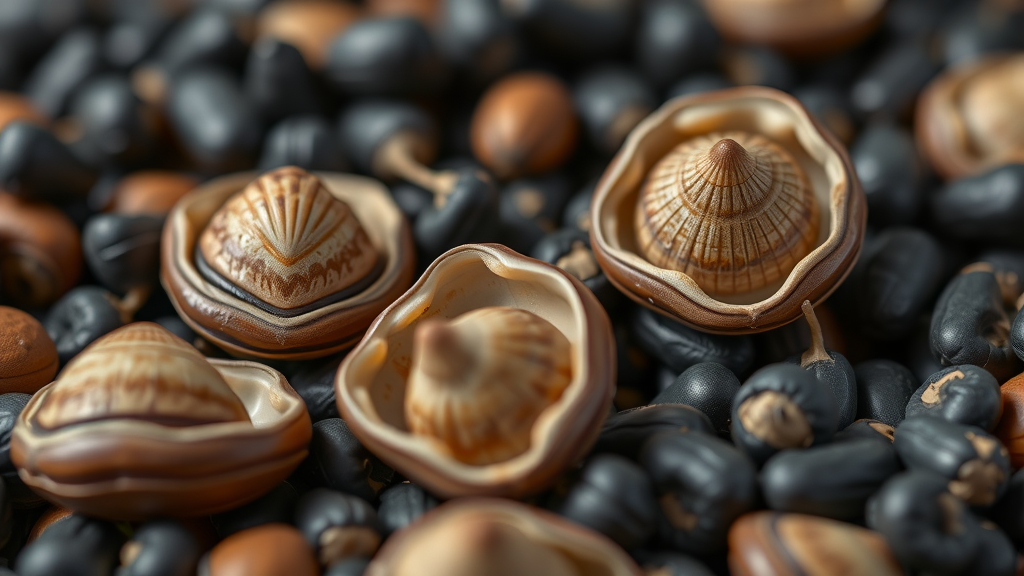
Carbon dioxide removal is one of the defining engineering challenges of the century, and one of the most promising answers may be sitting in an agricultural waste pile. Researchers at Universiti Teknologi PETRONAS in Malaysia have transformed rubber seed shells, a discarded byproduct of the natural rubber industry, into high-performance activated carbon adsorbents and then supercharged them with a biodegradable ionic liquid. The result is a sustainable, low-cost material that captures carbon dioxide with remarkable efficiency, holds onto its capacity through repeated use, and could help close the loop between biomass waste management and industrial carbon capture.
The scale of the problem the team aimed to address is considerable. Global carbon dioxide emissions since 1850 have driven average temperatures up by roughly 0.8 degrees Celsius, with even steeper rises in warmer regions, while the world generates an estimated 140 gigatonnes of biomass waste every year, much of which decomposes or burns improperly and contributes as much as 18 percent of emissions. At the same time, the biomass recycling market is projected to reach 142.3 billion dollars by 2034, and the global activated carbon market is expected to top 7.3 billion dollars by 2030. Turning one waste stream into a solution for another is precisely the kind of circular economy logic that underpins bioenergy with carbon capture and storage, and it aligns squarely with the United Nations Sustainable Development Goals on responsible consumption and climate action.
Rubber seed shell proved to be an ideal starting point because it contains about 64.5 percent carbon by mass. The researchers pre-treated the shells, ground them to a fine powder, and impregnated them with two different alkaline activating agents: potassium carbonate and potassium hydroxide, each mixed at an optimized two-to-one ratio with the biomass. After drying, the impregnated material was carbonized in a tube furnace at 800 degrees Celsius under a continuous nitrogen flow for three hours, then washed with dilute hydrochloric acid and distilled water until neutral. The yields were 37 percent for the potassium carbonate route and 29 percent for the potassium hydroxide route, conditions arrived at through systematic calibration of activator ratios, temperatures, and residence times.
The real innovation came next. Rather than leaving the carbon surface bare, the team functionalized it with ethanolammonium butyrate, an ammonium-based ionic liquid synthesized simply by adding ethanolamine dropwise to butyric acid at room temperature. This ionic liquid stands out among its peers because it is biodegradable, thermally stable, environmentally and economically sustainable, and has a moderate viscosity that eases processing. Loadings of 10, 20, and 30 weight percent were tested on both activation routes, and the samples were then subjected to a full battery of characterization techniques, including scanning electron microscopy, energy-dispersive X-ray analysis, Fourier-transform infrared spectroscopy, Raman spectroscopy, thermogravimetric analysis, and differential scanning calorimetry.
The performance results were striking. The best material, potassium carbonate activated carbon carrying 30 weight percent of the ionic liquid, adsorbed 3.71 millimoles of carbon dioxide per gram at 0 degrees Celsius and 2.49 millimoles per gram at 25 degrees Celsius at one bar. By contrast, the unmodified potassium hydroxide activated carbon managed only 0.95 millimoles per gram at 25 degrees Celsius. Adsorption rose with ionic liquid loading and fell with temperature, exactly as expected for an exothermic physisorption process in which higher molecular motion favors desorption. Interestingly, potassium carbonate activated samples outperformed their potassium hydroxide counterparts in carbon dioxide uptake even though the latter possessed superior textural properties, a discrepancy the authors attribute to pore structure collapse caused by the harsher activation chemistry of potassium hydroxide.
Equilibrium isotherm analysis told a consistent story. Among the four models tested, the Langmuir equation fit the experimental data best, with coefficient of determination values between 0.996 and 0.999, indicating that carbon dioxide adsorbs predominantly as a monolayer on energetically similar sites. The Langmuir affinity constant climbed with ionic liquid loading, confirming that the nitrogen-containing basic functionalities introduced by the ethanolammonium butyrate strengthen carbon dioxide affinity through weak Lewis acid-base interactions, while nitrogen is a poor match for these sites and passes through largely unretained.
Micropore analysis revealed a subtle but crucial trade-off. The pristine potassium hydroxide derived carbon boasted a specific surface area of 954 square meters per gram and a total pore volume of 0.43 cubic centimeters per gram, figures that progressively declined as ionic liquid loading increased, reaching 397 square meters per gram and 0.18 cubic centimeters per gram at 30 weight percent. Electron microscopy and elemental analysis confirmed the progressive surface coverage and the emergence of nitrogen and oxygen signals, while Raman spectroscopy showed rising defect density as the liquid infiltrated the pore network. Yet carbon dioxide uptake rose anyway, because the introduced functionalities more than compensated for the lost porosity. The team distilled this synergy into empirical equations linking the oxygen-to-carbon ratio, pore diameter, and Langmuir affinity, and derived a combined descriptor showing that surface chemistry enhancement constants were 29.25 for potassium carbonate samples and 6.60 for potassium hydroxide samples, underscoring that adsorption performance is governed by pore structure and surface chemistry together, not surface area alone.
Practical deployment demands more than raw capacity, and the optimized adsorbent passed those tests with distinction. The isosteric heat of adsorption ranged from 29.7 to 44.2 kilojoules per mole, well below the 50 kilojoule per mole threshold that signals chemisorption, confirming strong physisorption with modest regeneration energy requirements. Under simulated post-combustion conditions of 15 percent carbon dioxide and 85 percent nitrogen at one bar, the material achieved a carbon dioxide over nitrogen selectivity between 21.59 and 25.94, comparable to leading biomass-derived sorbents in recent literature. Most impressively, after ten consecutive adsorption-desorption cycles at 0 degrees Celsius, the material retained 99.26 percent of its original capacity, a figure that outperforms many previously reported cycling results and points to excellent structural durability for repeated industrial use.
The implications ripple outward in several directions. For carbon capture engineering, the study demonstrates that a deliberately greener ionic liquid, one that avoids the synthetic complexity and high viscosity of many amino acid and polymeric alternatives, can rival or exceed the performance of more exotic functionalization chemistries when paired with the right activation route. For waste valorisation, it shows that rubber seed shells, an abundant and largely untapped agricultural residue rich in carbon, can anchor a waste-to-resource supply chain for sorbent production. The authors caution that several questions remain before commercial deployment, including performance under humid conditions with mixed gas streams, adsorption kinetics and diffusion behavior, techno-economic feasibility, and life-cycle assessment at scale. They also suggest exploring other activating agents and wider operating windows. But the core message stands: with careful control of activation chemistry and a smart coating of sustainable ionic liquid, an agricultural throwaway can become a durable, selective, and regenerable weapon against rising carbon dioxide, and a template for the next generation of low-cost carbon capture materials.
Subject of Research: Ionic liquid functionalized activated carbon derived from rubber seed shell biomass for enhanced carbon dioxide capture
Article Title: Sustainable ionic liquid functionalized activated carbon for enhanced CO 2 capture: Integrated textural properties, adsorption performance and isotherms
Article References: Suleman, F., Borhan, A., Muhbat, S., Rashidi, N. A., Daood, S. S., & Abdulalh, N. H. (2026). Sustainable ionic liquid functionalized activated carbon for enhanced CO2 capture: Integrated textural properties, adsorption performance and isotherms. Cleaner Engineering and Technology, 34, Article 101314. https://doi.org/10.1016/j.clet.2026.101314
Image Credits: AI Generated
DOI: Not provided
Keywords: carbon capture, activated carbon, ionic liquids, rubber seed shell, biomass waste valorisation, CO2 adsorption, Langmuir isotherm, physisorption, CO2/N2 selectivity, microporous materials, adsorbent regeneration, sustainable materials
Cite Scienmag News
Alan Morgan. (September 12, 2026). Waste Rubber Seed Shells Become Ionic Liquid Coated Carbons That Capture More CO2. Scienmag. https://scienmag.com/waste-rubber-seed-shells-become-ionic-liquid-coated-carbons-that-capture-more-co2/
Alan Morgan. "Waste Rubber Seed Shells Become Ionic Liquid Coated Carbons That Capture More CO2." Scienmag, 12 September 2026, https://scienmag.com/waste-rubber-seed-shells-become-ionic-liquid-coated-carbons-that-capture-more-co2/. Accessed 12 September 2026.
Alan Morgan. "Waste Rubber Seed Shells Become Ionic Liquid Coated Carbons That Capture More CO2." Scienmag. September 12, 2026. https://scienmag.com/waste-rubber-seed-shells-become-ionic-liquid-coated-carbons-that-capture-more-co2/


