


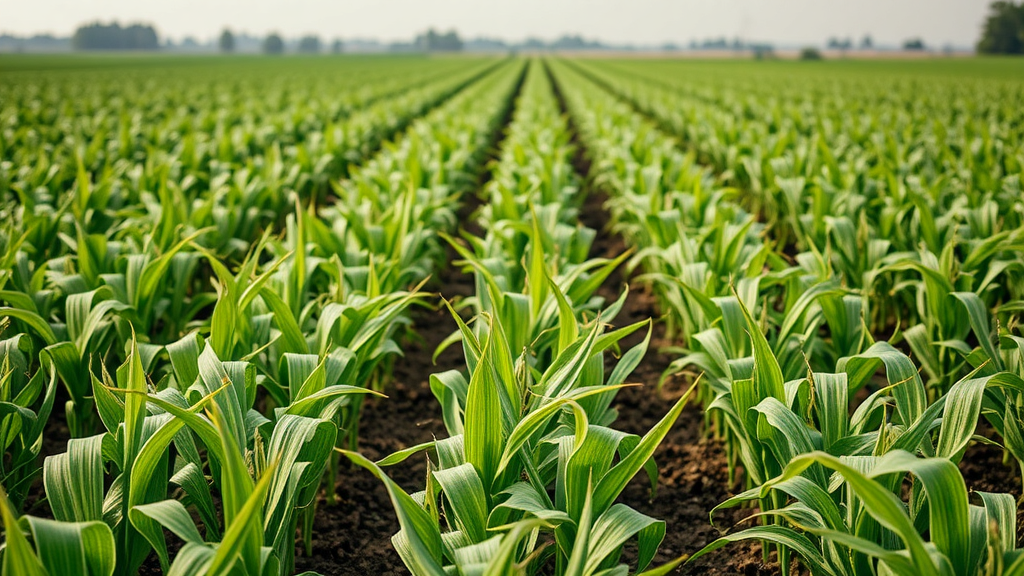
For four decades, genetically engineered crops have been among the most consequential—and most contested—technologies in American agriculture. Now, a comprehensive national analysis published in Nature Climate Change offers the most detailed picture yet of what these crops have actually delivered as the climate has changed. Drawing on county-level data spanning 1978 to 2020, researchers at Texas A&M University and the University of California, Berkeley find that the adoption of genetically engineered corn and soybean varieties is broadly associated with higher yields, lower year-to-year yield volatility, and a partial buffering of the damage that heat stress, precipitation extremes and pest pressures inflict on harvests. The study also reveals a quieter, less visible benefit: engineered crops appear to have dampened the northward march of US crop cultivation that rising temperatures would otherwise have driven.
The research team, led by Caroline Yifan Dong of Texas A&M University’s Department of Agricultural Economics, together with Chengcheng J. Fei, Bruce A. McCarl, David Zilberman of UC Berkeley and Xingguo Wang, assembled an unusually rich spatial dataset. It combines US Department of Agriculture records on county-level yields and harvested acreage for corn, soybean and upland cotton with the USDA Economic Research Service’s state-level adoption statistics for genetically engineered varieties, historical climate fields from the European Centre for Medium-Range Weather Forecasts ERA5 reanalysis, future contract prices for the three commodities, and soil and elevation data from federal surveys. By fusing these sources, the authors could separate the signal of biotechnology adoption from the confounding influences of weather, prices, soils, topography and the slow drift of farming itself across the landscape.
The analytical architecture proceeds in stages. The researchers first characterize how crop harvested land use changed across US counties between 1978 and 2020, tracking both the percentage of agricultural land devoted to each crop and the movement of the harvested-area centroid—the geographic midpoint of cultivation—for corn, soybean and cotton. They then estimate how genetically engineered adoption rates interact with climate variables to shape both mean yields and yield variability, using a production-function framework in the tradition of Just and Pope that explicitly models risk effects alongside average output. Finally, they build counterfactual simulations: what would national yields, yield variance and cultivation patterns have looked like in 2020 had genetically engineered varieties never been adopted?
The yield results are striking in their consistency for the two dominant row crops. Across the four-decade record, higher adoption of genetically engineered corn and soybean is associated with significantly higher mean yields and significantly lower variance of log yields—an econometric signature of reduced production risk. Crucially, the analysis shows a partial attenuation of adverse climate effects: in counties where engineered varieties dominate, the yield penalties associated with heat stress, excessive moisture and pest pressure are measurably smaller than they would otherwise have been. For upland cotton, the effects are present but more modest, suggesting that the benefits of first-generation engineered traits have not been uniform across crops.
This attenuation matters because the physiological logic is well understood. Herbicide-tolerant crops, which dominate soybean acreage, allow farmers to control weeds more flexibly and with less reliance on tillage, reducing competition for water and nutrients during critical growth windows. Insect-resistant crops expressing proteins from the soil bacterium Bacillus thuringiensis protect corn and cotton against pests such as the western corn rootworm, the corn borer complex and Helicoverpa zea, whose ranges and damage potential are expanding in a warming climate. By suppressing pest losses that climate change amplifies, these traits function as a form of embedded adaptation—an insurance policy written into the seed itself. The new findings quantitatively confirm what meta-analyses of genetically modified crops had suggested: that yield gains and risk reductions are real, and that they grow in importance as climatic stress intensifies.
Perhaps the most novel contribution of the study lies in its treatment of geography. Ecologists and agricultural economists have long documented that crop pests and pathogens are moving poleward, that growing seasons are lengthening in northern latitudes, and that the economic geography of American farming is responding. Previous work had shown crop cultivation centroids drifting north and west. What Dong and colleagues demonstrate is that genetically engineered adoption has slowed this drift. In their counterfactual no-GE scenario, the predicted northward shift in the centroids of corn, soybean and cotton cultivation between 1978 and 2020 is substantially larger than what actually occurred. In other words, by making crops more productive and more resilient in their traditional heartlands, engineered varieties reduced the incentive for farmers to chase favorable climates into new territory.
The land-use implications of that finding cut in an environmentally favorable direction. Cropland expansion in the United States has historically come at the expense of grasslands and wildlife habitat, often producing marginal yields on ecologically sensitive land. The study’s projections indicate that, compared with a world without engineered crops, the actual 2020 landscape featured different—and in several regions smaller—expansions of cultivated area, particularly along the northern edge of the Corn Belt. The authors caution that percentage-based maps of land-use difference can exaggerate changes in counties with small agricultural bases, and that their predictions should be read with that caveat in mind. But the overall pattern—dampened migration, moderated land conversion—is consistent with the view that yield-enhancing technology relieves pressure on land at the margin.
The study arrives at a moment when US agricultural productivity growth itself is under strain. Recent work has warned that large increases in public research and development investment are needed to avoid declines in American agricultural productivity, even as other researchers argue that recent maize yield gains owe more to climate and agronomy than to genetics in favorable environments. Against that backdrop, the new analysis does not claim that genetic engineering is the sole engine of yield growth—its counterfactual framework explicitly isolates the marginal contribution of adoption rates while controlling for climate, prices, soils and time. Nor does it settle debates about the sustainability of herbicide-tolerant systems, where weed resistance remains a serious challenge. What it does establish is that, at national scale and over four decades, engineered crops have functioned not merely as productivity tools but as instruments of climate adaptation, blunting some of the damage that a changing climate has already inflicted on American harvests.
For policymakers weighing the next generation of crop biotechnology—drought-tolerant hybrids, second-generation traits such as stress-responsive transcription factors, and gene-edited varieties engineered for heat and photosynthetic resilience—the findings carry a clear message. Adaptation to climate change will not be delivered by migration alone, since relocating cultivation is costly, disruptive and ecologically risky. The evidence assembled here suggests that the traits embedded in seeds over the past forty years have already absorbed a meaningful share of climate stress and slowed a forced geographic retreat of US agriculture. As heat, floods and pests intensify further, the question is no longer whether genetic innovation can contribute to climate resilience, but how quickly the next generation of resilient varieties can be developed, regulated and deployed.
Subject of Research: Impacts of genetically engineered crop adoption on US crop yields, yield stability and cultivation geography under climate change
Article Title: Genetically engineered crop adoption support yields and cultivation under climate change
Article References: Dong, C. Y., Fei, C. J., McCarl, B. A., Zilberman, D., & Wang, X. (2026). Genetically engineered crop adoption support yields and cultivation under climate change. Nature Climate Change. https://doi.org/10.1038/s41558-026-02737-3
Image Credits: AI Generated
DOI: 10.1038/s41558-026-02737-3
Keywords: genetically engineered crops, climate change adaptation, crop yields, yield volatility, corn, soybean, upland cotton, land use, crop migration, agricultural biotechnology, US agriculture, Nature Climate Change
Cite Scienmag News
Sloane Callahan. (September 12, 2026). Genetically Engineered Crops Boost Yields and Slow Climate-Driven Shifts in US Farming. Scienmag. https://scienmag.com/genetically-engineered-crops-boost-yields-and-slow-climate-driven-shifts-in-us-farming/
Sloane Callahan. "Genetically Engineered Crops Boost Yields and Slow Climate-Driven Shifts in US Farming." Scienmag, 12 September 2026, https://scienmag.com/genetically-engineered-crops-boost-yields-and-slow-climate-driven-shifts-in-us-farming/. Accessed 4 October 2026.
Sloane Callahan. "Genetically Engineered Crops Boost Yields and Slow Climate-Driven Shifts in US Farming." Scienmag. September 12, 2026. https://scienmag.com/genetically-engineered-crops-boost-yields-and-slow-climate-driven-shifts-in-us-farming/


