


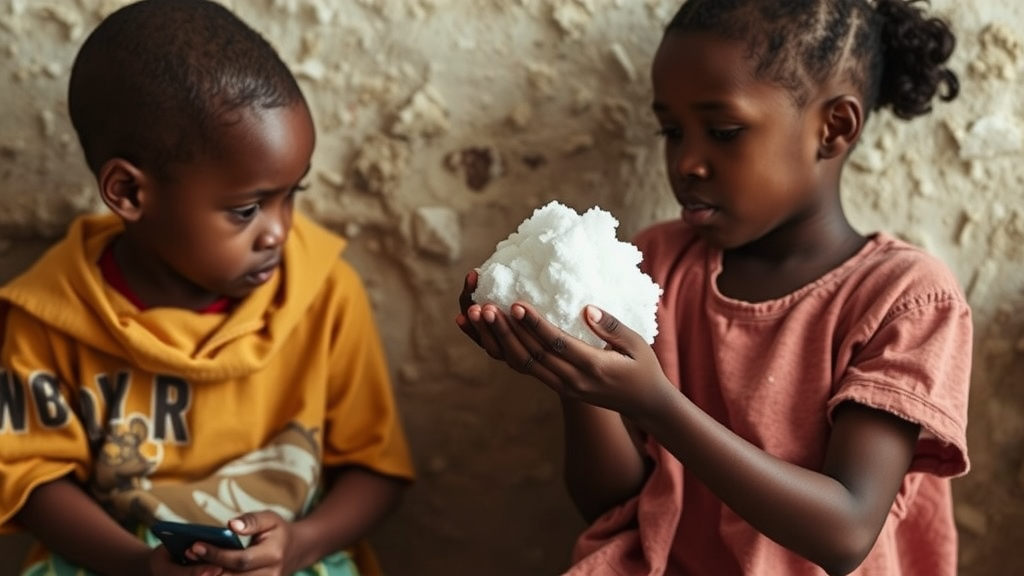
When a country loses access to a single micronutrient, the consequences can ripple through an entire generation. A new study published in Nature Food documents precisely that: researchers found that when Ethiopia’s iodized salt supply was abruptly cut off in May 1998, child survival declined and academic achievement fell measurably, with the damage concentrated in rural districts where the local environment itself is poor in iodine. The findings offer one of the clearest natural-experiment demonstrations yet that a seemingly small nutritional intervention—fortifying salt with iodine—is inseparable from the cognitive development, educational outcomes and very survival of children exposed to it in the earliest stages of life.
The interruption at the heart of the study was not a slow policy drift but a sudden break. For a period beginning in May 1998, iodized salt stopped flowing into Ethiopian households, meaning that iodine intake dropped back to whatever trace amounts occurred naturally in local foods and water. Because iodine concentrations in soil and crops vary dramatically across landscapes, this exposed children to a geographic lottery: in districts where environmental iodine was abundant, the consequences were muted; where soils and staple grains carried little iodine, children and pregnant women were effectively returned to a state of deficiency.
The biological stakes of iodine are well established. Iodine is an essential component of the thyroid hormones thyroxine and triiodothyronine, which regulate basal metabolism and, critically, drive brain development in the fetus and infant. Severe deficiency during pregnancy causes cretinism, marked by profound intellectual disability, while milder prenatal and early-childhood deficiency depresses intelligence quotient scores, school performance and even survival through mechanisms that include hypothyroidism and impaired immune function. Because the window of maximum vulnerability closes early—largely before a child enters school—deficiency during gestation and infancy inflicts losses that later nutrition cannot fully repair.
Against that backdrop, the Ethiopian interruption offered researchers a rare opportunity. Randomized trials that withhold iodine from pregnant women and children would be unethical, and many earlier studies of iodization relied on coarse baseline measures of deficiency, such as regional goiter rates recorded decades earlier. The Ethiopian case is different: the loss of iodized salt was sudden, affected the whole country, and coincided with rich new data on how much iodine naturally occurs in Ethiopian soils and grains. The study leverages the GeoNutrition survey work, published in Nature in 2021, which mapped the geospatial variability of nutritional quality in Ethiopian and Malawian cereals and provided a district-level measure of naturally occurring iodine.
The analytical strategy combined that environmental gradient with household and educational data spanning the interruption. Children who were in utero or in infancy when the iodized salt supply was severed could be compared with siblings and with cohorts born slightly earlier or later, and the severity of exposure could be calibrated by how iodine-poor their home district was. This design allows the researchers to separate the effect of iodine loss from the many other shocks—droughts, conflicts, economic fluctuations—that Ethiopia experienced during the same period.
The results were stark. The authors report a significant drop in child survival following the loss of iodized salt, and a parallel decline in academic achievement among affected cohorts, with both effects concentrated in rural districts with lower environmental iodine concentrations. In places where local foods provided a partial buffer, children fared comparatively better; where the environmental safety net was thin, the loss of fortification translated directly into biological harm. That gradient is important because it makes the causal interpretation far more difficult to dismiss: a purely coincidental shock, such as a regional famine or policy change unrelated to nutrition, would not be expected to track the geography of soil iodine so closely.
To probe that question further, the researchers ran placebo tests—analyses structured to detect effects where none should exist if iodine were the true mechanism. For example, they examined children whose ages meant they were not exposed during the critical developmental window, and districts where environmental iodine was plentiful. These tests confirmed that the losses were not driven by generic hardship but specifically by the absence of iodine during early life, strengthening the case that the interrupted fortification program itself caused the damage.
The findings resonate with a broader body of evidence assembled over decades. A randomized trial in Ethiopia by Mohammed, Marquis, Aboud, Bougma and Samuel, published in Maternal and Child Nutrition in 2020, showed that providing iodized salt to women before pregnancy improved children’s cognitive development—an in-country experimental counterpart to the new observational findings, demonstrating that restoring iodine early in life raises cognitive scores. Earlier work by Feyrer, Politi and Weil on the introduction of salt iodization in the United States documented large cognitive gains, though it relied on coarse baseline deficiency measures that limited precision. In Tanzania, Field, Robles and Torres showed that iodine deficiency depressed schooling attainment across Africa. And a 2021 review by Zimmermann and Andersson in the European Journal of Endocrinology documented that iodized salt coverage worldwide remains uneven and tenuous, with programs vulnerable to supply disruptions, regulatory lapses and declining political attention.
What the Ethiopian study adds is the reverse-direction evidence: not what is gained when iodization begins, but what is lost when it stops. This matters because salt iodization is often treated in global health as a solved problem. In reality, fortification programs depend on continuous supply chains, quality monitoring and enforcement, and the new results suggest that a single interruption lasting long enough to affect a birth cohort can impose lifelong costs in mortality and human capital. The magnitude of the educational losses implies economic consequences as well, since lower achievement translates into reduced productivity and earnings across the affected generation’s working lives.
For policymakers, the message is twofold. First, universal salt iodization programs deserve the same vigilance applied to vaccination campaigns: they must be monitored continuously, and disruptions must be treated as public health emergencies rather than logistical footnotes. Second, the environmental gradient in the findings underscores that fortification is not uniformly protective on its own; in regions where soil iodine is naturally scarce, food systems may need complementary strategies, including diversified fortification or targeted supplementation for women of reproductive age. The Ethiopian cohort that lost its iodized salt in 1998 cannot recover what was taken from it, but the evidence it generated makes a compelling case that the world’s remaining gaps in iodine coverage are not benign—and that closing them, and keeping them closed, is among the most cost-effective investments available in child health and education.
Subject of Research: The impact of interrupted salt iodization on child survival and educational outcomes in Ethiopia
Article Title: Interrupted salt iodization harmed child health and education in Ethiopia
Article References: Interrupted salt iodization harmed child health and education in Ethiopia. (2026). Nature Food. https://doi.org/10.1038/s43016-026-01415-z
Image Credits: AI Generated
DOI: 10.1038/s43016-026-01415-z
Keywords: salt iodization, iodine deficiency, Ethiopia, child mortality, academic achievement, micronutrients, thyroid hormones, nutrition policy, early childhood development, food fortification, environmental iodine, natural experiment
Cite Scienmag News
Daisy Hatcher. (September 12, 2026). When Ethiopia Lost Iodized Salt, Children Paid With Their Lives and Their Grades. Scienmag. https://scienmag.com/when-ethiopia-lost-iodized-salt-children-paid-with-their-lives-and-their-grades/
Daisy Hatcher. "When Ethiopia Lost Iodized Salt, Children Paid With Their Lives and Their Grades." Scienmag, 12 September 2026, https://scienmag.com/when-ethiopia-lost-iodized-salt-children-paid-with-their-lives-and-their-grades/. Accessed 12 September 2026.
Daisy Hatcher. "When Ethiopia Lost Iodized Salt, Children Paid With Their Lives and Their Grades." Scienmag. September 12, 2026. https://scienmag.com/when-ethiopia-lost-iodized-salt-children-paid-with-their-lives-and-their-grades/


