


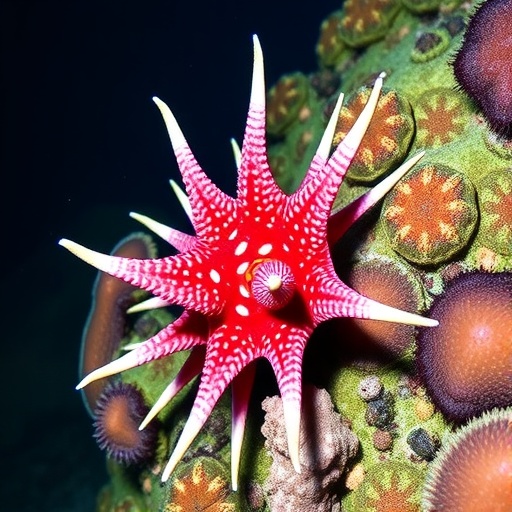
Crown-of-thorns starfish are among the most destructive coral predators on Earth, and a new study has revealed that their appetite varies far more dramatically than scientists previously assumed. Research published in the journal Coral Reefs shows that the daily feeding rates of the Pacific crown-of-thorns starfish (Acanthaster cf. solaris) depend overwhelmingly on two factors: the size of the individual starfish and the amount of coral cover at the site where it lives. Strikingly, the largest starfish living amid abundant coral consumed more than ten times the coral tissue of smaller individuals on depleted reefs, a finding that could reshape how the Great Barrier Reef is protected from one of its most persistent threats.
The study, led by Josie F. Chandler of James Cook University and colleagues, quantified daily feeding rates for 565 individual starfish across five regions of the central, northern and far northern Great Barrier Reef, from Townsville and Cairns to Lizard, Princess Charlotte Bay and Cape Grenville. Between March 2023 and March 2024, the team conducted 208 Scooter-Assisted Large Area Diver-based surveys, a novel method in which divers use underwater scooters to cover large reef areas efficiently. In total, more than 2,600 fresh feeding scars were measured, each attributed with confidence to a single starfish feeding in isolation.
The feeding mechanism of the crown-of-thorns starfish is central to understanding its destructive potential. Like other sea stars, it can evert its stomach through its mouth and spread it over the surface of a coral colony, digesting living tissue externally. When fully extended, the stomach covers a planar area roughly equivalent to the starfish’s oral disc, but it can drape over complex three-dimensional surfaces such as branching corals. This means the actual amount of tissue consumed increases with the structural complexity of the prey, which helps explain the starfish’s well-documented preference for tabular and corymbose Acropora corals, the very corals most vulnerable to bleaching and storm damage.
To translate simple field measurements into ecologically meaningful quantities, the researchers used genus-specific calibration curves developed for 15 distinct coral morphotaxa. Each fresh feeding scar, identifiable by sloughing tissue, mucous coverage or bare white skeleton not yet colonised by turf algae, was measured for maximum diameter with a flexible tape. These linear dimensions were converted into two-dimensional planar area and three-dimensional tissue surface area. The number of days over which scars were assumed to accumulate was standardised according to scar persistence: five days during summer surveys, when water temperatures ranged from 27 to 31 degrees Celsius, and seven days during winter surveys, when temperatures ranged from 24 to 26 degrees Celsius.
Analysing the data required a combination of machine learning and mixed-effects statistics. Boosted Regression Tree algorithms were first used to identify which of ten candidate predictors, including body size, population density, coral cover, Acropora cover, season, month, water temperature, latitude, region and reef, had the strongest influence on feeding rates. Generalized linear mixed effects models were then fitted for three separate metrics: the number of coral colonies consumed, the combined planar area of all feeding scars, and the total three-dimensional tissue surface area consumed. The final models included starfish body size category, total coral cover category and population density, with site as a random effect.
The results were unambiguous. Body size was the strongest and most consistent predictor of daily feeding across all three metrics, with rates increasing markedly from the smallest size class, up to 15 centimetres, to the largest, above 40 centimetres. The predicted daily planar area consumed across all starfish averaged 164.04 square centimetres, with individual values ranging from just 1.58 to a remarkable 2,135.29 square centimetres per day. When expressed as three-dimensional tissue surface area, the mean rose to 900.46 square centimetres per day, with extremes approaching 7,421 square centimetres. Perhaps most striking, the largest starfish at sites with more than 50 percent coral cover consumed an average of 221.99 square centimetres of planar coral area per day, more than ten times the 18.86 square centimetres consumed by smaller individuals at sites with less than 15 percent coral cover.
Just as revealing was what did not matter. Population density, season, water temperature and latitude showed no significant effect on daily feeding rates, challenging long-standing assumptions in outbreak models that treat every starfish as an equal unit of destruction. Seasonal variation in feeding has been proposed in earlier work, potentially driven by temperature-mediated metabolic demand or seasonal gametogenesis, but this study’s design, spanning eight degrees of latitude and allowing temperature effects to be examined in isolation from reproductive cycles, found no such link. The authors caution that the observed temperature range was relatively narrow at two to three degrees Celsius, and laboratory studies have shown starfish metabolism does rise with temperature, suggesting ocean warming could still increase feeding pressure under future climate scenarios.
The influence of coral cover operated in an unexpected way. While the area of coral consumed increased significantly at high-cover sites, the number of colonies preyed upon did not. This indicates that starfish on coral-rich reefs are not attacking more colonies, but rather consuming larger bites from bigger, structurally complex colonies. Because branching corals such as Acropora pack far more tissue surface area into a given footprint than massive corals do, high-cover reefs effectively supercharge individual feeding rates. In this study, 78 percent of the variation in total coral cover was explained by Acropora cover alone. The findings align with previous research showing that when Acropora abundance exceeds 30 percent, crown-of-thorns starfish exhibit strong site fidelity and homing behaviour, whereas on prey-poor reefs they roam widely in search of food.
The absence of a density effect is also scientifically significant. Density-dependent feeding is well documented in other echinoderms, particularly sea urchins, but the starfish densities observed here, ranging from 1.69 to 73.68 individuals per hectare, are moderate compared to catastrophic outbreaks exceeding 1,000 starfish per hectare recorded elsewhere. The authors suggest that behavioural shifts tied to crowding may only emerge at extreme densities, or that per-capita feeding may simply be insensitive to density and instead governed by prey availability. Measuring individual feeding rates also becomes inherently difficult at very high densities, when feeding scars cannot reliably be matched to specific individuals.
Beyond its ecological insights, the study delivers a practical tool for reef managers. Because the size categories used match those routinely recorded by Great Barrier Reef culling teams, and the coral cover categories align with protocols of the Great Barrier Reef Marine Park Authority and the Australian Institute of Marine Science Long-Term Monitoring Programme, the predicted feeding rates can be applied immediately to existing survey datasets. Managers can combine local population size-structure with coral cover data to estimate cumulative feeding pressure in real time, forecast coral loss as either benthic area or tissue surface area, and reassess intervention thresholds. This replaces the older, cruder approach of assuming uniform per-capita feeding, which the new data show can badly misestimate the true impact of an outbreak.
The findings also carry a deeper warning about the future of the reef. If Acropora-dominated environments are essential for sustaining high starfish densities and rapid individual feeding, widespread coral loss from bleaching could eventually impose natural constraints on outbreaks, as starving populations in prey-depleted environments may collapse. Conversely, any recovery of complex coral habitats could amplify the destructive capacity of starfish that remain. The study’s context-dependent, size-structured feeding estimates offer a substantially more accurate foundation for modelling coral mortality, prioritising culling effort and, ultimately, buying time for one of the world’s most iconic ecosystems as it faces the compounding pressures of predation and climate change.
Cite Scienmag News
Violet Maxwell. (September 9, 2026). Pacific crown-of-thorns starfish feeding rates vary with size and coral cover. Scienmag. https://scienmag.com/pacific-crown-of-thorns-starfish-feeding-rates-vary-with-size-and-coral-cover/
Violet Maxwell. "Pacific crown-of-thorns starfish feeding rates vary with size and coral cover." Scienmag, 9 September 2026, https://scienmag.com/pacific-crown-of-thorns-starfish-feeding-rates-vary-with-size-and-coral-cover/. Accessed 9 September 2026.
Violet Maxwell. "Pacific crown-of-thorns starfish feeding rates vary with size and coral cover." Scienmag. September 9, 2026. https://scienmag.com/pacific-crown-of-thorns-starfish-feeding-rates-vary-with-size-and-coral-cover/


