


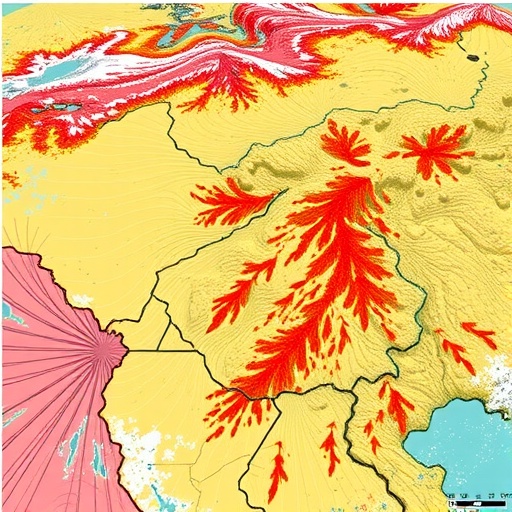
Deep beneath the high-altitude terrain of Yunnan Province in southwest China, one of the country’s most important porphyry copper deposits is getting a computational makeover. A team of Chinese geoscientists has developed an artificial intelligence model that reads three-dimensional geological data with unusual sophistication, combining a multi-scale convolutional neural network with a lightweight attention mechanism to pinpoint where copper ore is most likely to hide. The work, published in the journal Natural Resources Research, was tested on the Pulang porphyry copper deposit, a giant Cu-Au system that has long served as a natural laboratory for mineral exploration science, and the results suggest the new architecture outperforms a suite of established machine learning methods that exploration geologists have come to rely on.
The technique at the heart of the study is mineral prospectivity mapping, often abbreviated MPM, a discipline that seeks to translate scattered geological evidence into predictive maps of where undiscovered mineralization is most likely to occur. Traditionally, MPM relied on knowledge-driven or data-driven statistical frameworks, such as weights of evidence modeling and fuzzy logic, to combine layers of evidence like lithology, structure, and geochemistry. In the past decade, however, the field has been transformed by deep learning, particularly convolutional neural networks, which can automatically learn the spatial patterns that connect predictive geological layers to known ore locations. The promise is considerable: rather than a geologist hand-crafting the rules of mineralization, the network learns them directly from data, capturing subtle correlations between three-dimensional predictive maps and the mineralizing processes that formed a deposit.
Yet as the research team, led by Xiaochen Wang of the Shanxi Institute of Technology together with Qinglin Xia of the China University of Geosciences, Shuai Leng of the Hubei Geological Survey, and Yuqi Liang of the Shanxi Geological Exploration Bureau, points out, existing CNN-based approaches to three-dimensional prospectivity mapping suffer from two persistent weaknesses. The first is scale. Geological structures that control ore formation operate across multiple spatial scales simultaneously, from kilometer-scale magmatic intrusions and regional faults down to meter-scale alteration halos and fracture networks. A conventional CNN applies filters of a fixed size at each layer, which means it can struggle to capture features that vary dramatically in their spatial extent. The second weakness is computational cost. Three-dimensional CNNs are notoriously expensive to train and run, because the number of parameters multiplies rapidly when convolutions extend across three spatial dimensions. For exploration companies and geological surveys weighing whether to adopt these tools, heavy models that demand specialized hardware and long training times represent a real barrier to practical use.
The researchers’ answer to both problems comes from borrowing and adapting ideas that have proven their worth in computer vision. The first ingredient is the Inception module, an architectural concept introduced by Szegedy and colleagues at Google in 2015, which runs convolutional filters of several different sizes in parallel on the same input and concatenates their outputs. By allowing the network to look at the same block of 3D geological space through filters of multiple receptive field sizes at once, the Inception design directly addresses the multi-scale character of geological structures. Small filters can pick up fine-scale features such as tight alteration zones, while larger filters register broader patterns such as the geometry of an intrusive body or the envelope of a hydrothermal system. The second ingredient is a lightweight attention mechanism, or LAM, a computationally inexpensive module that teaches the network where to look. Attention mechanisms, popularized in architectures such as the convolutional block attention module known as CBAM, reweight feature maps so that the most informative channels and spatial locations dominate the final prediction. The lightweight variant adopted by the Wang and Xia team achieves a similar effect with far fewer parameters, keeping the model lean enough for practical deployment while sharpening its ability to outline the most promising predicted areas.
To put the new architecture through its paces, the researchers applied it to the Pulang porphyry copper deposit in Yunnan Province, part of the greater Pulang porphyry Cu-Au district in the Zhongdian region of northwest Yunnan. Pulang is a genuinely giant system, one of the most significant porphyry copper deposits in China, formed by repeated pulses of mineralized magma emplaced within the Geza arc of the eastern Tibetan margin. Previous geological studies have documented its redox-controlled genesis, its association with felsic intrusions, and the fractal characteristics of its ore-forming fluids, providing a rich body of knowledge against which any predictive model can be judged. Building a three-dimensional geological model of such a deposit requires integrating drill hole data, cross-sections, and surface geology into a coherent block model of the subsurface, from which predictive layers representing factors such as proximity to intrusions, alteration intensity, and structural controls can be extracted and fed to the network.
The experimental comparison was thorough. The Inception-enhanced 3D CNN with the lightweight attention mechanism was benchmarked against five alternatives: a 3D CNN equipped with the full convolutional block attention module, a 3D CNN with an Inception module but no attention, a basic 3D CNN with neither enhancement, a support vector machine, and a random forest classifier. Performance was assessed using standard evaluation indices, receiver operating characteristic curves, and ore-controlling rate curves, metrics that measure how well a model’s high-prospectivity zones actually capture known ore while minimizing false positives in barren ground. Across all of these measures, the proposed model came out ahead, demonstrating what the authors describe as remarkable robustness and favorable generalization capabilities.
Perhaps the most consequential finding is where the model placed its high-prospectivity zones. Rather than merely reproducing the footprint of known mineralization, the network successfully outlined prospective targets in the deep portions of the deposit and along the edges of the existing mining area, precisely the kind of blind or concealed targets that represent the future of exploration at a mature mine. Brownfield exploration, the search for new ore around and beneath operating mines, is increasingly important as global discovery rates for major deposits decline and the industry is forced to look deeper and smarter for the metals that energy transition technologies demand. A tool that can credibly flag deep and marginal targets from existing geological data offers direct economic value, guiding where expensive drill holes should be placed and reducing the risk inherent in exploration investment.
The technical logic behind the model’s advantage is worth unpacking. In a standard 3D CNN applied to prospectivity mapping, the network receives voxels, the three-dimensional analogs of pixels, each carrying values from multiple predictive layers. Successive convolutional layers build up increasingly abstract representations of the spatial patterns in this data, and a final classifier converts these representations into a probability of mineralization. The failure modes are familiar: fixed-size filters miss features at the wrong scale, and the network wastes capacity attending to irrelevant regions of the volume. The Inception design tackles the first failure by construction, while the lightweight attention mechanism tackles the second by selectively amplifying the feature channels and spatial locations that correlate with known ore. The combination means the network can, in effect, zoom across scales and focus its attention where the geology matters, all without the parameter bloat that makes heavier attention schemes impractical. This matters because the authors’ stated goal is not merely academic benchmarking but practical use in real exploration campaigns, where computational budgets and data volumes are both significant constraints.
The study sits within a rapidly moving research frontier. In recent years, researchers have deployed graph convolutional networks, self-attention transformers, semi-supervised self-training, and uncertainty-aware deep learning for prospectivity mapping, and hybrid models combining convolutional and graph-based components have been applied to porphyry and skarn systems. The Pulang study’s contribution is a reminder that architectural refinement can matter as much as exotic new paradigms: by combining a well-established multi-scale convolution design with a deliberately lightweight attention module, the authors achieved state-of-the-art performance while keeping the model deployable. The authors also acknowledge the geologists of the Pulang copper deposit for their assistance with field investigations and the provision of original datasets, and the work was supported by the Doctoral Start-up Foundation of Shanxi Institute of Technology, the Shanxi Province Basic Research Program, and the Natural Science Foundation of Hubei Province of China.
For the broader minerals industry, the implications extend beyond one deposit in Yunnan. The method provides, in the authors’ words, a favorable means to accurately identify exploration targets associated with deeply buried mineralization in future exploration surveys. As demand for copper intensifies with the electrification of transport and the expansion of renewable energy infrastructure, and as shallow, easily discovered deposits become exhausted, the ability of machine learning models to see into the deep subsurface will only grow in strategic importance. The Pulang experiment demonstrates that carefully engineered neural architectures, tuned to the multi-scale realities of ore-forming geology and restrained enough to run on practical computing budgets, can turn the accumulating archives of three-dimensional geological data into concrete drilling targets. The next discoveries, increasingly, may be made first in silico.
Cite Scienmag News
Violet Maxwell. (September 9, 2026). Lightweight 3D CNNs Improve Mineral Prospectivity Mapping in Southwest China. Scienmag. https://scienmag.com/lightweight-3d-cnns-improve-mineral-prospectivity-mapping-in-southwest-china/
Violet Maxwell. "Lightweight 3D CNNs Improve Mineral Prospectivity Mapping in Southwest China." Scienmag, 9 September 2026, https://scienmag.com/lightweight-3d-cnns-improve-mineral-prospectivity-mapping-in-southwest-china/. Accessed 9 September 2026.
Violet Maxwell. "Lightweight 3D CNNs Improve Mineral Prospectivity Mapping in Southwest China." Scienmag. September 9, 2026. https://scienmag.com/lightweight-3d-cnns-improve-mineral-prospectivity-mapping-in-southwest-china/


