


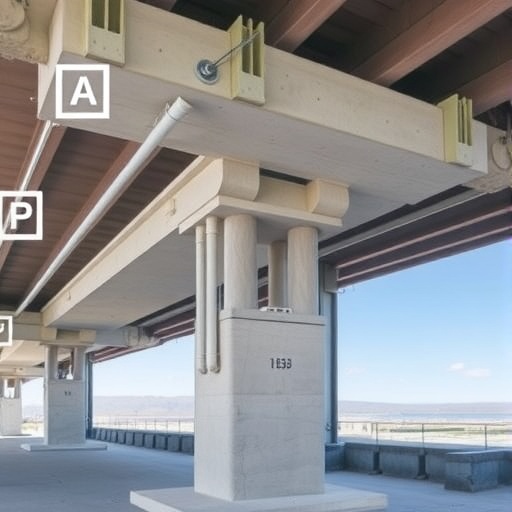
In a development that could reshape how engineers approach one of the most persistent weaknesses in reinforced concrete buildings, researchers have shown that swapping out ordinary concrete in the core of a beam–column joint for a steel-fiber-strengthened epoxy composite can dramatically improve a structure’s ability to withstand the grinding, back-and-forth forces of an earthquake. The study, published in the Bulletin of Earthquake Engineering, reports strength gains of more than 50 percent and nearly a tripling of energy dissipation compared with a deficient conventional joint — all achieved without adding a single hoop of transverse reinforcement to the joint core.
The vulnerability of beam–column joints is one of the most sobering lessons of modern seismic engineering. When an earthquake shakes a reinforced concrete frame, the regions where beams meet columns become battlegrounds of shear. Diagonal cracking propagates through the joint core, concrete crumbles, and the reinforcement anchoring the beam bars can lose its grip. Once the joint fails, the entire load path of the building is compromised, and the frame can lose its ability to carry gravity loads even while the earthquake continues. Many existing buildings, particularly those designed before modern seismic codes mandated dense joint confinement, contain joints with little or no transverse reinforcement — a hidden deficiency that retrofit programs around the world have struggled to address economically.
Retrofitting joints conventionally involves jacketing with steel, concrete, or fiber-reinforced polymer wraps, often increasing member dimensions and requiring extensive labor. The new research explores a different philosophy entirely: rather than adding material around the joint, why not replace the weak material inside it? The team, led by Shuangcen Li of Sichuan University Jinjiang College, Hamed N. Harharah of King Khalid University in Saudi Arabia, and Jemshid Ismael and Kiyan Endalib of the University of Bartin in Turkey, developed and tested a material they call a steel-fiber-reinforced epoxy composite, or SFREC.
The SFREC is not a conventional cement-based concrete at all. It consists of an epoxy resin binder combined with silica sand as aggregate, a cement–microsilica blend as filler, and hooked-end steel fibers dispersed throughout the matrix. The choice of epoxy as the binder is significant. Unlike cement paste, which is brittle and develops fine cracks under tension at relatively low stress levels, epoxy is a polymer with substantial tensile capacity and excellent adhesion to both aggregate and embedded steel. The microsilica filler packs into the gaps between sand grains, densifying the matrix, while the hooked-end steel fibers act as microscopic reinforcement bridges. When a crack tries to open in the composite, the fibers spanning the crack resist its growth, and their hooked geometry means they must pull out or deform before the crack can widen — a mechanism that absorbs significant energy.
Before testing full joints, the researchers first characterized candidate SFREC mixtures through compressive, direct tensile, and flexural tests. Using a multi-criteria performance ranking, they selected a mixture designated F30-EB15-SF1.0 as the optimal formulation for the structural stage of the program. This two-stage approach ensured that the material entering the joint specimens had been vetted for the properties that matter most in seismic response: compressive strength to resist joint shear, tensile strength to control diagonal cracking, and flexural toughness to sustain deformation without brittle fracture.
The heart of the study was a series of three half-scale exterior beam–column joint specimens subjected to quasi-static reversed cyclic loading — the standard laboratory method for simulating the repeated oscillations a building experiences during an earthquake. The first specimen, BCJ-REF, served as a baseline: a conventional joint with no transverse reinforcement in the core, representing the deficient detailing found in many older buildings. The second, BCJ-TR, was a normal-concrete joint incorporating conventional joint-core transverse reinforcement, representing the code-compliant solution. The third, BCJ-SFREC, was identical in reinforcement detailing to the reference specimen but had a portion of the normal concrete within the joint core replaced with the selected SFREC mixture.
The results were striking. Under cyclic loading, the reference joint BCJ-REF behaved as expected for a deficient detail: pinched hysteresis loops, rapid strength degradation, and a displacement ductility factor of only 2.73, indicating limited capacity to deform beyond yield without losing strength. The conventionally detailed BCJ-TR improved matters considerably, reaching a ductility factor of 4.11 — the hoops within the joint core confining the concrete and holding the joint together as cracks formed. But the SFREC joint, BCJ-SFREC, outperformed both. It achieved a peak load of 6.23 kilonewtons, representing an increase of 55.4 percent over the reference joint and 39.4 percent over the conventionally confined joint. Its displacement ductility factor of 4.64 exceeded even the joint with transverse reinforcement.
Perhaps most remarkably, the SFREC joint accomplished this without any transverse reinforcement in the core whatsoever. The fibers within the epoxy composite appear to have taken over the role that steel hoops normally play: confining the joint, transferring shear across diagonal cracks, and preventing the catastrophic disintegration of the core. The hooked-end fibers, randomly oriented in three dimensions, are ideally positioned to bridge the diagonal tension cracks that form under cyclic joint shear — a task for which discrete fibers are naturally suited, since cracks in joints form in complex, changing orientations that fixed reinforcement hoops cannot fully intercept.
The energy dissipation results underscore the point. The SFREC joint accumulated approximately 470 joules of cumulative hysteretic energy dissipation over the loading history — an increase of 128.2 percent over the reference joint and 62.6 percent over the conventionally confined joint. Energy dissipation is among the most important metrics in seismic design: a structure that dissipates more energy through stable, repeated inelastic cycles absorbs more of the earthquake’s input energy, limiting the demands transmitted to the rest of the building and reducing the risk of collapse. The substantially fuller and more stable hysteresis loops observed for the SFREC joint indicate that the composite core maintained its integrity and its load-carrying capacity through repeated cycles of cracking and reopening, with the steel fibers continuously working to restrain crack growth.
The implications for practice are significant. A localized material substitution at the joint core offers a targeted strategy for improving the seismic performance of deficient exterior joints, whether in new construction — where the SFREC could be cast into the joint region while conventional concrete fills the members — or potentially in retrofit applications, where damaged or weak joint concrete could be removed and replaced with the composite. Because the improvement is confined to the joint itself, the approach avoids the dimensional increases, weight additions, and architectural disruption associated with jacketing schemes. The epoxy binder’s rapid curing characteristics, relative to conventional concrete, could also shorten construction timelines.
The researchers are careful to frame the work as exploratory. The experimental program involved three half-scale specimens under one loading protocol, and questions of long-term durability, fire behavior of epoxy-based materials, bond between the SFREC core and surrounding normal concrete, and performance at larger scales remain open. Epoxy resins can soften at elevated temperatures, and any field application would need to account for fire protection requirements. The bond between the new composite and the existing concrete substrate, in retrofit scenarios, would also require careful detailing to ensure composite action.
Nevertheless, the study provides compelling experimental evidence that the material within a joint core, and not merely the reinforcement within it, governs how that joint performs under seismic demands. Decades of seismic engineering have focused on detailing — hoops, anchors, confinement — as the path to joint robustness. This work suggests that a carefully engineered composite material, with steel fibers doing the work of crack control in three dimensions and an epoxy matrix providing tensile capacity far beyond that of cement paste, can deliver comparable or superior performance with a fundamentally simpler reinforcement arrangement.
As cities worldwide continue to grapple with vast inventories of pre-modern-code reinforced concrete buildings, strategies that combine effectiveness with constructability will be essential. A fiber-strengthened epoxy joint core that raises strength by more than half and nearly triples energy dissipation — using no joint hoops at all — offers a provocative glimpse of where that search may lead. The next steps, scaling the concept from the laboratory to real frames, will determine whether this clever material substitution becomes a practical tool in the global effort to make existing buildings safer when the ground begins to shake.
Cite Scienmag News
Violet Maxwell. (September 9, 2026). Strengthened epoxy composites improve seismic performance of beam-column joints. Scienmag. https://scienmag.com/strengthened-epoxy-composites-improve-seismic-performance-of-beam-column-joints/
Violet Maxwell. "Strengthened epoxy composites improve seismic performance of beam-column joints." Scienmag, 9 September 2026, https://scienmag.com/strengthened-epoxy-composites-improve-seismic-performance-of-beam-column-joints/. Accessed 9 September 2026.
Violet Maxwell. "Strengthened epoxy composites improve seismic performance of beam-column joints." Scienmag. September 9, 2026. https://scienmag.com/strengthened-epoxy-composites-improve-seismic-performance-of-beam-column-joints/


