


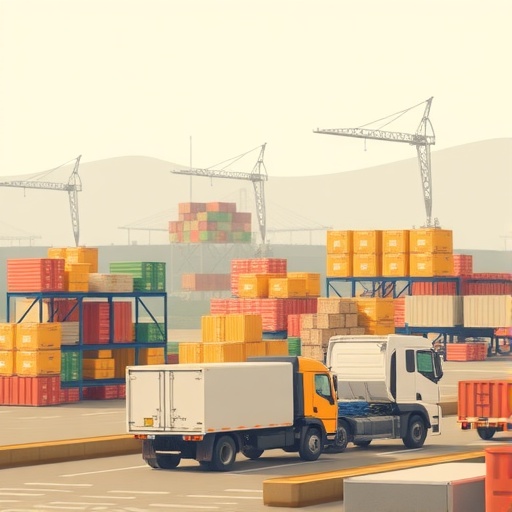
When an earthquake flattens a highway or a flood submerges a warehouse, the difference between life and death often comes down to logistics. Aid that exists but cannot be delivered is, in humanitarian terms, no aid at all. A new study published in Discover Sustainability tackles this problem head-on, presenting a mathematical framework for designing humanitarian relief supply chains that can keep functioning even when disaster strikes the network itself. The research, conducted by Ghazale Jannesari of the University of Kashan, Ali Fallahi of Sharif University of Technology, and Hadi Mokhtari, also of the University of Kashan, offers a detailed blueprint for how relief organizations might position factories, warehouses, and transport routes so that supplies continue to flow to victims despite the chaos that follows catastrophic events.
The core insight of the study is that resilience cannot be bolted onto a supply chain after the fact; it must be engineered into the network from the very beginning. Every year, natural and man-made disasters around the world cause enormous damage to affected regions and their populations, and the immediate response depends on an efficient humanitarian relief supply chain. Yet the very conditions that trigger a relief operation—unstable, damaged, and unpredictable environments—are the same conditions most likely to disrupt that operation. Roads close, depots become inaccessible, and shipments are delayed precisely at the moment when speed matters most. The researchers argue that the design of the network itself should anticipate these failures rather than merely react to them.
To capture this, the team built a model that treats the humanitarian supply chain as a multi-layered system spanning suppliers, production centers, distribution centers, and the affected regions where aid is ultimately consumed. The model determines the optimal locations of production and distribution facilities and governs the allocation of raw materials and finished relief items across every level of the network. Formulated as a mixed-integer linear programming problem, the framework belongs to a class of optimization models in which some decision variables must take whole-number values—such as whether to open a facility at a given site—while others vary continuously, such as the quantity of goods shipped along a route. These problems are notoriously difficult because the number of possible configurations grows explosively with the size of the network, but they yield provably optimal solutions when solved exactly, making them a rigorous foundation for network design.
What distinguishes this work from conventional facility-location models is the deliberate integration of two resilience strategies into the optimization itself. The first is the maintenance of inventory at distribution centers. By holding pre-positioned stocks of relief items close to potential disaster zones, the network creates a buffer that can absorb the shock of delayed upstream deliveries. Pre-positioning is a well-established concept in humanitarian logistics, but deciding how much to store and where involves a delicate trade-off: too little inventory leaves the network exposed to disruption, while too much ties up scarce funding and storage capacity that might serve other purposes. The model balances these competing pressures quantitatively rather than relying on ad hoc judgment.
The second strategy concerns transportation. Rather than assuming that every route in the network will be available when needed, the framework incorporates the selection of reliable transportation routes across different levels of the supply chain. To identify which routes deserve that label of reliability, the researchers employed the Analytic Hierarchy Process, a structured decision-making technique that decomposes a complex choice into a hierarchy of criteria and pairwise comparisons. In this application, candidate routes are scored against multiple criteria, and the resulting weights are aggregated into an overall reliability assessment. Only routes that clear a specified reliability threshold are considered trustworthy enough to carry relief flows in the model. The approach effectively imports a layer of multi-criteria decision analysis into the optimization, allowing the mathematical program to distinguish between the geography of what is reachable and the geography of what is dependable.
A crucial finding of the computational analysis is that this reliability filtering is robust. The researchers tested how sensitive the route rankings were to changes in the weights assigned to the evaluation criteria and to the reliability threshold itself, and they found that the main route rankings remained relatively stable. In practical terms, this means that relief planners do not need to calibrate the hierarchy process with perfect precision for the method to yield sensible guidance. The top-ranked corridors identified as reliable stay near the top even when expert opinions about criterion importance shift somewhat—a valuable property in real disaster settings, where data is often incomplete and expert judgment is the primary input.
On the computational side, the team validated their model using CPLEX, a commercial exact solver capable of finding and proving optimal solutions for mixed-integer programs. Exact optimization works well for small instances, but as the number of suppliers, facilities, routes, and demand points grows, the search space expands combinatorially and solver runtimes balloon beyond anything usable in a planning cycle. To overcome this limitation, the researchers designed three metaheuristic algorithms—a genetic algorithm, differential evolution, and particle swarm optimization—each tailored to the structure of the problem through a problem-specific solution representation scheme. This representation encodes complete network design decisions, including facility openings, inventory levels, and flow allocations, in a form the algorithms can mutate, recombine, and improve over successive iterations.
The genetic algorithm mimics biological evolution, maintaining a population of candidate network designs and iteratively selecting, crossing over, and mutating them in proportion to their fitness. Differential evolution generates new candidate solutions by combining weighted differences between existing ones, a mechanism particularly effective on continuous optimization landscapes. Particle swarm optimization, by contrast, moves a flock of candidate solutions through the search space, each one pulled toward both its own best position found so far and the best position discovered by the swarm. The performance comparison among these three approaches produced a clear winner. The genetic algorithm reached the CPLEX optimal solution in sixty percent of small-sized test instances, and on medium- and large-sized problems it achieved the lowest mean relative percentage deviation—a standard benchmarking metric that measures how far a heuristic solution strays from the best known optimum, expressed as a percentage—while keeping computational times competitive with the alternatives.
The implications extend beyond the academic literature on supply chain modeling. Humanitarian organizations operate under severe budget constraints and intense time pressure, and every improvement in the reliability of their logistics networks translates directly into faster, more dependable aid delivery. A framework like this one gives planners a defensible, quantitative basis for the agonizing choices they face: which regions to serve from which depots, how much stock to pre-position where, and which transport corridors to invest in securing. Because the model explicitly accounts for disruptions rather than assuming a benign operating environment, the networks it produces should degrade more gracefully when reality intrudes—losing a route here or a facility there without collapsing entirely.
The methodology also illustrates a broader trend in operations research: the hybridization of exact optimization, multi-criteria decision analysis, and metaheuristics within a single decision-support pipeline. The Analytic Hierarchy Process handles the qualitative, judgment-laden question of which routes can be trusted; the mixed-integer program handles the quantitative, constraint-heavy question of how to configure the network optimally given those trusted routes; and the metaheuristics handle the scale problem, extending the analysis to networks too large for exact methods. Each technique compensates for the weaknesses of the others, producing a tool that is simultaneously rigorous about values and preferences, mathematically precise about costs and capacities, and computationally tractable at realistic sizes.
The authors are careful to ground the work in the realities of disaster response. Relief logistics differ from commercial logistics in fundamental ways: demand arrives in sudden, unpredictable surges; the objective function prioritizes speed and coverage of human need over profit; and infrastructure failures cascade in ways that are difficult to predict. Any model that ignores these features risks producing elegant solutions that fail in the field. By embedding disruption risk directly into the network design problem—through inventory buffers and reliability-screened transportation—the study moves humanitarian logistics modeling closer to the conditions under which real relief operations actually unfold.
For the research community, the study contributes a validated benchmark suite and a demonstrated set of algorithmic design choices that future work can build upon. The problem-specific solution representation scheme in particular offers a template for encoding rich network design decisions into metaheuristic frameworks, and the sensitivity analysis of the route reliability rankings establishes a methodological standard for testing whether multi-criteria screening procedures are stable enough for operational use. For practitioners, the message is perhaps simpler: resilience is a design property, and with the right combination of inventory positioning and reliable route selection, it can be quantified, optimized, and delivered before the next disaster strikes. The full study is available open access, reflecting a growing commitment in the sustainability research community to making disaster-resilience tools freely available to the organizations that need them most.
Cite Scienmag News
Violet Maxwell. (September 9, 2026). Building resilient humanitarian supply chains through integrated inventory and transportation design. Scienmag. https://scienmag.com/building-resilient-humanitarian-supply-chains-through-integrated-inventory-and-transportation-design/
Violet Maxwell. "Building resilient humanitarian supply chains through integrated inventory and transportation design." Scienmag, 9 September 2026, https://scienmag.com/building-resilient-humanitarian-supply-chains-through-integrated-inventory-and-transportation-design/. Accessed 9 September 2026.
Violet Maxwell. "Building resilient humanitarian supply chains through integrated inventory and transportation design." Scienmag. September 9, 2026. https://scienmag.com/building-resilient-humanitarian-supply-chains-through-integrated-inventory-and-transportation-design/


