


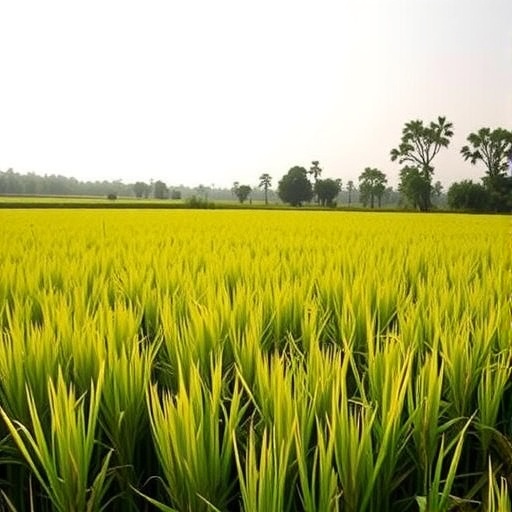
Rice, the staple crop that feeds more than half of humanity, has a persistent and well-documented problem: it accumulates arsenic from flooded paddy soils with alarming efficiency, delivering one of the largest dietary sources of this carcinogenic metalloid to people who eat it regularly. For years, the most celebrated agronomic fix has been silicon. Rice roots absorb arsenite, the reduced form of arsenic that dominates in waterlogged paddies, through the same silicic acid transporters they use to take up silicon, so adding silicon-rich amendments to the soil has generally been expected to outcompete arsenic at the molecular gate and push grain arsenic concentrations down. A new study published in Plant and Soil by Shihao Zhu of Hunan Normal University and colleagues in China and Sweden now complicates that tidy picture in a way that could reshape how silicon is prescribed in the world’s rice paddies. Analyzing more than one hundred paired soil and rice grain samples, the researchers found that soil available silicon is indeed the single strongest predictor of arsenic in the grain—but the relationship is not a simple, monotonic decline. Instead, it is a multi-phase, nonmonotonic curve in which silicon can mobilize arsenic, suppress it, or have almost no effect, depending on how much of the element is already in the soil and what the surrounding landscape is doing.
The team assembled an unusually broad evidence base to attack the question. Within Dao County in Hunan Province, China—a region where rice arsenic contamination is a recognized public-health concern—they collected sixty paired soil and rice grain samples across a topographically varied landscape. They then integrated forty-four additional paired soil–rice observations drawn from published studies spanning Asia, the Americas, and Australia, allowing them to test whether the patterns they observed locally held up against independent data from different continents and growing conditions. To wring meaning from this heterogeneous dataset, the researchers deployed a modern statistical arsenal: machine learning models to rank the importance of each candidate variable, Shapley Additive exPlanations, or SHAP, values to quantify how each factor pushed individual predictions up or down, generalized additive models to trace the shape of the silicon–arsenic relationship without forcing it into a straight line, and Bayesian structural equation modeling to formalize the hypothesized causal web linking soil chemistry, topography, hydrology, and plant uptake.
The results were striking. Across the full suite of edaphic, topographic, and spatial variables considered, soil available silicon emerged as the highest-ranked predictor of arsenic concentrations in rice grains. But the generalized additive models revealed that its influence changes character across the concentration gradient, resolving into three distinct response regions. In the first region, at relatively low soil silicon availability, adding silicon was associated with higher grain arsenic—a counterintuitive but mechanistically plausible outcome. Silicon in soil solution exists chiefly as silicic acid, and as it dissolves from silicate minerals or applied amendments it can displace arsenic from adsorption sites on iron (oxyhydr)oxides, the very mineral surfaces that normally sequester arsenic in soil. Under fluctuating redox conditions typical of paddies, this competitive desorption can release arsenic into soil porewater, exactly where roots go looking for water and nutrients. In effect, the silicon added to protect the plant can first wash more of the poison off the soil’s binding sites and into circulation.
The second and third response regions tell a more hopeful story. At intermediate silicon availability, the models point to a phase where root iron plaque dynamics dominate. Rice roots leak oxygen into the anoxic rhizosphere, oxidizing soluble ferrous iron into ferric forms that precipitate as a reddish coating—the iron plaque—on the root surface. This plaque acts as a chemical checkpoint, sorbing arsenic before it can cross into the root. Prior work has shown that silicon alters both the kinetics of plaque formation and its binding behavior, and the new field data suggest that in this middle range the plaque-mediated retention of arsenic begins to outweigh the mobilization effect, bending the response curve downward. In the third region, at high silicon availability, the dominant mechanism shifts again, this time toward the plant’s own defenses. Silicon is known to stimulate suberization and lignification in rice roots, thickening the endodermal and exodermal barriers that regulate what enters the stele, and to compete directly with arsenite at silicic acid transporters such as Lsi1 and Lsi2. With strong root barriers in place and transporters saturated with silicon, arsenic entry into the plant—and ultimately the grain—is suppressed. The nonmonotonic curve, then, is the net trace of three overlapping mechanisms, each gaining and losing dominance at different soil silicon levels.
The study also quantified what else matters besides silicon. Soil pH, amorphous Fe (oxyhydr)oxides—measured as AAO-Fe—and topographic position contributed substantially to the variation in grain arsenic concentrations. This makes chemical sense. pH governs both arsenic speciation and the surface charge of adsorbing minerals; amorphous iron phases provide the reactive surfaces where arsenic binds and from which silicate can displace it; and topography controls the flow of water through the landscape. When the researchers used their fitted models to generate spatial prediction surfaces, they found that elevated grain arsenic concentrations clustered in low-lying areas connected to local hydrological pathways. Water moving downslope carries both dissolved constituents and fine particles; in these convergent zones, arsenic liberated by reduction and mobilized during flooding accumulates, while silicon can be exported by the same fluxes. Topography, in other words, is not merely backdrop—it actively choreographs the geochemical drama in each field, and the same silicon amendment can behave differently on a hillside terrace than in a valley-bottom paddy fed by shared irrigation channels.
The practical implications are potentially significant for a problem that global assessments have flagged as worsening. Recent syntheses have documented escalating arsenic contamination across Chinese soils and a pervasive global threat of arsenic in groundwater, and rice-based baby foods have been identified as a particular exposure pathway for vulnerable populations. Against this backdrop, the standard advice—”add silicon to reduce arsenic”—could backfire in fields where soil silicon is already scarce relative to arsenic, because the mobilization phase of the response curve would dominate. The authors’ conclusion is deliberately nuanced: optimizing, rather than simply increasing, soil available silicon may help reduce arsenic accumulation in rice grains in paddy fields that are not severely contaminated with arsenic. In practice, this means soil testing to establish where a given field sits on the silicon–response curve, and then calibrating amendment type, rate, and timing accordingly—paired, the study suggests, with attention to soil-condition regulation and irrigation management that jointly shape redox, pH, and dissolved silicon fluxes.
The methodological framework the team built is itself part of the contribution. By combining machine learning for predictive ranking, SHAP for interpretable attribution, generalized additive models for flexible dose–response shapes, and Bayesian structural equation modeling for mechanistic hypothesis testing, the study offers a template that other research groups can adapt to their own regions and crops. The authors are careful to frame their response regions and mechanistic interpretations as locally grounded hypotheses that now require evaluation under controlled, multi-season, and multi-region conditions—an acknowledgment that field correlation, however sophisticated the statistics, cannot fully disentangle the competitive, mineralogical, and plant-physiological processes at work. Controlled experiments that manipulate silicon availability while tracking porewater arsenic, iron plaque formation, root barrier development, and transporter expression would be the natural next step.
For now, the message to the rice-growing world is a caution against one-size-fits-all geochemistry. Silicon is not a magic antidote to arsenic; it is a player in a crowded reaction network involving iron minerals, pH, redox oscillations, water movement, and the plant’s own barriers. The Zhu and colleagues study demonstrates that the sign and strength of silicon’s effect on grain arsenic depend on where a field sits across a three-phase response landscape shaped by topography as much as by soil chemistry. As rice-consuming populations and food-safety regulators press for lower arsenic in grain, the path forward may run not through more amendment, but through smarter amendment—prescribed field by field, slope by slope, with the full soil–water–plant system in view.
Cite Scienmag News
Alan Morgan. (September 9, 2026). Silicon’s complex effects on arsenic in rice shaped by terrain and soil. Scienmag. https://scienmag.com/silicons-complex-effects-on-arsenic-in-rice-shaped-by-terrain-and-soil/
Alan Morgan. "Silicon’s complex effects on arsenic in rice shaped by terrain and soil." Scienmag, 9 September 2026, https://scienmag.com/silicons-complex-effects-on-arsenic-in-rice-shaped-by-terrain-and-soil/. Accessed 9 September 2026.
Alan Morgan. "Silicon’s complex effects on arsenic in rice shaped by terrain and soil." Scienmag. September 9, 2026. https://scienmag.com/silicons-complex-effects-on-arsenic-in-rice-shaped-by-terrain-and-soil/


